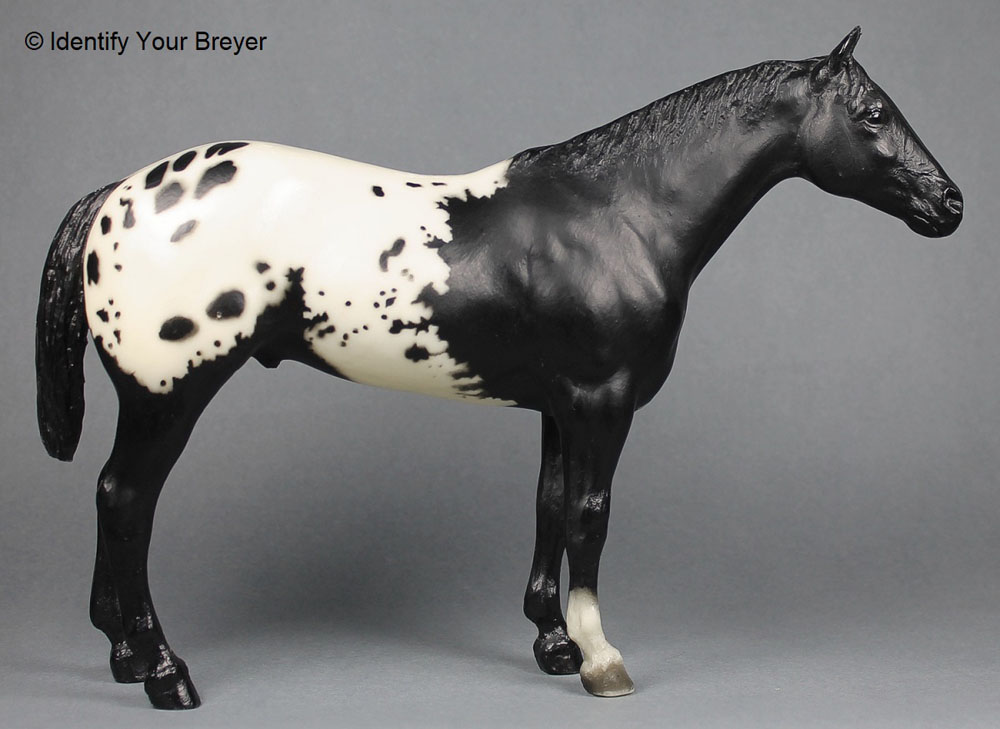
I apologize that this has taken me much longer to write than I had originally planned, but I wanted to tell Chris Hess' story to the best of my ability. As Breyer's primary sculptor for nearly 40 years, Hess' work shaped and influenced our hobby in a multitude of ways. His story is important because he was so much more than "just" a model horse sculptor---he was also a draftsman, a wood carver, a mold maker, a problem solver, an innovator, and more. Not surprisingly, the research for this post led me down all sorts of interesting sidetracks and rabbit holes that I want to follow, and I will do my best to share all of the neat connections I found as coherently as possible, if not in this post, then in subsequent follow ups.
The impetus for this tale began last year not long after Erin Corbett and her Volo Artem team purchased Stone Horses (formerly the Peter Stone Company). Peter entrusted Erin as the new keeper of several boxes full of the company's historical paperwork, some of which had once belonged to Breyer and Stone artist Chris Hess. (For those unaware of the history, Peter is the son of Sam Stone who co-founded the Breyer Molding Company in 1943, and Peter worked for and later owned the company until it was bought out by Reeves International in 1984. When Peter eventually left Breyer in 1996 to start his own company, the first piece his new company produced was a Chris Hess sculpture that Breyer had rejected.)
Pretty much every collector knows that Chris Hess sculpted the majority of Breyer's models from the very beginning of the horse and animal line in 1950 until his death in 1988. In that span of nearly 40 years, Hess sculpted 100 horses for Breyer (74 Traditional, 19 Classics, and 7 Little Bits) as well as 27 animal molds (if I counted correctly). He also sculpted at least two more horses that were rejected by Breyer and later produced by Stone, the rearing horse Trouble and the landing Jumping Horse. While the many Breyer horses he sculpted are probably his greatest legacy, he sculpted a number of other interesting pieces "including the children’s riding toy known as the 'Wonder Horse,' Santa Claus figures, [and] art and advertising pieces. Christian was [also] the sculptor and mold maker responsible for many of those familiar plastic pink yard flamingos." (1)
 |
There are many, many spring horses called the Wonder Horse,
so I'm not sure which one Hess sculpted, but this is a very
early example from the late 1940s.
|
Christian Fritz Hess was born in Chicago,
IL, on August 6, 1916. While there isn't really any information
available about Hess' childhood, we do know he studied at the
prestigious Art Institute of Chicago. And this is where the first rabbit
hole appeared for me. One of the very first things that grabbed my
attention while looking through
Hess' papers with Erin was a series of very old pages from the classic animal
anatomy book Handbuch der Anatomie der Tiere für Künstler stamped
"Property of Elizabeth Haseltine." The name was immediately familiar,
but it took me a moment to remember why. Naturally, the sculptor Herbert
Haseltine came immediately to mind. He created the magnificent bronze
of Man O' War that stands atop that great horse's grave at the Kentucky
Horse Park. But then it clicked. Not far from
the University of Chicago, my alma mater and employer, is a statue of a
sleeping fawn by Elizabeth Haseltine. I pass it regularly while walking
or cycling
on the lakefront path in nice weather, and I remember being curious a
few years ago to find out if she was related to Herbert (as best I can
tell, she was not).
Elizabeth Haseltine was a remarkable sculptor
known for her exquisite animals. The Chicago Tribune's art critic
described her work as "delicate, true, simple, and fascinating." (2)
Elizabeth studied and later taught at the University of Chicago and
worked closely with fellow artist Lorado Taft at his famed Midway Studio
on campus. It's a five minute walk from my office, and it's happily still in
use as an art space. Elizabeth also then took a teaching position at the
Art Institute of Chicago downtown, and I think it's quite probable that
Hess was one of her art students. I'm sure she must have given him the
pages of the animal anatomy book while he took her classes.
I
could write a whole post just about Haseltine and Taft and how their
work has been in the background of my everyday life for the last 25 years, but
that's probably more navel-gazing than anyone really cares for. Suffice
it to say, the work of Haseltine and Taft can be found around the
university and in many places elsewhere in the city as well. They are
two of the most significant and influential sculptors in Chicago
history, so that should give some perspective as to the importance of the
artistic tradition that Hess trained up in.


Hess was not a horse
person per se when he began his career with Breyer although he had
obviously studied animal anatomy with Haseltine. After leaving the Art
Institute, he worked as a commercial artist, a wood carver, and a
designer of decorative architectural elements for buildings before
serving in the Navy during World War II. When he returned home to
Chicago, his talents eventually led him to mold making and a career with
the Breyer Molding Company in 1950. (3) Hess sculpted the Breyer Western Horse, their very first model horse, and tooled the mold for it as well. (4) I love this quote from a recent article by Jocelyn Cote that Breyer posted about Chris Hess' work for them:
"Chris
had a unique perspective that no other Breyer artist in history has had
– not only was he a sculptor, but he was also Breyer’s main tooling
engineer. Working alongside two other craftsmen, Paul Olson and Gordon
Johnson, they created the injection molds (referred to shorthand as
“tools”) from which all Breyer models created on those original
sculptures have sprung. The tool that molded your 75th Anniversary
Western Horse model, for example, is the very same tool engineered by
Chris and his team all those years ago – and that same tool also molded
the original palomino #57 models that adorned the Mastercrafters clocks.
When you hold any model sculpted by Chris Hess in your hands, you are
quite literally touching Breyer history." (5)
That gives me
goosebumps. It's so remarkable that the original tooling not only still
exists but also still works after 75 years. It's also incredible to me that Hess not only was an excellent sculptor, but he also had the engineering skills to design and tool the molds to cast his work.
Hess' earliest designs for Breyer were technically copies of pieces produced by other companies---the Western Horse and Pony were derived from the Hartland Victor, and the Boxer was a direct copy molded from the porcelain Boehm Boxer. By the mid-1950s however, Hess began to create sculptures that were entirely his own. One of the earliest of these was Lassie, the beloved TV show Collie. Amongst the papers left with Stone were four promotional photos of the real dog, including this one bearing sculpting notes in Hess' hand.

While the archive of Hess papers held by the Stone company is in no way the entirety of his inspirational source materials, it is full of fascinating gems. He kept examples of work by other prominent equine artists such as Marilyn Newmark and Jeanne Mellin Herrick.
There were also a number of images of lynxes, both photos and sketches by another artist. I would guess they were part of a group of references Hess used for the wildlife series he created independently of Breyer in the 1980s. I'll share a couple of those images here, but I will definitely need to write a whole post about the wildlife series to do it all justice.
The most interesting papers are of course the ones related to Breyer designs. The majority of the pages are photos that Hess worked from to create his sculptures. As you'll see, he had an incredible gift for translating a 2D image into a highly accurate 3D sculpture. One of the earliest photos in the collection is this handsome Morgan horse. While Hess' Stretch Morgan mold wasn't an exact replica, this photo certainly influenced the pose and possibly the markings.
The next image was that of a black Angus bull. He should look familiar. I love all of the sculpting notations.
There are a number of reference pages for the real Andalusian horses Hess used as references for Legionario III and the Classic Andalusian Family. (I will probably break this out into another post about the Garrison Ranch and their horses eventually.) Once again, Hess' notes on these pages absolutely give me goosebumps.
 |
The source for the Classic Andalusian Mare---the pose and the
flow of the mane and tail were captured pretty perfectly by Hess |
An article about Galiceño ponies includes a photo that likely inspired Hess' pony.
This quadruple exposed photo shows US Equestrian Team and dressage champion Keen performing the half-pass. While Hess ultimately sculpted Keen in a cantering pose, it's fun to see his references all the same.
There were also two similar photos of the great pacer Dan Patch. Breyer ultimately released him on the Pacer mold in 1990, but I can't help but wonder if a standing model was considered, possibly before Adios was released.
The archive also contained a photo of Phar Lap torn from a 1984 issue of the Blood-Horse as well as a movie still from the 1983 movie about the champion racehorse. Hess' sculpture of the Red Terror was sculpted in a different phase of the gallop so it could stand, and it was released in 1985. While he had already engineered two smaller models, the classic scale Hobo and Polo Pony, to balance on one leg in a base, both were prone to warping, and duplicating the pose in the famous photo below was not something Breyer would be able to tackle successfully for another 20 years.
According to Peter Stone, Hess worked primarily from photos (and sometimes illustrations), and he rarely visited his subjects in person. So I was really excited to find a few of his sketches amongst the photos. There were several of wood barns that collectors will recognize as releases from the late 1970s and early 1980s.
But the real gem was this sketch of Stud Spider, actor James Brolin's champion racing Appaloosa. It's always fascinating to me to see another artist's process, so Hess' notes about corrections for his in process sculpture are fascinating.

Hess
may not have been a horseman when he started working for Breyer, but he
certainly developed an eye for equine anatomy and the distinctions between breeds from
Shetland Ponies to Belgians to Thoroughbreds and everything in between. In the years since his death, more horse-oriented artists have taken up the reins and have sculpted more anatomically correct models for the Breyer line, but there is no
denying the timeless appeal of Hess' work. Models like Lady Phase, the Clydesdale
Mare, Adios, the walking Shire, and the Cantering Welsh Pony remain fan
favorites even though they're all around 50 years old now. I personally love the classic scale Black Stallion Returns
set and the all of the Little Bits molds. They were some of my childhood favorites, and I still have a huge soft spot for them.
There are more interesting papers from the years after Chris passed that tell some of Peter Stone's story, some early BreyerFest tidbits, and his new venture at the helm of Stone Horses. I'll share those in a subsequent post since this one is already quite long.
I also plan to start revamping my Model Horse History site in the next few weeks so I can start uploading the many model horse references I've collected over the years, including these from Chris Hess' collection (and more). I strongly feel that our collective hobby knowledge and resources should be shared freely. Making them available to all hobbyists is the best way we can learn and preserve our hobby's history.
As always, thanks for reading!
-----------------------------------------------------------------------------------
1)
Quoted from a transcription of a flier given out to attendees of the
first Peter Stone company breakfast held during BreyerFest 1997,
https://breyerhistorydiva.blogspot.com/2018/05/the-chris-hess-flier.html
2) https://www.hydeparkhistory.org/blog/hyde-park-stories-david-wallach-fountain
(3) Young, Nancy Atkinson. Breyer Molds and Models: Horses, Riders, and Animals 1950-1997. (Atglen, PA: Schiffer Publishing Ltd, 1999), pg. 334.
4)
https://www.breyerhorses.com/blogs/collecting/chris-hess-the-soul-of-breyer-animal-creations?srsltid=AfmBOop3umhPuns8ApwBpMuVnjCHNePvoI4A2MArstBeWaDFZs2ATaF5
5) Ibid