Showing posts with label grand wood carving. Show all posts

Friday, April 14, 2017

Hoosier Pony Live, part 2: OF and CMG chinas and Grand Wood Carving horses

Competition at Hoosier Pony Live was fierce in all divisions. Here is a sampling of some of the stunning OF chinas. Hagen-Renakers predominated, at least on my camera.

Rare Hagen-Renaker Monrovia White Heather
Gorgeous HR Monrovia Rose Grey Large Zara
Stunning HR San Dimas White Sheba
HR Glossy Monrovia Sespe
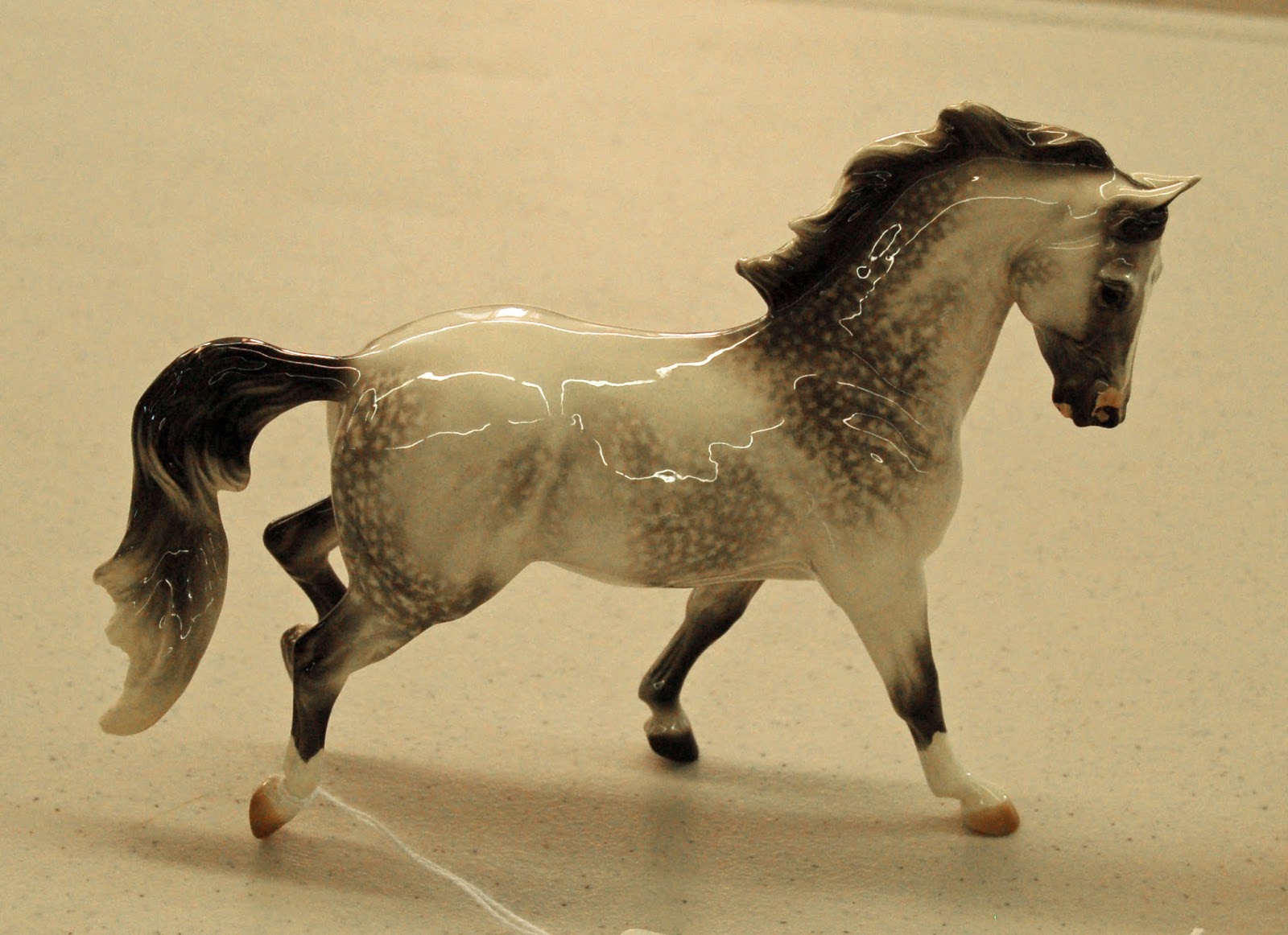
Rare HR Rose Grey Sherif
Hard to find HR Monrovia Chestnut Peggy Lou
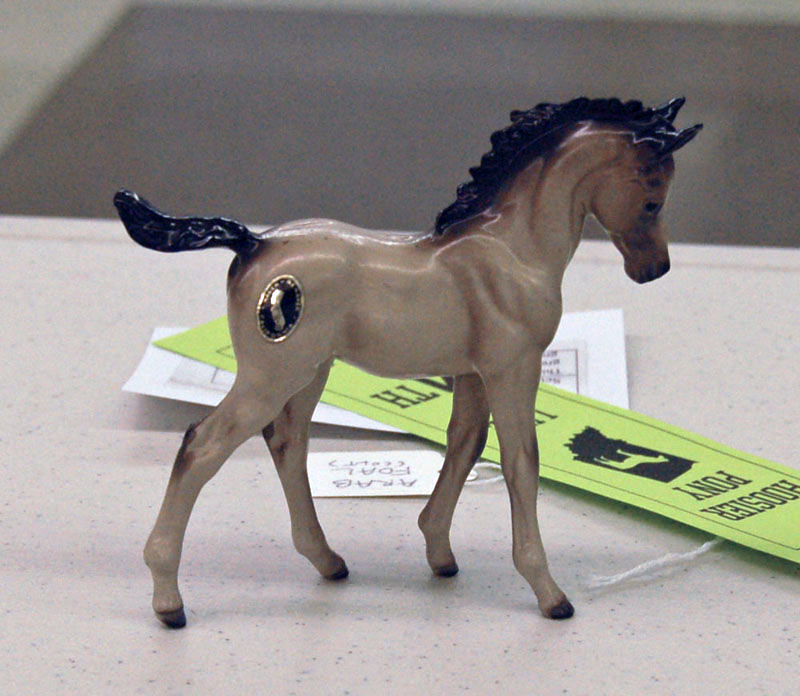
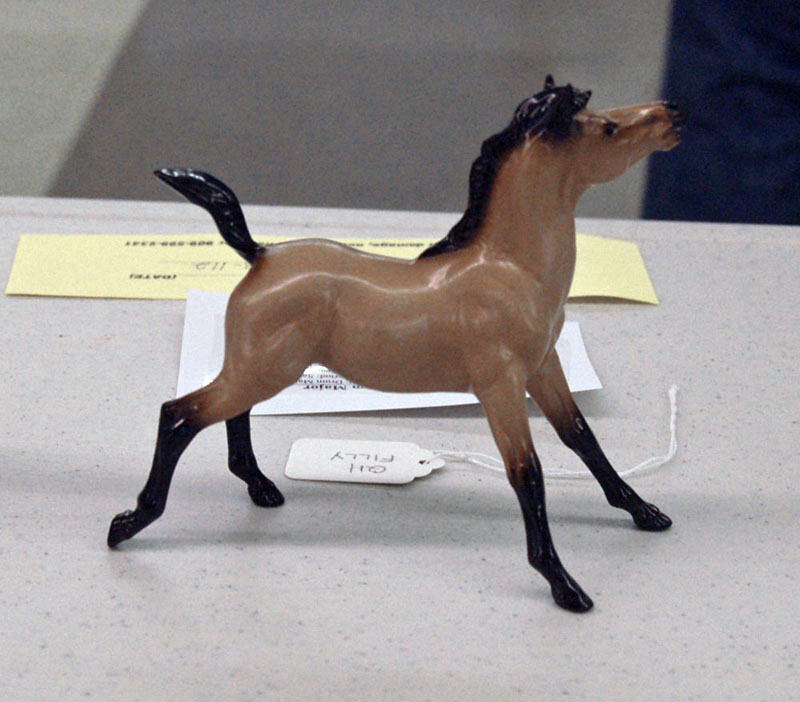
One of a kind HR San Dimas Buckskin Drum Major from the HR Archive

I didn't get many pictures of the OF chinas other than the Hagen-Renakers, but here at least is one Euro clinky, the highly sought after Royal Copenhagen Grazing Shetland.


And here are some lovely custom glaze chinas that caught my eye.

CMG "Baxter," cast from a Breyer Classic Mustang CMized by Sommer Prosser,
molded and glazed by Joan Berkwitz
Sarah Minkiewicz "Oliver" glazed by Lesli Kathman (?)
Sarah Minkiewicz "Taboo" glazed by unknown
Kristina Lucas Francis' "Kulfi" glazed by Kristina (?)
Lynn Fraley's "Tynk" glazed by Lesli Kathman (?)
And now for something completely different. I am rather fond of Grand Wood Carving horses, especially the racehorses, as is my friend Diana Dubbeld. They're not very common, but between the two of us, we made a pretty decent showing.

L to R: Diana's Citation, Man O' War, and War Admiral, and my Whirlaway
A close up of Diana's GWC horses
Tomorrow, I'll have a bunch of pictures from the vintage custom classes. Stay tuned!

Friday, July 12, 2013

Friday Featurette: Wooden Horses Part 2

As I mentioned in last Friday's blog post, the Breyer Racehorse bears a striking resemblance to the earlier "Whirlaway" model produced by Grand Wood Carving, a company that was located mere blocks from the Breyer factory near downtown Chicago in the 1950s. The resemblance is in fact too great to be a coincidence. The Breyer Racehorse was without a doubt copied from the GWC piece. (A number of early Breyer models were copies of pieces by other companies---the Western Horse (Hartland Champ), the Proud Arab Mare and Foal and Family Arab Stallion (Hagen-Renaker's Large Zara, Zilla, and Amir), the Large Poodle (Rosenthal), the Walking Hereford and Boxer (Boehm), etc---but that will be a subject for later post.)

GWC "Whirlaway" on the left, Breyer Woodgrain Racehorse on the right

The real horse Whirlaway won the Triple Crown for Calumet Farm in 1941, so we know the GWC piece must date to that year or later. Most of the GWC racehorses are portraits of horses from the 1930s-1950s, but they may have been produced after those years as well. I don't have any paperwork from the company unfortunately, so I'm not sure how long any of their horses were made. Nancy Young, author of Breyer Molds and Models, believed their heyday had ended by the 1960s.

Breyer's records from the 1950s are likewise pretty spotty. We do know that the Racehorse was the third equine model released by Breyer (circa 1954, preceded only by the Western Horse and Pony), and the mold was also one of the first to be released in woodgrain (circa 1959). The mold was undoubtedly copied directly from Grand Wood Carving's Whirlaway model as the comparison photo above attests, and I think that it's very likely that the distinctive woodgrain color with white markings was inspired by GWC as well.

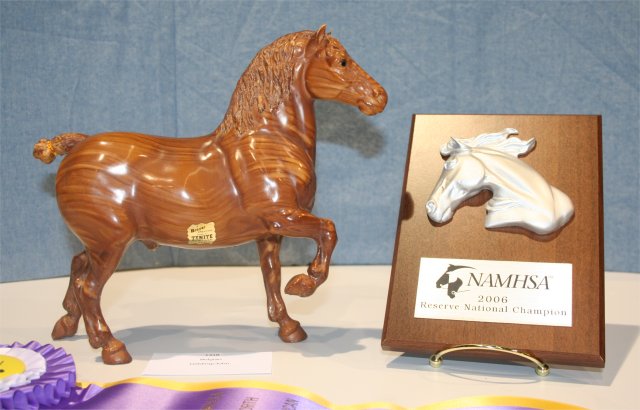
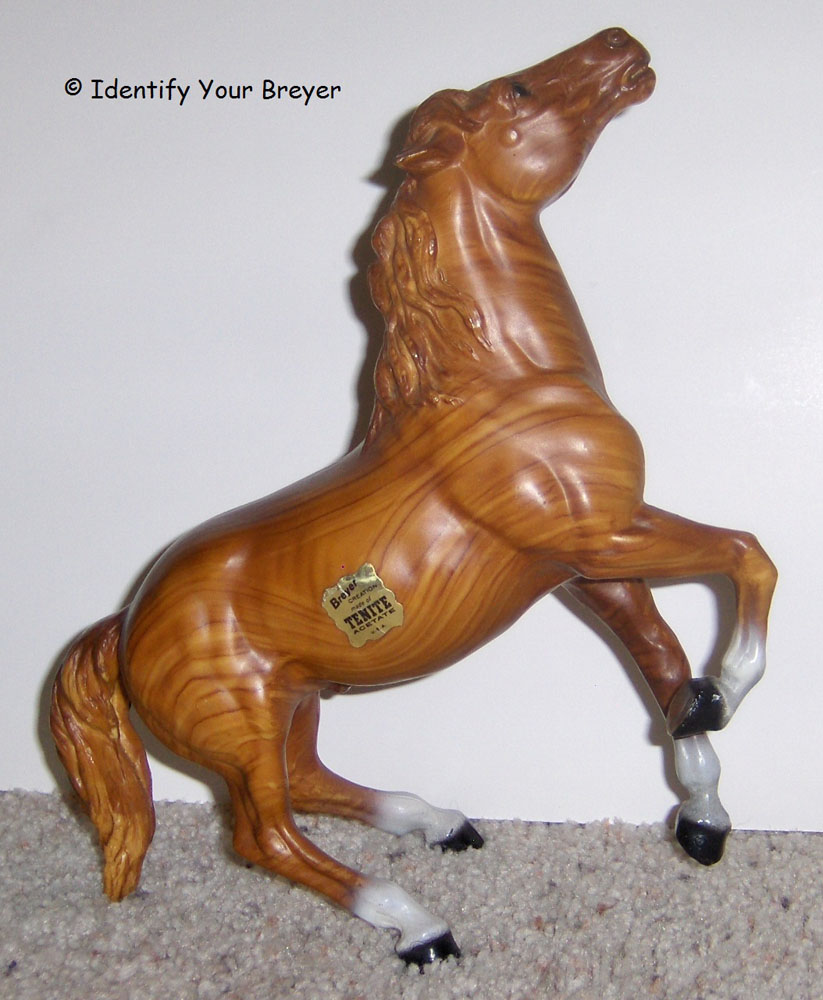
 Tenite sticker on a Woodgrain Poodle

An interesting feature sported by some of the early Breyer woodgrains are gold foil stickers that declare them to be "made of tenite acetate." Glossy realistically colored models such as the Appaloosa PAM and PAF occasionally had these gold stickers as well. Presumably, they were to indicate and emphasize that the models were indeed durable plastic rather than wood (or porcelain in the case of the realistic models). The plastic models were also likely cheaper than their wood or porcelain counterparts while still looking the part.

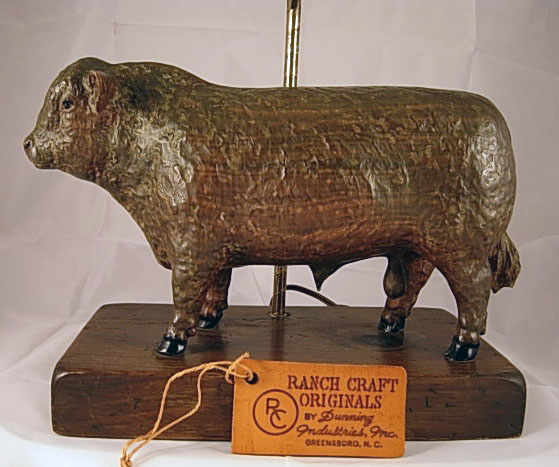
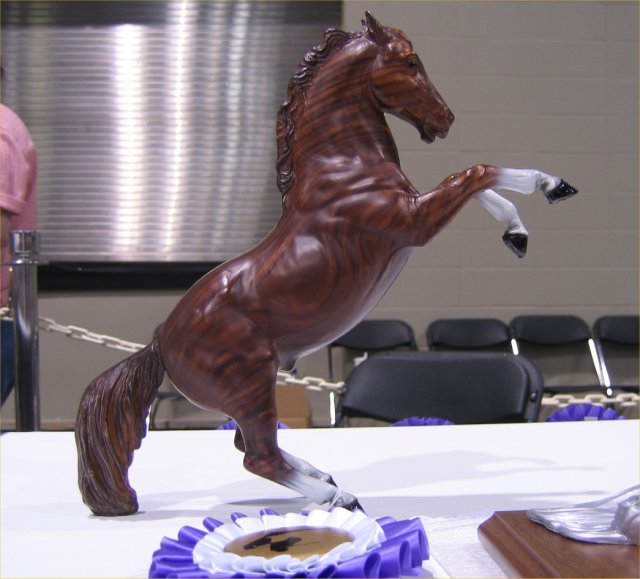
Breyer eventually produced 29 different horse and animal molds in the woodgrain color. Some are just streaked brown with no painted details other than black eyes while others have added white socks, a white star, and black hooves. Most woodgrains are matte to semi-gloss in terms of finish, though some, often those found on the Dunning "Ranchcraft" lamps, have a high semi-gloss or even glossy finish. The last woodgrain in production, the Fighting Stallion, was discontinued at the end of 1973. 

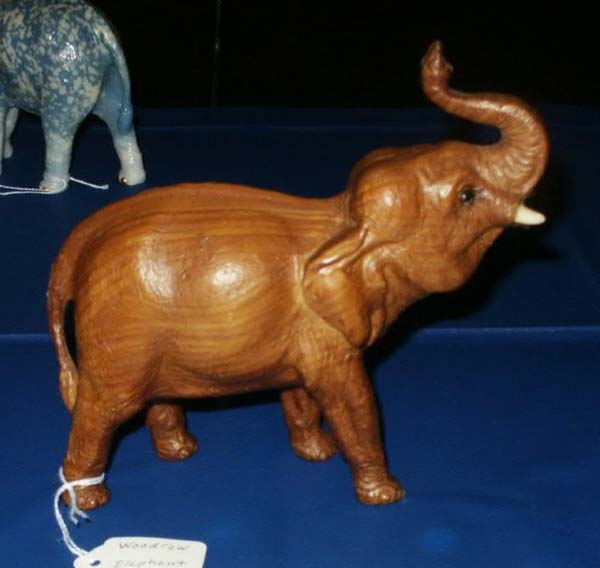
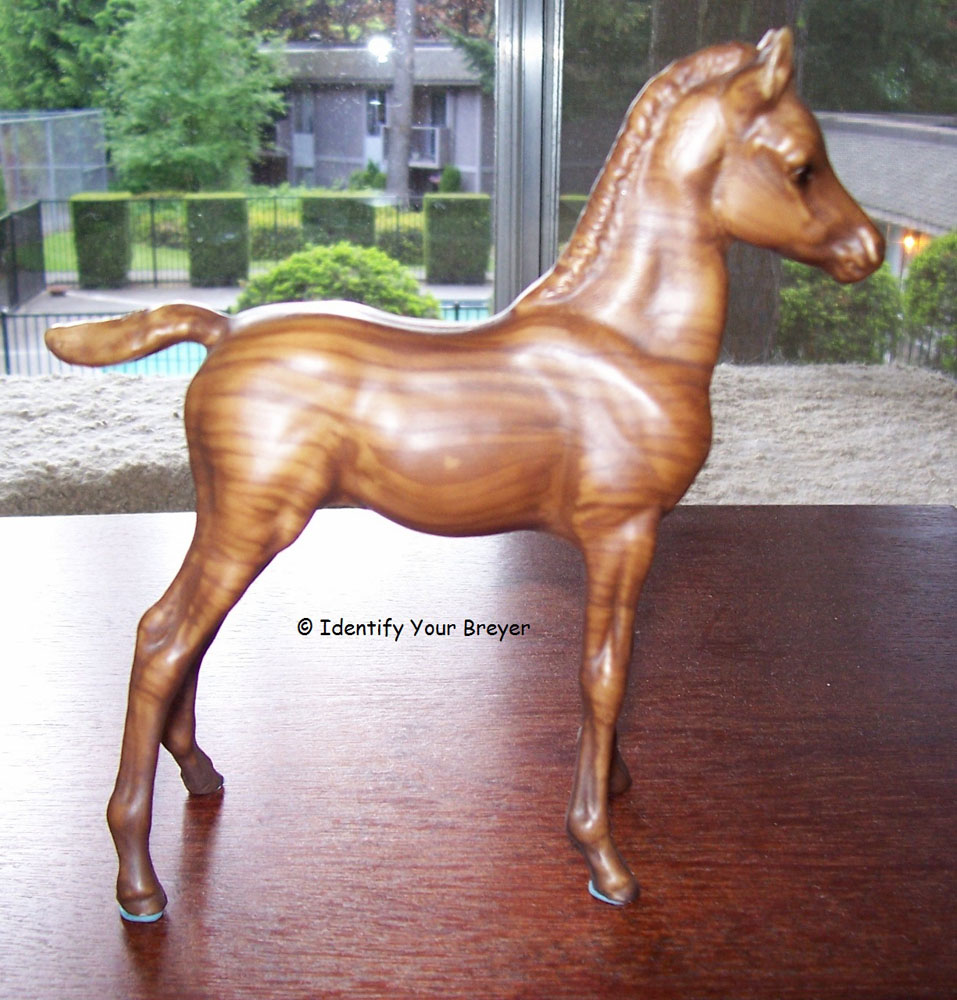
In terms of collectibility, the woodgrain line includes some of the very rarest and most desirable Breyer models ever made. Seven of them are rare enough that only a handful of examples of each are presently known to collectors. They are the Buffalo, Donkey, Elephant, In-Between Mare, Polled Hereford, Proud Arabian Foal, and Walking Angus molds.

 
Woodgrain Buffalo Lamp

Both the Woodgrain Buffalo and the Woodgrain Hereford have only been found on lamps (to date) which suggests that they may have been special runs for Dunning Industries and never regular releases. (One Hereford does exist without a lamp, but the model has holes in its feet indicating that it was probably on a lamp at one time or was intended for a lamp.) The PAF was likely a regular run along with the PAM, but because of the copyright infringement lawsuit brought by Hagen-Renaker in 1959, we know that not many of them were sold before production was halted. The In-Between Mare, if it was actually released, was discontinued before very many were made. (You can read more on the HR lawsuit and the In-Between Mares here.) The others were possibly short special runs although no documentation on any of them has yet come to light. It's possible they were regular runs that were just never issued in large numbers for whatever reason.

Woodgrain Proud Arab Mare

Several other woodgrain models are considered very rare, and while they are hard to find, they do exist in greater numbers than the seven listed above. They are the Proud Arab Mare, the Fury, the Belgian, and the Stretch Morgan. Interestingly, though several dozen of each of these models are probably accounted for in collectors' hands, these four models are still highly desirable and command four-figure prices not far behind the rarest seven.

Most of the other woodgrain models are reasonably common, though several command multiple hundreds of dollars, such as the Mustang and the Walking Hereford. Others, like the Family Arabians or Fighting Stallion can be found and purchased at easily affordable prices, often less than the cost of a new Breyer.

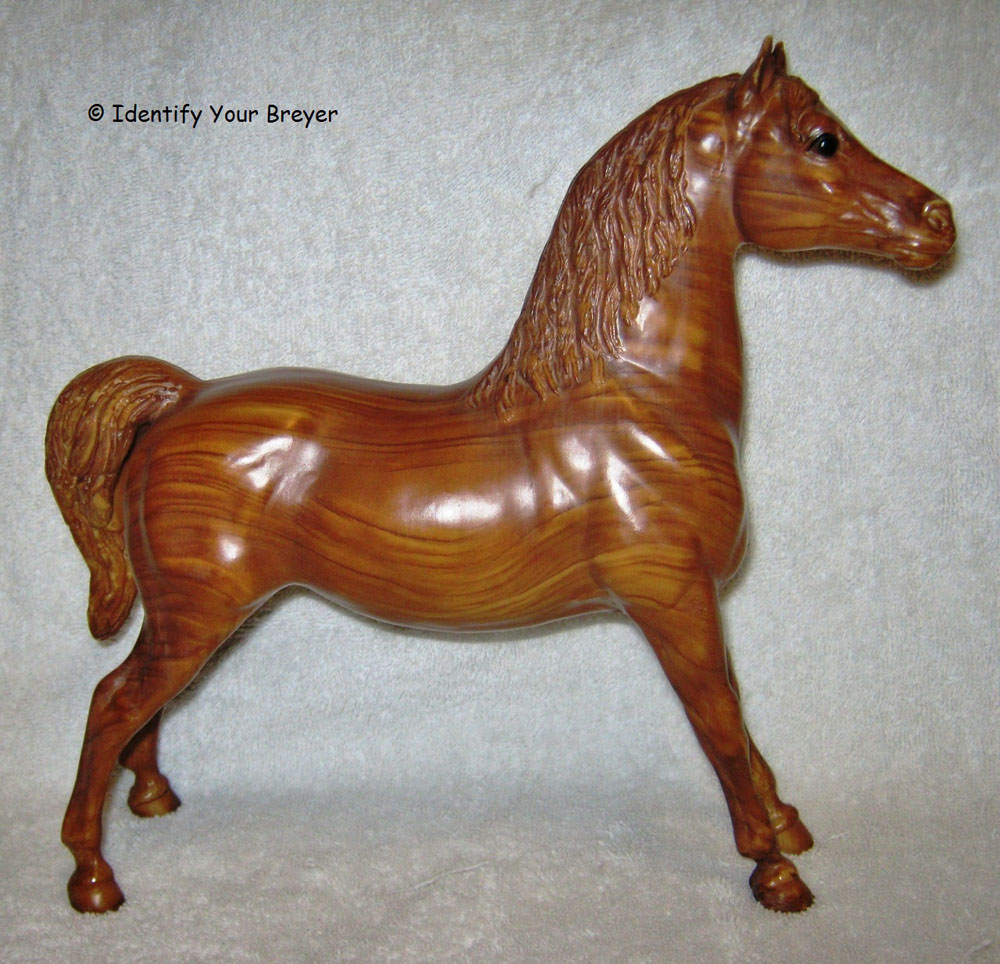
Woodgrain Fury

The "graining" on Breyer's woodgrain models varies from model to model. Some, like the Fury above, have bold stripes of light and dark paint while others are more uniform in tone. The shade of brown used on these models also ranges from golden to dark chocolate. Many woodgrain Running Mares, Running Foals, and Fighting Stallions that came on the Dunning "Ranchcraft" lamps exhibit the dark brown coloration.

 Click to see a larger view

Besides the usual rubs and scratches other models are prone to, woodgrains sometimes develop bubbling as seen in the picture above. The exact cause is unknown, but it may be the result of exposure to heat and/or humidity. Woodgrains with semi-gloss or glossy topcoats occasionally develop a milky opacity to the finish, especially in the muscle grooves or other areas where the finish may have pooled. In my experience, both as a collectibility shower and a judge, in the show ring, only bubbling is generally considered a flaw.

Breyer has attempted to revive the woodgrain color twice since it was discontinued. In the early 1990s in Just About Horses, Breyer announced an upcoming special run series of new woodgrains. Unfortunately, according to Breyer historian Nancy Young, Peter Stone said the run was cancelled because the last Breyer employee who knew how to paint the distinctive color had left the company. Rumors have also circulated for years that the chemicals and/or paint used to create the woodgrain look were no longer legal. Then in 1999, Breyer released two woodgrain keychains, the G2 Andalusian and G2 Clydesdale, as a special run for Breyerfest. The models are dark reddish-brown with subtle darker striping, but they bear very little resemblance to the original vintage woodgrains. But given the recent success Breyer has had at duplicating some of their unique vintage paint jobs for the Vintage Club, I'm hopeful they'll try woodgrain again soon.

Next time: Hartland woodcuts!

Friday, July 5, 2013

Friday Featurette: Wooden Horses Part 1

Most model horse collectors are aware of the various faux wood models that have been sold over the years by the major model horse producing companies. Both Breyer and Stone created plastic models painted to look as though they were made of wood called "woodgrains," and Hartland similarly made plastic horses sculpted to look as though they were carved from wood known as "woodcuts."

Breyer, Stone, and Hartland woodgrains/woodcuts

Few collectors however are aware of the company that very likely inspired the creation of all of these models, Grand Wood Carving of Chicago, IL. Chicago, you say? Yes, indeed, the original home of the Breyer Molding Company as well, and interestingly enough, the factories for both companies were located little more than a mile apart. But more on that later!

Grand Wood Carving got its start in 1939, producing a variety of horses and other animals carved from primarily Central and South American mahogany as well as a few other types of wood. Though they produced a variety of portrait horses and breeds, a large part of their equine line was devoted to racehorses, both Thoroughbreds and Standardbreds.

GWC's "Whirlaway" and "Dan Patch"

Because GWC horses are actually made of wood, they are of course all carved rather than injection molded like the plastic models inspired by them. To achieve a consistent look for each individual "mold," GWC utilized 24-spindle Salstrom carving machines which worked off patterns for each horse or animal. (For more information on these neat machines, please click here.) The pieces were all then hand-finished, a process that included sanding as well as staining. Because of this, GWC horses can vary a bit from piece to piece, particularly in leg thickness, stain color, and markings.

Many of the horses were issued with descriptive stickers, hang tags, or belly bands, and all of these bits of paper ephemera are decidedly rare today. Even the horses themselves are incredibly hard to find despite the company remaining in business until 1983. I suspect this scarcity is the result of several factors: 1) the models were probably never issued in large numbers, 2) they were expensive even when originally available, and 3)  most importantly, GWC pieces were not physically marked. I would guess that this lack of identifying marks  means many of them go undetected by people not familiar with the company. Happily, for those collectors interested in these quirky and charismatic folk art horses, Ed Alcorn has an amazing array of GWC models  displayed on his website here. Breyer collectors should find both the Whirlaway and Man O' War models familiar. More on their inspiration from GWC next Friday!

Thursday, September 13, 2012

"De Mostest Hoss That Ever Was"

"The days are long at Belmont.
Speed they never learn.
And it's many a day since Man O' War
Has looped the upper turn."

Man O' War winning the 1920 Belmont Stakes

Thus begins Blood-Horse editor Joseph Estes' poem "Big Red" published in the October 23, 1937, issue of that magazine, an homage to the greatest racehorse of all time. The legend of Man O' War has inspired many such tributes in a variety of forms---literature, art, advertising, brand names, and of particular interest to model horse collectors, sculpture.

Man O' War was born on August Belmont's Nursery Stud farm near Lexington, KY, on March 29, 1917. By top runner and sire Fair Play out of the regally bred mare Mahubah, a daughter of the English Triple Crown winner Rock Sand, Man O' War was recognized early on as a quality horse by his breeder. Belmont reluctantly sold the colt, however, after enlisting in the army at the age of 65 to serve in World War I.

Samuel Riddle famously purchased Man O' War for $5,000 at the 1918 Saratoga yearling sale and raced him in his black and gold Glen Riddle Farm colors. As a 2 year-old, Man O' War captured 9 of his 10 starts with his one loss, a fast-closing second, coming though no fault of his own. (He was turned sideways at the start and was intentionally boxed in at the rail by the other jockeys for most of the race.) He carried 130 pounds, an impost usually reserved for older horses (and rarely even then), 6 times while giving away substantial weight to his rivals and beating them easily by open lengths.

At three, he was sublime and utterly untouchable, winning all 11 of his starts, including the Preakness, Belmont, Withers, Dwyer, Travers, Lawrence Realization, Jockey Club Gold Cup, and a match race against the 1919 Triple Crown winner Sir Barton.

If you read the race charts for Man O' War they all conclude with some variation of "eased final furlong" or "in a canter." Despite never being fully extended, he set three world records, two American records, two track records, and equaled another track record. And he didn't just break records by hundredths of seconds; he shattered them. In the Lawrence Realization, he shaved more than 4 seconds off the world record for 1 5/8th miles, winning by an estimated 100 lengths, both unheard of feats. His record for a 1 1/4 miles in the Travers stood for an unprecedented 42 years. No other horse in history can boast such a resume, especially when you take into account the staggering imposts Man O' War carried. In one race, he carried an astonishing 32 pounds more than his rivals. It's no surprise then that his groom Will Harbut called him "de mostest hoss that ever was."

At stud, Man O' War's brilliance continued. He sired numerous champions including Triple Crown winner War Admiral, as well as American Flag (Belmont, Withers, Dwyer), Crusader (Belmont, JCGC, Suburban), Clyde Van Dusen (Kentucky Derby), Scapa Flow (2 year-old champion), Florence Nightingale (Coaching Club American Oaks), Maid At Arms (Alabama), Edith Cavell (CCAO, Pimlico Cup over males twice), and the champion steeplechasers Battleship and Blockade. Man O' Wars daughters, in addition to being top flight runners, proved to be exceptional brood mares as well. He died at the age of 30 on November 1, 1947, and his funeral was broadcast publicly on the radio. He and several of his best offspring were originally interred at Faraway Farm under a larger than life statue by Herbert Haseltine, but in the early 1970s, the graves and statue were moved to their present location at the Kentucky Horse Park.

Man O' War was first immortalized as a collectible work of sculpture by the Grand Wood Carving company of Chicago sometime in the 1940s, probably after the great horse's death. This model is carved from mahogany, and it should look familiar to Breyer collectors.

Photo courtesy of Ed Alcorn / The Hagen-Renaker On-Line Museum Collection

There is some evidence that Breyer sculptor Chris Hess may have worked for the Grand Wood Carving company before being hired by Breyer, but that is the subject for another post. Suffice it say, Breyer had copied the work of GWC before, and their 1967 traditional scale model of Big Red was most definitely influenced by the GWC piece, right down to the halter. This is one of the earliest variations of the #47 Man O' War with eye-whites and distinctive battleship grey hooves.
Photo courtesy of Kristen Arendt

GWC produced a number of famous racehorses, many of which came on wood bases with name plaques. The idea for the Breyer Presentation Collection may have come from that practice. The Presentation Man O' War is the rarest of the traditional MOWs, made from 1971-1973 only.

The trad MOW was produced from 1967-1995, and not surprisingly, his color varied a bit over the years. The models from the late 1980s into the 1990s have, in my opinion, always best exemplified the "look" of Big Red. They tend to be a vibrant rich red chestnut with little shading.
Photo courtesy of Kristen Arendt

In 1990, Sears offered a very popular set of three glossy racehorses including Man O'War. Only 2000 pieces were made.
Photo courtesy of Penny Lehew, co-author of the Breyer Animal Quick Reference

In spring of 1961, Hagen-Renaker released their Designers Workshop Man O' War sculpted by Maureen Love. Of all of the MOW portraits, hers was the truest to the physique and majesty of the real horse as the photo below will attest. The HR MOW was in production from Spring 1961-Spring 1971 and from Fall 1974-Fall 1975, so he's not an especially rare piece. He is particularly lovely, however, and a must have for all MOW fans.
Monrovia and San Dimas versions, photo courtesy of Ed Alcorn / The Hagen-Renaker On-Line Museum Collection

A photo of Man O' War as a young stallion. I believe this may have been the photo that inspired Maureen Love's sculpture.
Photo courtesy of Thoroughbred Heritage

In 1975, Breyer arranged a lease for plastic production rights of Hagen-Renaker's DW Thoroughbred models, including Man O' War. The #602 Classic Man O' War model ran until 1990. Like his traditional counterpart, he ranged in color from more golden chestnut to deep red chestnut. His face marking also varied. The earliest models have a broken stripe like the model on the left, and the later ones had a star like the model on the right. The star-faced model first appears in the 1988 catalog.

In the late 1980s, American Artists released a series of resin racehorses. Fred Stone sculpted Man O' War for them, and the pose of this model bears a striking resemblance to Fred's famous painting of the horse. I believe 2500 pieces were made.
Photo courtesy of Karen Grimm / The Black Horse Ranch Collection

In 2004, the most recent Man O' War model was produced by Starlite Originals, sculpted by Kitty Cantrell. It was limited to 2500 pieces.
Photo courtesy of Karen Grimm / The Black Horse Ranch Collection

As you may have guessed, I have been a lifelong, die-hard fan of Man O' War. One of my earliest memories is of my dad reading C.W. Anderson horse books to me, and MOW was, rightfully so, the benchmark by which Anderson measured all other horses. So it's only fitting that I painted by my own Man O' War on Carol Williams' incredible Valor resin. While Valor is a mega-popular model, I don't think my guy is exactly collectible other than to me, but how could I not include him?

"We watch the heroes parading,
We wait, and our eyes are dim,
But we never discover another
Like him."

(Estes' entire poem can be found here.)