Saturday, May 3, 2014

Saturday Snippet: Swaps!

I meant to get this posted yesterday as a Friday Featurette, but I ran out of time. However, since today is the Kentucky Derby and therefore a national holiday on my calendar, I think it's perfectly appropriate to kick back and blog about horse racing and Derby winners. (And it's much more interesting than listening to celebrities try to pretend they know anything about racing!)

So that said, the Swaps model is pretty far from being rare, but some interesting coincidences have made it the perfect subject of today's post. The first is that the favorite for today's 140th running of the Kentucky Derby has a Swaps connection, despite being nearly 60 years removed from that great Derby winner. California Chrome, like Swaps before him, is a California-bred chestnut who stamped his ticket to Churchill Downs with a victory in the Santa Anita Derby.

 California Chrome winning the SA Derby with ease (Benoit photo)

The connection doesn't end there though. California Chrome is trained by Art Sherman, who, in 1955, traveled to Churchill Downs in a railroad car with Swaps as his exercise rider. Now he's back as the trainer of the favorite. Because of these connections, comparisons between Swaps and California Chrome are inevitable, and while the latter still has much to prove, it got me thinking about Swaps, one of the first great Cal-breds, and some of the odd-ball Swaps models I've acquired lately.

The real Swaps was so much more than just a great Cal-bred---he easily ranks as one of the best American runners of all time. He began his racing career in May of his two year-old year, winning his first start, a MSW at Hollywood Park. He started 6 times more that year, winning only two, and despite that inauspicious start, he would come into his own at three.

 Swaps

Swaps began racking up wins at Santa Anita, despite chronic soundness issues (and mismanagement of those issues form his parsimonious bordering on abusive owner and trainer). He took the San Vincente and the Santa Anita Derby with ease before shipping to Churchill Downs for the Kentucky Derby. There, he conquered the favorite Nashua, a champion in his own right, winning geared down by about 2 lengths. Swaps' connections then sent him back home to California, eschewing the Triple Crown trail, while Nashua took the Preakness and Belmont. Swaps however took on older horses and the clock and beat both, setting a new world record for a mile and a sixteenth in the Californian.

Nashua's success on the east coast prompted his owners to propose a match race against Swaps. Unbeknownst to the public however, Swaps had suffered an injury in a workout before the race, and according to Olin Gentry, manager of Darby Dan Farm where Swaps later stood at stud, "he was so sore he didn't know where to put that foot down." His connections opted to go forward with the race anyway, but unsurprisingly, Swaps was no match for Nashua that day. The injury, worsened by running on it, required surgery and sidelined the horse for nearly six months.

Though he was never completely sound again, Swaps put together an astonishing 4 year-old campaign. He raced 10 times, carrying 130 pounds in 7 of those starts, and winning 8 of them. He set four world records and equaled another, often while giving away more than 15 pounds to his rivals. In the mile and a quarter Hollywood Gold Cup, Swaps smashed the track record by a full second, an astonishing feat. In his only defeats, he was sadly noticeably sore. As two-time Triple Crown winning jockey Eddie Arcaro said, “[he] was probably the worst managed horse in history. There is no telling how great Swaps would have been if he’d been managed right. No telling."

Swaps underwent surgery twice more in September of 1956 and suffered from another abcess before breaking down in a workout. His right hind leg was broken in two places, forcing his retirement. His career ended with 19 wins out of 25 starts. He set 5 new world records and equaled another as well as setting three new track records. At stud, he sired Kentucky Derby and Belmont winner Chateaugay, the champion filly and broodmare Affectionately, and the hugely influential broodmare Intriguing (an ancestress of California Chrome incidentally).

It's not surprising therefore that California native and Santa Anita frequenter Maureen Love chose to sculpt Swaps for Hagen-Renaker. He was the first of the five famous TBs she sculpted, released in 1957, the year after Swaps retired. He was produced until 1974, so he's not hard to find, but the models do vary a bit, especially in terms of color, shading, sock height, and placement. My own example unfortunately has fairly soft detail, but his socks are pretty close to those of the real horse.


But the story of the HR Swaps and his oddities is the story for another day and another blog. Kristina Lucas Francis plans to cover it for her Muddy Hoofprints blog, so be sure to subscribe to it if you haven't already!

Breyer acquired the rights to the Hagen-Renaker Designers Workshop Thoroughbreds in the mid-1970s, and they issued the Swaps model in plastic from 1975-1990. Like most models produced in those years, they varied in color, shading, number and placement of socks, and face markings.


The Swaps models on the left and in the middle are fairly typical examples. The left-hand model has tall socks while the center model has low socks. Both have a diamond-shaped star that is typical of the earlier releases. The Swaps on the right has only one sock, and it's on the wrong hind leg. He also has a tear-drop shaped star. He is a somewhat less common variation that is thought to have occurred in the years nearer to the end of the production run.


This Swaps, however, with four socks instead of the usual two is highly unusual and rare. I have not seen another like him, and I was really tickled to find him. If only he had a blaze, I could name him California Chrome!

Tuesday, January 21, 2014

Imitation is the Sincerest Form of Flattery?

Back in November, my friend and fellow blogger Kristina Lucas Francis brought an eBay auction to my attention. The item was a replacement insert for a lighted Budweiser bar sign; it was printed on translucent paper with mirror image printing on either side. The horses should look awfully familiar to Breyer collectors.


I clicked the Buy-It-Now button and then waited and waited and waited for the print to arrive. USPS decided to send it from New Jersey to my local hub in the suburbs of Chicago, but then for some reason, the print took a jaunt to Miami for several weeks. Finally, just before Christmas, it made its way back to Chicago and into my hands.

Obviously, this print is interesting to model horse collectors because of the striking resemblance the horses bear to Breyer's traditional Clydesdale Mare and Foal molds sculpted by Chris Hess. But what is truly fascinating, as Kristina pointed out to me, is the copyright date on the print (click to enlarge). 


The print was copyrighted in 1964 while Breyer's Clydesdale Mare and Foal did not debut until 1969. Allowing a year for molding, the print still predates the Breyer models by four years. While I can't state conclusively that Breyer's Clydesdales were inspired by this print, given the company's history of copying the designs of other makers in the 1950s and 1960s, it's not a stretch to think that someone from Breyer saw a sign like this in a bar, maybe even Chris Hess himself. I personally think the similarity between them is too strong to be mere coincidence.


There are subtle differences---the heads of the mare and foal are turned a little bit more in the print and the colt's tail is swished a little differently---but I think the similarities of pose, leg placement, hair, etc, speak for themselves. Interestingly, even the color of the original releases echos what is shown in the print. Despite actually being bays, the foal coloration was rendered as chestnut by Breyer. And the mare in the print has just a hint of black on her knees and hocks, something that could easily be overlooked by someone not familiar with horse color. Breyer's mare reflects that with only a darker mane and tail. Granted, most Breyer "bays" at that time were produced with no black on the legs, but I think it's interesting all the same.

I hope you enjoyed this post! Kudos to Kristina for spotting this fascinating piece of the puzzle that is Breyer history!

Monday, January 6, 2014

Melty Monday: Vinegar Syndrome Revisited

(Last year's adventure with vinegar syndrome for those unfamiliar with shrinkies/oozies: http://modelhorsecollectibility.blogspot.com/2013/01/vinegar-syndrome-breyer-shrinkies-and.html )

Melty in terms of plastic horses. Not so much in terms of the weather here. With temps in the -14 range with -43 windchill, the snow here in Chicago isn't going anywhere fast. Would that it was the snow melting and not the horses though!

I spent some time over the holidays again working on inventorying my collection, and I was alarmed to see the continued disintegration of the shrinkies and oozies I pulled out of storage in the last few years. My BHR SR sorrel/orange PAS has shrunk dramatically in both height and width in the last year, and his paint has radically lightened. He looks like he has a film of chalk dust all over him now. And worse still, one of his back hooves had started to melt to the plastic shelf he's been sitting on.

I didn't get a chance to check on the shrinkies/oozies that had been relegated to the garage (I'm sure they're practically soup by now), but I was both interested and horrified to see what had become of my dapple grey Five Gaiter. He has been lying on a styrofoam meat tray on a shelf in  climate-controlled room for several years now, and he has shrunk even more...

How he looked a few years ago:

He's smaller and even more curved now. He no longer stands.


His head doesn't seem to be shrinking at the same rate as his body, and it's not quite proportional anymore. His hind leg reacted with the styrofoam tray and has melted through it partially:


I flipped him over and was startled to see that the vinegar syndrome process had eaten a hole through the styrofoam:


And he's reached the point where he's beginning to develop "warts." I'm not sure what causes them---bits of good plastic mixed in with bad? Or plastic decaying at a different rate?


My mom wanted to throw him away, but for the sake of scientific observation (and because he's a sentimental favorite (::sniffle::)), he's been sentenced to life in the garage for the time being. I'll check on him in July when I'm home again for BreyerFest to see what exposure to a Georgia summer has done to him.

(And in the meantime, if anyone has a non-shrinky dapple grey Five Gaiter for sale, I sure would love to own one. Mine didn't survive nearly long enough.)

Friday, November 8, 2013

Friday Featurette: Hartland grail achieved!

My dad travels a lot for work, and about 20 years ago, he came home from a trip with a special find. While on the road, he stopped for lunch and then decided to look through a nearby antique mall. When he arrived at the house later that evening, he came up the front steps grinning and said he'd found "a decorator." And he was right. It wasn't a Breyer decorator, but it was a gold Hartland 9" Mustang which was just as exciting. We didn't know much about it at the time, but eventually we learned that it had been made as a special run for a brewery. It was meant to be affixed to a sign that would have been on display in a bar.

For most of the intervening years since then, I focused mostly on collecting Breyers, but I happily bought old Hartlands when I could find them at reasonable prices. I've always liked their stylized look, especially the horses made in the 1960s, and for the last few years, I've been actively filling in gaps in my collection of horses from that era. I've also been filling in the gaps in my knowledge about Hartlands.

So, in my post about Hartland woodcuts earlier this summer, I mentioned the elusive gold woodcut 9" Mustang and included a photo of a partial set I found on Google.  According to Gail Fitch's book Hartland Horses and Dogs, the gold Mustang was issued as a special run in the late 1960s for the Pittsburgh Brewing Company in Pittsburgh, PA, who distributed Mustang Malt Liquor. No one knows how many were made or even exactly when they were made, but the horses are found often enough off the beer sign that I suspect there are a reasonable number to be had. Finding models still on the beer sign and with the original beverage container is however much more unusual. I see horses with the bases only very occasionally and complete sets hardly ever. So that said, I was really pleased to be able to add this set to my Hartland collection.


Unlike the other Hartland woodcuts which were molded in colored plastic, this model is molded in white plastic and was then painted gold. The base on this example is lettered on both sides, but some are only lettered on one side. I believe the piece was meant to come with the empty glass bottle as shown here, but I have seen at least one with an aluminum can instead. I'm not sure if it came both ways or if the can was a replacement for a presumably broken or lost bottle. Either way, it's a fun bit of breweriana and Hartland history.

Monday, September 9, 2013

Shedding a little light on Breyer Western Horse Lamps

(My apologies for the terrible pun. I couldn't resist.)

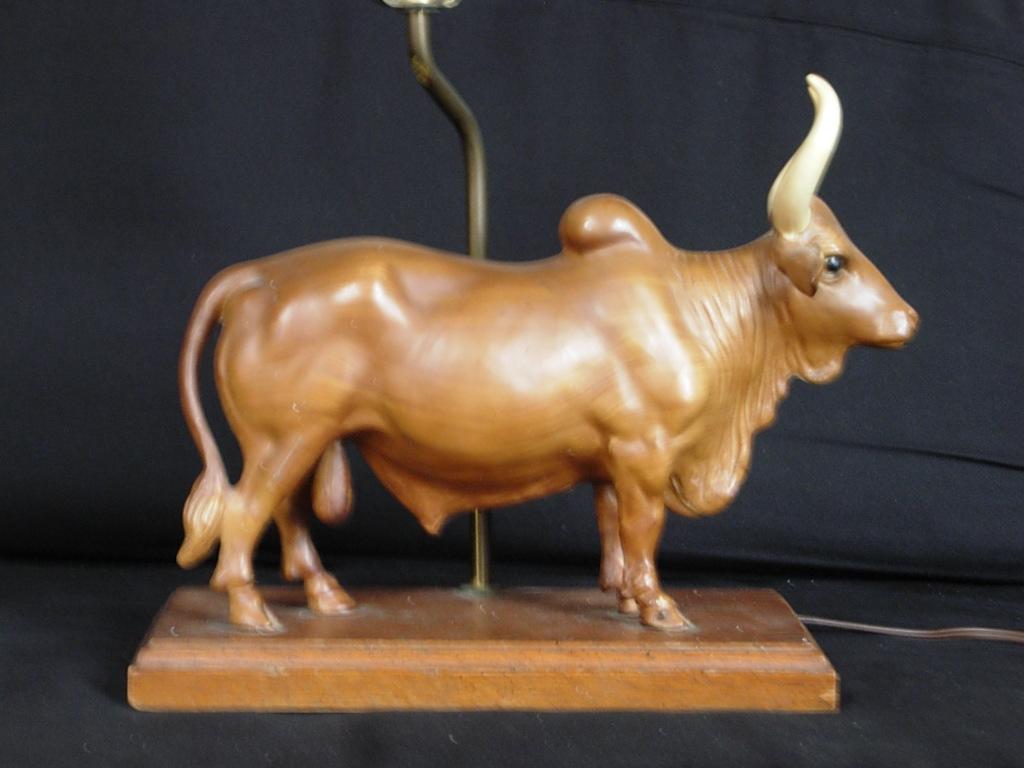
Most collectors are familiar with the "Ranchcraft" line of Breyer woodgrain lamps sold by Dunning Industries in the 1960s and 1970s. They featured models such as the Running Mare and Foal, the Fighting Stallion, the Family Arab Foal, and even a few animals like the Longhorn Steer and the Brahma Bull. These woodgrain models were mounted on wooden bases and the lamps sported rustic burlap shades.A few non-woodgrain models graced these lamps, too, like the grey Elephant and Donkey and the Bay Rearing Stallion.

A typical Dunning Lamp

Less common, however, are the Western Horse lamps. Like the Western Horse clocks, they date to the early 1950s, near the beginning of Breyer's model horse history. The Western Horse lamps, as with the clocks, have turned up in both alabaster and palomino. In my experience, the alabasters usually come on black-painted metal bases while the palominos are typically seen on brown-painted bases. A few green-painted bases have been found, too. That said, they are fairly scarce, and I've seen only a handful of these neat old lamps.

An alabaster Western Horse on a black base 
(The shade and saddle are not original to this piece.)

A palomino Western Horse on a brown 
base with the original shade and saddle


My mom, sister, and I recently acquired the palomino lamp pictured above, and we were pleased to discover a manufacturer's sticker on the bottom of the base. As far as I know, no other examples are known with any sort of identifying marks (although if you happen to have one, I'd love to know!), so we were pretty excited to finally have a maker's name to add to our provenance files.


I have not yet been able to track down much information about the Marks Manufacturing Company, but as I work in a top-notch research library, that of my alma mater, the University of Chicago, I have access to some handy sources like a 1956 Chicago phone book. I was able to track down the address of Marks, and  like the Mastercrafter Clock Company, it was a near neighbor of the Breyer factory. All three were located just west of downtown Chicago. Mastercrafters was about one mile due east of Breyer, and Marks was a bit northeast, about 2 miles away.

The use of the zone number (22) rather than a zip code helps narrow the date on this piece to the 1950s, and the high grommet saddles and painting style of the Western Horses on the lamps pinpoint them to the early 1950s. Based on pictures I've found of other (non-horse) Marks made lamps, the company appears to have been in business as early as the 1930s if not earlier. I have not yet been able to determine if it was related to the well-known Clayton Mark and Company (of Evanston, IL) and Mark (no "s") Manufacturing Company of Indiana. The latter two companies specialized in steel manufacturing of pipes and well equipment and were founded by Clayton Mark (of Marktown fame) and his sons. It's not a huge stretch to think that someone in the family might have opted for the decorative side of metal work, but it could also be a complete coincidence.

I plan to do more digging to track down the history of Marks. I'm very curious to know how long the company was in business after their collaboration with Breyer and whether or not it was related to one of Clayton Mark's companies. I'll be sure to blog about anything I find!

Next time, some news on those chinas we all Love!

Friday, July 19, 2013

Welcome, BreyerFest readers!

Welcome to the Model Horse Collectibility blog! If you saw my flyers at the CHIN, thank you for surfing on over to check out the blog! Here are some quick links to some of the most popular posts:

What is collectibility?
http://modelhorsecollectibility.blogspot.com/2011/04/what-is-collectability-and-why-should.html

Collectibility reference materials
http://modelhorsecollectibility.blogspot.com/2011/06/collectibility-reference-materials.html
http://modelhorsecollectibility.blogspot.com/2011/08/collectibility-reference-materials.html

The importance of provenance
http://modelhorsecollectibility.blogspot.com/2011/11/importance-of-provenance.html

Vinegar syndrome: all about shrinkies and oozies
http://modelhorsecollectibility.blogspot.com/2013/01/vinegar-syndrome-breyer-shrinkies-and.html

Wooden horses, woodgrains, and woodcuts series:
http://modelhorsecollectibility.blogspot.com/2013/07/friday-featurette-wooden-horses-part-1.html
http://modelhorsecollectibility.blogspot.com/2013/07/friday-featurette-wooden-horses-part-2.html
http://modelhorsecollectibility.blogspot.com/2013/07/almost-friday-featurette-wooden-horses.html

Future topics will include:
* The resin revolution
* Stickers
* Original finish vs after market
* Epherema and values
* More real horse and portrait model profiles

If you'd like to suggest a topic, please feel free to leave a comment!

Wednesday, July 17, 2013

(Almost) Friday Featurette: Wooden Horses Part 3

It's not quite Friday, but with BreyerFest rapidly approaching, I thought I'd make another post in the series about wooden horses and wooden wannabes.

In the 1960s, Breyer was not the only company producing plastic model horses that were finished in a faux-wood style. Hartland Plastics of Hartland, Wisconsin, a town about 25 miles west of Milwaukee, introduced a line of models called "woodcuts" beginning in 1964.These models differed from Breyer's faux-wood models in that they were sculpted to look as though were whittled or carved from wood rather than just painted to look that way.

The Hartland woodcut look was achieved in three different ways. Some models have an angular surface meant to look like carving marks:
Walnut 9" TWH

Some are both carved and marked with incised graining (in horizontal bands in this case):
Ebony 7" Saddlebred Stallion

Carved (subtly) and grained (in swirls):
Cherry 9" Mustang

Only one mold shows graining but not carving:
Test Run Walnut 9" Five-Gaited Saddlebred (more on this one below)

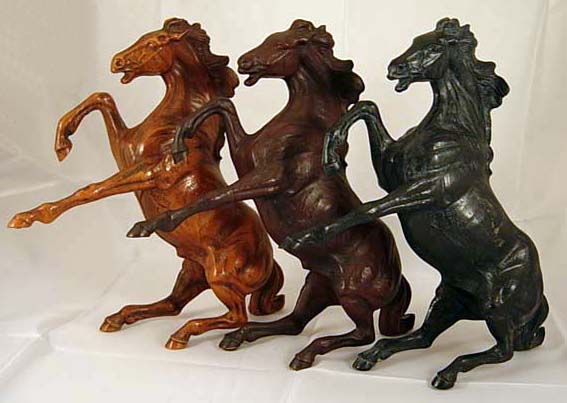
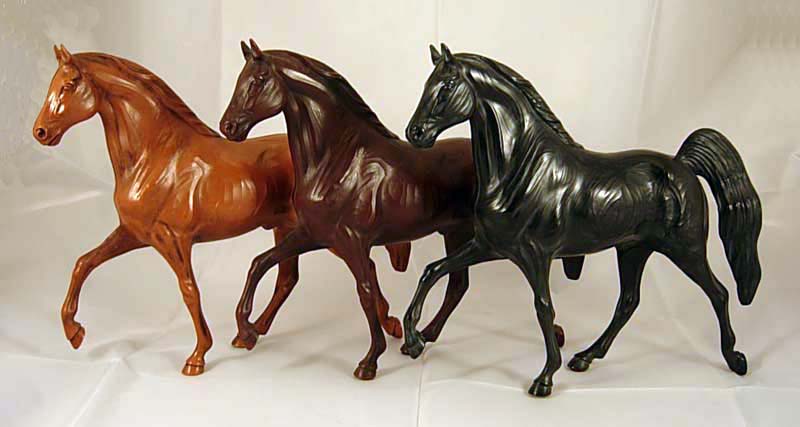
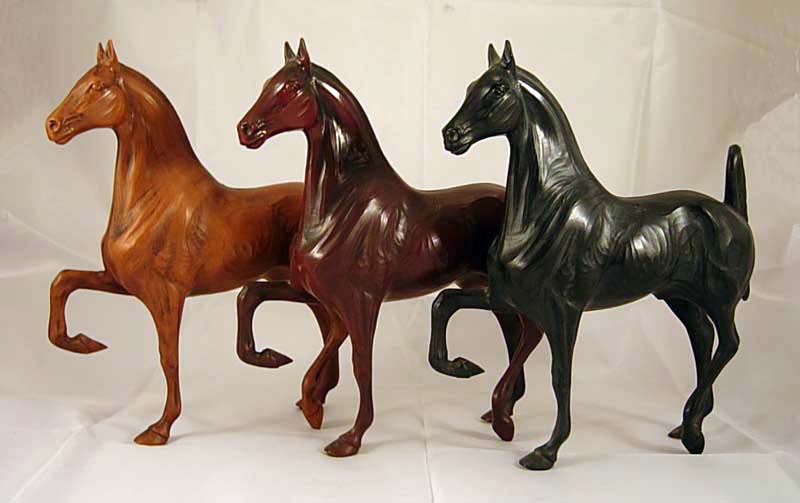
The woodcut molds are unique molds separate from the corresponding smooth body versions. They were sculpted by Roger Williams, and the carving and/or graining was added by Alvar Bäckstrand. The models came came in three shades: walnut (tan), cherry (dark reddish-brown), and ebony (black). They were usually cast in tan, reddish-brown, and blue-grey or black plastic respectively and had a wash of darker shading rubbed over the surface to highlight the woodgraining look. Some models, especially the later walnut pieces, have very little of the contrasting color applied.

 Walnut, Cherry, and Ebony TWHs

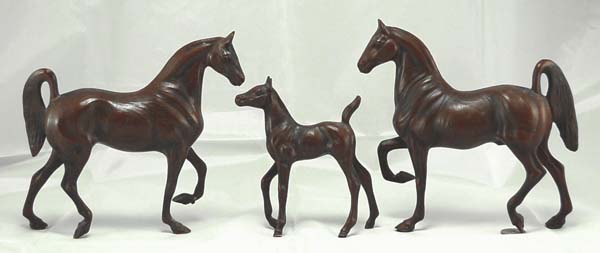
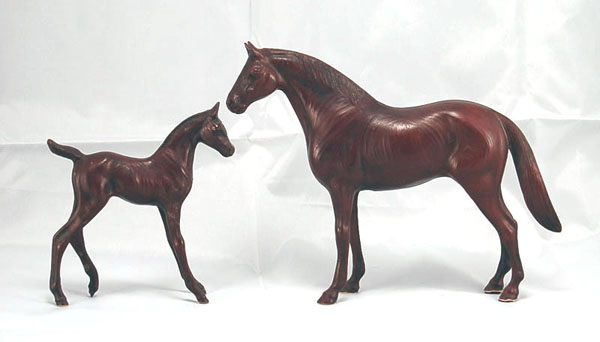
Hartland issued the following molds as woodcuts in the mid-1960s: 9" Mustang (subtly carved and grained), 9" Tennessee Walking Horse (two mane variations, both carved), 9" Three Gaited Saddlebred (carved), 7" Saddlebred Family (carved and grained), 7" Thoroughbred Mare and Foal (carved and grained), and the 6" Arab Stallion (carved). All of these models were available in all three woodcut colors. The ebony and cherry colors were only issued between 1964-1966 whereas the walnut models were almost all available for 3 or 4 years in the mid- to late-1960s, and the 9" Mustang and Three Gaiter were also re-released in walnut from 1970-1973 when Durant took over the company.

Despite relatively short productions runs, the 9" models are all fairly common, the Mustang most of all. The 9" models bring around $20-40 depending on color and mold with the Mustangs tending more toward the $5-10 range because they are so easily found. The 7" and 6" models are considerably more scarce, having been limited in production in all colors to only 1 or 2 years. The Thoroughbred Mare and Foal for example were issued in 1965 only, making them the rarest of the bunch. The family sets often sell for around $100.

In the late 1960s, Hartland issued the woodcut Mustang in gold. Most were mounted on promotional Mustang Malt Beer signs to be displayed in bars.

Hartland has passed through several owners and has therefore been in and out of business a number of times since the 1960s. Under two new incarnations, those headed by Paola Groeber from 1987-1990 and Sheryl Leisure from 2000-2007, the 9" Mustang and TWH woodcut molds were issued in several realistic horse colors. The woodcut models painted and sold by Paola were all test runs as far as I know. The models sold by Sheryl were a mix of small regular runs and test runs. For more information on these models, I highly recommend Hartland Horses and Dogs and Hartland Horses: New Model Horses Since 2000 by Gail Fitch, both of which are available directly from the author.

An unpainted 9" woodcut TWH molded in swirled black and grey plastic
Less than 10 were sold by Sheryl Leisure in August 2002

The rarest woodcut, to the best of my knowledge, is a one-of-a-kind test run 9" Five-Gaited Saddlebred. She came from the collection of a former Hartland employee and probably dates to the mid-1960s. She was sold mounted on a base as shown and is grained only, not carved. My best guess is that she was possibly a one-off prototype that was never put into put into production, perhaps because she was too similar to the 9" Three Gaiters. 


Some woodcut Hartlands were issued with gold stickers, a factor that can make an ordinary model extraordinary if found with the sticker still in place. I have seen two different styles---a round sticker and a rectangular sticker. Both indicate the models have a "hand-rubbed, wood carved finish."

Ebony 9" Mustangs with two sticker variations 
(The rectangular sticker on the left is partially missing.)
 
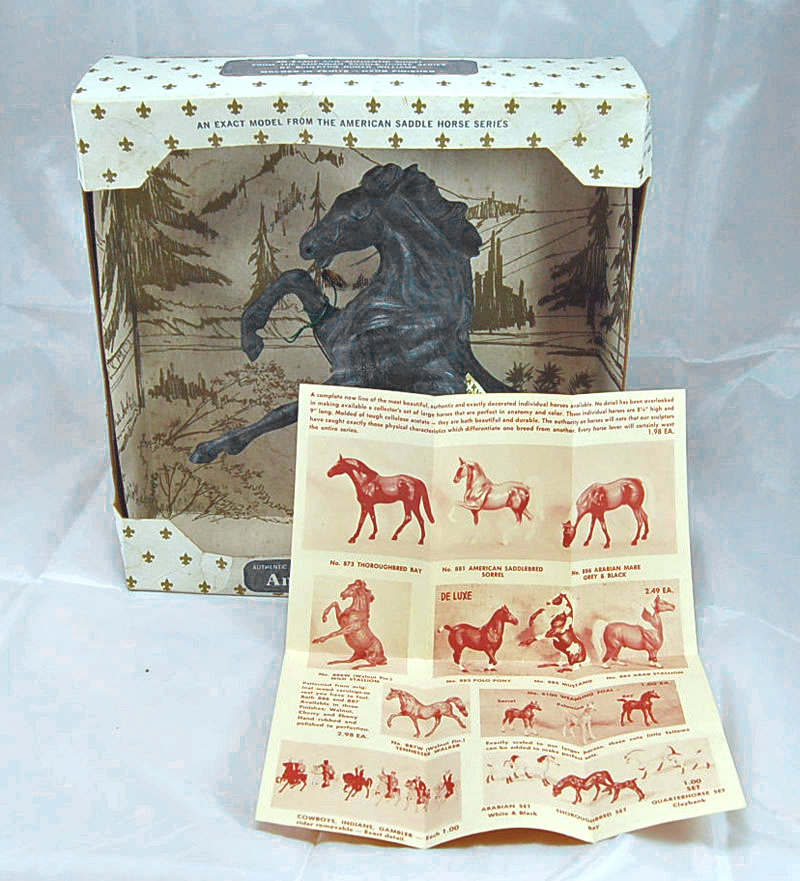
Finding Hartlands, especially woodcuts, in their original packaging is also unusual and adds significantly to their value. 
 
Ebony 9" Mustang with original box and catalog
 
If you enjoyed this post and want to learn more about Hartlands, Gail Fitch's books are the best source of information. I am still educating myself about Hartlands, and her books have been hugely helpful in learning about the company and the models produced under its various owners. Because they are highly stylized, Hartlands aren't to everyone's taste, but I find them charming, and I hope more hobbyists will take an interest in them.

The last installment featuring Peter Stone woodgrains will be posted after BreyerFest. Hope to see you there!