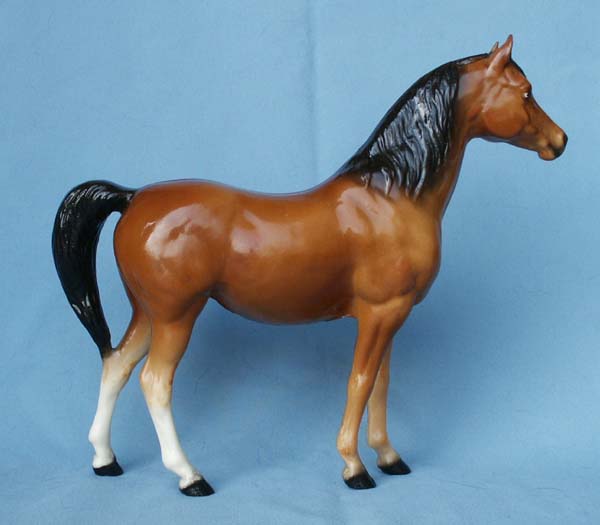
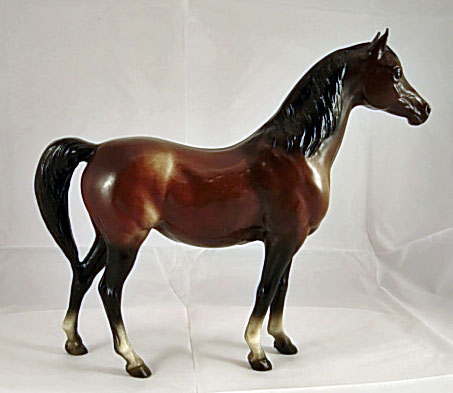
Most model horse collectors are aware of the various faux wood models that have been sold over the years by the major model horse producing companies. Both Breyer and Stone created plastic models painted to look as though they were made of wood called "woodgrains," and Hartland similarly made plastic horses sculpted to look as though they were carved from wood known as "woodcuts."
Breyer, Stone, and Hartland woodgrains/woodcuts
Few collectors however are aware of the company that very likely inspired the creation of all of these models, Grand Wood Carving of Chicago, IL. Chicago, you say? Yes, indeed, the original home of the Breyer Molding Company as well, and interestingly enough, the factories for both companies were located little more than a mile apart. But more on that later!
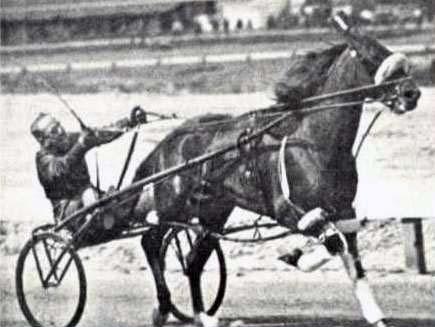
Grand Wood Carving got its start in 1939, producing a variety of horses and other animals carved from primarily Central and South American mahogany as well as a few other types of wood. Though they produced a variety of portrait horses and breeds, a large part of their equine line was devoted to racehorses, both Thoroughbreds and Standardbreds.
GWC's "Whirlaway" and "Dan Patch"
Because GWC horses are actually made of wood, they are of course all carved rather than injection molded like the plastic models inspired by them. To achieve a consistent look for each individual "mold," GWC utilized 24-spindle Salstrom carving machines which worked off patterns for each horse or animal. (For more information on these neat machines, please click here.) The pieces were all then hand-finished, a process that included sanding as well as staining. Because of this, GWC horses can vary a bit from piece to piece, particularly in leg thickness, stain color, and markings.
Many of the horses were issued with descriptive stickers, hang tags, or belly bands, and all of these bits of paper ephemera are decidedly rare today. Even the horses themselves are incredibly hard to find despite the company remaining in business until 1983. I suspect this scarcity is the result of several factors: 1) the models were probably never issued in large numbers, 2) they were expensive even when originally available, and 3) most importantly, GWC pieces were not physically marked. I would guess that this lack of identifying marks means many of them go undetected by people not familiar with the company. Happily, for those collectors interested in these quirky and charismatic folk art horses, Ed Alcorn has an amazing array of GWC models displayed on his website here. Breyer collectors should find both the Whirlaway and Man O' War models familiar. More on their inspiration from GWC next Friday!
I'm a big fan of Kristina Lucas-Francis' Muddy Hoofprints blog, and with BreyerFest looming, Kristina has been doing a series of shorter weekly posts on Mondays since she, like many of us, are short on time leading up to the big weekend in Kentucky. I too am finding my blogging time limited this summer with commissions and Breyerfest planning, so I've decided that Kristina's idea is brilliant, and I'm totally going to borrow it. My first Friday Featurette comes at the request of a reader. The post about Adios was so popular that I've been asked to do a similar one on the legendary racehorse Phar Lap.
Phar Lap(1926-1932)
Though Australia considers him a native son, the great chestnut gelding Phar Lap was actually bred and foaled in New Zealand at Timaru on the South Island. He was sired by Night Raid, a well-bred horse from England who failed to perform there and was eventually exported to Australia. Night Raid fared no better racing down under, retiring with an overall record of 2 wins and a 3rd from 35 starts. He stood at stud there only a year before being shipped on to New Zealand where he finally found his niche. Though siring Phar Lap alone would have made him a success, Night Raid actually produced a number of good runners, 13 of them stakes winners. He led the sire list in Australia from 1929-1931.
Night Raid
Phar Lap's dam Entreaty was a New Zealand-bred. Her sire Winkie was a full-brother to the 1910 1000 Guineas winner Winkipop though he never displayed the same talent, hence his exportation to New Zealand. Entreaty's other foals were no match for Phar Lap in terms of ability, but her daughters proved to be important producers. Interestingly, Entreaty can be found in the tail-female line of the modern Australian superstar mare Sunline through Phar Lap's full-sister Fortune's Wheel.
Entreaty with Te Uira, a full-siter to Phar Lap
Phar Lap, Entreaty's second foal, was born on October 4, 1926. In January of 1928, he was sold at the New Zealand Yearling Sales at Trentham racecourse for 160 guineas to Hugh Telford, brother of Harry Telford who would become Phar Lap's trainer. The colt was purchased for David Davis, Telford's racing partner, and was shipped to Australia to begin his career.
At first, Phar lap did little to impress his connections. He was thin, gangly, and wart-covered as a youngster, and it took him some time to grow into his huge 17 hand frame. Because he took so long to develop, he was gelded, and he eventually matured into a lean, handsome, and surprisingly kind horse. He was given the name Phar Lap from the Thai word "farlap" meaning lightning, a reference to his peculiarly shaped star.
His career started slowly with four off the board finishes as a two year-old, but in his last start of the season over six furlongs, he finally scored a win in the Rosehill Maiden Juvenile Handicap. It was not quite a portent of things to come as his three year-old season likewise began poorly with four more dismal up-the-track finishes. Given a little extra ground in his next start, the nine furlong Chelmsford Stakes, Phar Lap produced an excellent second place finish, and from that point on, he began a streak of dominanting wins that earned him the nickname the Red Terror.
Phar Lap made 15 further starts at three, winning an astonishing 13 of them, including the prestigious Rosehill Guineas and the AJC Derby at Randwick, the Craven Plate at Randwick, and the VRC Derby at Flemington. Sent against older horses for the first time in the 2-mile Melbourne Cup, Phar Lap finished third behind Nightmarch, another son of Night Raid, having made the pace through most of the race. He ran third again in the St. George Stakes at Caulfield, and then he easily annexed a string of important stakes races including the VRC St. Leger at Flemington, the Governor's Plate and King's Plate at Flemington, and AJC Plate at Randwick, among others. In the 2 1/4 mile AJC Plate, Phar Lap revenged himself on Nightmarch, humbling him by 10 lengths.
Given a break over the winter, Phar Lap was kept in shape with long gallops over the sand dunes on Australia's coast. (Fans of the 1983 movie about the horse will remember that spectacular montage.) When he returned at four, he was virtually unstoppable. He won 14 of 16 starts that season, most important of which were his victories in the Cox Plate and the Melbourne Cup. He defeated his former nemesis Nightmarch no less than four times with ease. As a five year-old, Phar Lap won 8 races in a row before finishing a shocking 8th in the Melbourne Cup. An overzealous training regimen and a staggering impost cost him that race.
In late 1931, Phar Lap boarded a ship destined for San Francisco in order to compete in what was then the world's richest race, the Agua Caliente Handicap held in Tijuana, Mexico. He arrived in good order and had two months to acclimate and resume training. Phar Lap went to post on March 20, 1932, as the heavy favorite, and he won as a heavy favorite should, with ease and in track record time. Thanks to the wonders of Youtube, footage of this historic race can be seen here:
Remarkable video footage of Phar Lap's Agua Caliente win:
After the race, Phar Lap was shipped back to California while his next career start was considered. Tragically, less than three weeks later, the great horse became suddenly ill and died. The cause of his death has not yet been conclusively proven, but the two most likely causes were either arsenic poisoning or duodenitis-proximal jejunitis, an acute form of gastroenteritis brought on by stress. Speculation was rampant for many years that Phar Lap had been deliberately poisoned (by rivals, American gangsters, etc), and recent tests done on Phar lap's hair did confirm the presence of arsenic in his system. Arsenic, however, was a common component in tonics for racehorses at that time, and trainer Harry Telford's own recipe book included such a tonic which he considered "good...for all horses."
After his death, Phar Lap's hide was stuffed and put on display at the Melbourne Museum, and his skeleton was likewise mounted and put on exhibit at the New Zealand National Museum in Wellington.
In my experience, taxidermists rarely do well with equine subjects, but happily for racing fans, Phar Lap's hide was beautifully mounted and has been well cared for. The grand gelding looks like he could step out of the case and walk around the display at any moment. He's so lifelike that one could argue he's the ultimate model horse.
Terrible joke aside, Phar Lap has been more traditionally immortalized in model form by Breyer on two occassions. In 1985, Breyer released a lovely galloping portrait of Phar Lap in a rich red chestnut color befitting his "Red Terror" nickname. Most Phar Lap models have two hind socks like the real horse, but occassionally, models with only a single sock turn up. The Phar Lap model was discontinued in 1988.
(Photo by Museum Victoria)
In 2007, Breyer produced a special run Phar Lap model on the Lonesome Glory mold exclusive to Target stores in Australia. Not surprisingly, this newer Phar Lap model is rather hard to acquire and is therefore quite desirable.
(Photo by eventingpony24)
In the mid-2000s, the English company Caughley Porcelain produced a number of sculptures of famous racehorses, both as limited editions and as trophies for prestigous races. Not surprisingly, they included a portrait of Phar Lap in their line up. The edition was limited to 250 pieces. Sadly, as of 2011, Caughley is no longer producing equine sculptures, and what few pieces they did are rarely seen for sale. (Hopefully, I will have a blog devoted to Caughley horses coming soon.)
(Photo by Caughley Porcelain)
I am not aware of any other Phar Lap models made either as toys or fine art, though I hope others do exist. Even after 80 years, Phar Lap is still the benchmark against which great Australian horses are measured, and because he is remembered with such affection, I hope more Phar Lap models will be produced in the future.
Before I get started, I should warn you that while I am a Thoroughbred racing enthusiast and have been all of my life, I am but a novice when it comes to harness racing. The same goes for my knowledge of Breyer and Boehm; the history of the former I have been immersed in all my life as a collector, but the latter I have only admired from afar. Doing research for this post however has given me a greater understanding of both harness racing and Boehm porcelain, and it has offered some fascinating insights into the lives of two men who greatly influenced their respective fields, Delvin Miller (harness racing) and Edward Marshall Boehm (American fine porcelain). The story, though, begins with a horse.
The famous Standardbred pacer Adios was born January 3, 1940, at The Two Gaits Farm in Carmel, IN, just north of Indianapolis. His sire Hal Dale, a tail male great-great-great-grandson of Hambletonian, was a successful pacer and producer of speedy horses, and his dam Adioo Volo had a regal pedigree. Though nearly 50 years have passed since Adios died, he is still considered one of the greatest, if not the greatest, Standardbreds of all time, both for his talent on the track and for the legacy he left as a sire of champions.
Adios setting a world record in 1945
Adios won 43 of 87 starts over 4 seasons of racing, and set a number of world records at 1 mile and 7/8ths of a mile. One record set in Shelbyville, IN, stood for 43 years. As a sire, Adios produced an unprecedented number of champions, including two pacing Triple Crown winners, Adios Butler and Bret Hanover.
Adios at stud
Adios was owned and raced for a time by Harry Warner of Warner Brothers studio, but after being retired to stud, Adios was purchased by Delvin Miller of Pennsylvania, to stand at his Meadow Lands Farm. Miller was a trainer and driver of harness horses, and he was a champion of the sport all his life. His competitive driving career spanned eight decades, from the late 1920s to the early 1990s, a feat unequaled by any other driver. He raced in 40 countries and won a total of 2,442 races including the Hambletonian, the Yonkers
Trot, the Kentucky Futurity, the Fox Stakes and the Messenger. Miller also worked tirelessly throughout his life to improve safety standards in the sport both for the people and the horses, and from all accounts, he was a thoroughly likeable, friendly guy with tremendous enthusiasm for his sport.
So it is to Mr. Miller that model horse collectors owe their gratitude for the Adios models that exist today. Shortly after Adios' death in 1965, Miller commissioned equine artist James Nelson Slick to sculpt a life-size bronze statue of his great stallion. It was unveiled on August 12, 1967, at the Meadows Racetrack, which Miller helped found, to coincide with the first running of the Adios Pace, a prestigious race for 3 year-olds. Smaller versions of the statue were and still are presented as trophies to the winning owner.
Slick's Adios statue stands at the entrance of the Meadows, and it should look familiar to model horse collectors.
For a number of years, Breyer collectors assumed that the Breyer Adios model had been copied from the Boehm Adios which had itself been copied from the Slick statue. After all, in the 1950s, Breyer copied several Boehm pieces, such as the Walking Hereford and the Boxer, not to mention copying other pieces from other companies including Rosenthal (Poodle), Hagen-Renaker (PAM, PAF, FAS, etc), and Grand Wood Carving (Racehorse and Man O' War).
But the fact is that the Boehm and Breyer Adios models were both independently inspired by the Slick statue and were produced concurrently. Nancy Young's research for her Breyer Molds and Models books revealed that Delvin Miller had lent a copy of the small bronze trophy statue to Peter Stone and Chris Hess to copy for a plastic version in the fall of 1967. By July of 1968, the mold for Adios was being perfected as per letters between Breyer and Miller. Reading between the lines, it seems that Miller may have been the driving force behind the addition of an Adios model to the Breyer line. The model was released in plastic in 1969.
The Boehm model in comparison was also released in 1969. Edward Marshall Boehm was an avid animal lover, and.though he is best known for his exquisite bird sculptures, he also created a number of stunning horses, of which Adios was the last. Boehm was a self-taught artist who revolutionized the production of English-quality hard-paste porcelain production in America. He owned and bred harness racehorses, and Miller may have similarly encouraged him to produce a porcelain version of his great horse based on Slick's statue. (It's also possible that Boehm simply worked from some of the same photos of the horse that Slick used.) Whatever the case, the first Boehm Adios cast was presented to Miller on October 14, 1968, which indicates that the Boehm company's Adios was being sculpted and molded at the same time as Breyer's.
Boehm died only three months later on January 29, 1969, at the age of 55. His studio continued production in the capable hands of his wife Helen, and as I mentioned above, the Boehm porcelain Adios was also released in 1969. It was intended to be a run of 500 pieces, but Reese Palley wrote in his book The Porcelain Art of Edward Marshall Boehm that the edition was closed in June of 1974 when only 130 horses had been made.
The Boehm Adios
The Breyer Adios enjoyed a longer run, remaining in production until 1980. It was also featured as a part of the Presentation Collection in the early 1970s. These models were mounted on wood bases with metal name plates.
Ad from the November 1971 issue of Western Horseman
A Presentation Collection Adios. The nameplate reads only "Adios." (Photo from IDYB)
In 1969, actually predating the Presentation Collection, Delvin Miller ordered Adios models from Breyer to sell himself through various magazines and retail outlets. These models were also mounted on bases, but the bases have a shallower beveled edge, and their name plaques read "Adios 1:57 1/2," a reference to the world record time for a mile set by Adios in 1945. Miller ordered more models in 1981, and because Breyer has discontinued the Adios model, a small special run edition was created specially for him because of his long standing friendship with the company.
A 1969 Delvin Miller Adios (Photo from IDYB)
My sister's 1981 Delvin Miller Adios which was mounted in reverse
While Breyer's regular run, freestanding Adios is quite common, the Breyer Presentation Collection Adios, the Delvin Miller SR Adios, and the Boehm Adios are quite rare. The prices vary, but roughly $300-400 will buy a Breyer PC or DM Adios, and the Boehm models run anywhere from $400-850 or more.
The hardest to acquire of them all, though, is the bronze trophy. You'll need a fast horse, a good trainer, a smart driver, and a lot of luck to acquire one of those!
I posted this explanation on Model Horse Blab several years ago, and I thought it was worth repeating here as it's a question I get asked frequently. Just as confusion exists over whether or not a Proud Arab Mare is old mold or new mold, many hobbyists are confused by the molds that were made to replace the PAM, the In-Between Mare and the Family Arabian Mare. The history of these three molds is a little convoluted, but the trick to telling them apart is surprisingly easy (which will be revealed at the end of this post).
Woodgrain PAM
As I discussed in a previous blog post, Breyer's Proud Arab Mare and Foal molds were originally closely copied from Hagen-Renaker designs. After a very short period of production, less than two years, HR successfully sued Breyer for copyright infringement. Production of the PAM and PAF stopped in late 1959. The FAS was not deemed similar enough to HR's Amir model, so that mold remained a part of the Breyer line. But that did, however, leave Breyer in need of a new mare (and foal) for their Arabian family.
In early 1960, Breyer molded and produced a small number of models
aptly named the In-Between Mare. She is the same size as the PAM but
more closely resembles the coarser FAM in looks. Her neck is long and
she sports a bit of a hay belly. Due to molding problems, these mares
lean to the left. She has been found in Alabaster, Woodgrain, and Appaloosa so far, which makes sense as those are 3 of the 4 colors the PAM had been available in. A handful of each color are known to collectors, and it's possible that examples of the 4th color, bay, may eventually turn up. Enough IBMs have been found---nearly a dozen---that there is some speculation that they may have been released from the factory to stores, possibly accidentally. The presence of the gold tenite stickers on several of the woodgrains would certainly suggest that they were intended for distribution.
Woodgrain Family Arab Mare
Whatever the case, production of the In-Between Mare was ultimately scrapped in favor of the similar but more attractive Family Arab Mare who debuted later in 1960. She has been in production, along with the FAF and FAS, ever since. (The PAM of course was re-issued in 1971.)
So how does a casual collector determine which of the three mares they have? Obviously, all three are distinctly different in terms of sculpting style and stance, and to someone familiar with OF Breyers, the nuances are easy to discern. Happily, for those less well-versed in Breyer minutiae, there is a very simple trick to tell which is which---the tails.
As you can see, the end of the PAM's tail is
attached to her left hock. The In-Between Mare's tail touches her right
buttock before angling out again. And the FAM's tail hangs loose. Tada!
Over the Christmas break, I flew down to Atlanta to visit my family. Between delicious meals slathered in gravy, my sister and I started inventorying our collections. They have been in storage in my parents' basement for more than 10 years now, and given that I've been collecting since the early 1980s and my sister since the late 1980s, we knew we were doomed to find some shrinkies/oozies.
What exactly are shrinkies and oozies? Both names are used to refer to Breyer models that are beginning to disintegrate from a problem that seems to be akin to vinegar syndrome in film. Like some kinds of film, many Breyers were made of a kind of plastic called cellulose acetate, and they are likewise starting to break down on a molecular level. The problem has only cropped up in the last few years, and so far, the only models that seem to be affected are those that were produced from around 1987-1992. (It is certainly possible that models may crop up from outside that range of years, but let's hope not many.) Not all models from those years are affected though, and it stands to reason that the affected models were made from a defective batch (or batches) of plastic.
Symptoms of vinegar syndrome include shrinking of the model in height and width, warping, slow implosion of the body cavity, legs that warp inward, paint discoloration (it gets lighter), a whitish film on the model that feels like chalk dust or soft powder, a strong vinegar smell, liquid oozing from the plastic, yellowing of white plastic areas, and in extreme cases, bubbling and collapse of the model.
Unfortunately, at this time, there is no known method to stop vinegar syndrome. So far, models that have been kept out in the open air tend to just slowly shrink and warp without any of the uglier symptoms. But as this is a recent development for Breyers, we don't yet know exactly what will eventually happen. Models kept in storage and models exposed to heat and humidity are much more likely to ooze and frequently go through the full gamut of symptoms.
My sister and I found more affected models than I would have liked, all in varying stages of decay. None of them are especially valuable (other than my red bay 1988 Your Horse Source SR Phar Lap), but many of them have sentimental value. Here are a few of the victims:
These two Mustangs are both examples of #118, the "American Mustang," made from 1987-1989. I purchased the one on the right on sale at a Breyer signing party in 1990. The one on the left was a flea market acquisition, and at the time I bought him, he was not overtly affected by vinegar syndrome. He was lighter in body color and mane and tail color, a common variation of the run, but he was not nearly so light-colored as he looks now. In person, he is a textbook shrinky/oozy. He is smaller than his normal counterpart and starting to curve to one side, he is leaking goo from various places, and he has the tell-tale paint fading that is so typical of vinegar syndrome horses. From what I've seen, the lighter discoloration often seems to start where the model's legs meet the hollow body, as evidenced here.
Sadly, my awesomely eye-scorching neon palomino FAS is also a shrinky (purchased 1987 or 1988). He was signed by Peter Stone in 1990, and as you can see, the decomposition of his plastic has turned the once crisp signature into a blurry grey haze. His delightful lemon yellow color has also faded.
The bag he was in is full of oozy droplets.
And here's a close up of my sister's #702 buckskin variation Stretch Morgan (1988-1989). His paint hasn't faded too much yet, but you can see he's oozing and the plastic is starting to crinkle.
Sadly, he was one of my sister's favorite models. I was going to give her my own buckskin variation as a replacement, but alas, he is a shrinky, too.
For some reason, the #821 Rocky (1990-1992) pony is one I have seen several times over in spectacularly bad shape. This example, provided by longtime collector Penny Lehew, is bubbling and showing signs of crystalization. (My own Rocky has not reached this stage, but he was bad enough that I didn't even dare to open his bag.)
When removed from storage or from hot and humid conditions, affected models generally seem to stop oozing. My #109 dapple grey Five-Gaiter (1987-1988) was found swimming in brown goo in his bag when he was removed from storage several years ago. His white areas had yellowed and he had begun to shrink. He was then washed thoroughly and left on a tray on a shelf in the open air to see what would happen. Interestingly, he has stopped oozing, and his white areas have brightened up. He has continued to shrink, however, and as you can see in the picture below, he is beginning to curl sideways.
Happily, not all models from 1987-1992 are affected, and contrary to some early reports, vinegar syndrome is not contagious from model to model. For example, my Cips has turned out to be a shrinky, but my sister's Cips is fine. My Sears SR Black Blanket Appaloosa Performance Horse is oozing like mad, but the other two horses from that set who were stored in the same box are still normal.
It's taken around 20 years for these models to begin to manifest symptoms of vinegar syndrome, and there's no way to predict whether or not the currently unaffected models from those years will remain thus. Certain models do seem to be more likely to be affected, such as the 1987 Black Horse Ranch SR Proud Arabian Stallions, but because they were small runs of only 500 pieces per color, it stands to reason that many were made from the same batch of bad plastic. Because this is such a new issue with the 1987-1992 era Breyers, only time will tell which models will be affected.
"How I can tell if my PAM is Old Mold or New Mold?"
If you've been in the hobby for any length of time, you're bound to have been asked this question. You've probably even asked it yourself at some point. It's a common query, and one that is surprisingly easy to answer given the amount of confusion it has generated over the years.
Simply put, if your Proud Arabian Mare is Glossy Alabaster, Glossy Bay (honey bay, not mahogany), Glossy Appaloosa, or Woodgrain, it's Old Mold. If it's any other color color, it's New Mold. Easy and straightforward, right? So why the confusion? And why are there old and new versions of the mold anyway?
In spring of 1957, the California pottery company Hagen-Renaker released their large Designers Workshop Arabian family sculpted by Maureen Love. By 1958, Breyer had released plastic copies of the mare and foal (with the stallion entering production in late 1958 or early 1959), but for the purpose of this post, we're only going to look at the mares. HR dubbed their mare "Zara," and Breyer named their mares Pride (alabaster), Sheba (bay), and Speck (appaloosa). (The Woodgrain PAM was never given a name.)
(HR Zara on the left courtesy of Ed Alcorn's HR Online Museum/Breyer Glossy Bay OM PAM on the right)
As you can see, though they are not identical, the mares are decidedly similar. Not surprisingly, Hagen-Renaker sued Breyer in 1959 for copyright infringement and won. Production of Breyer's Proud Arab Mare mold ceased by the end of that year.
With that in mind, we know that the Glossy Alabaster color was available in 1958, and the Glossy Bays were in production no later than 1959, but the Glossy Appaloosa and Woodgrain colors were only produced for a short time in 1959, hence their far greater scarcity.
Old Mold Woodgrain, Appaloosa, Bay, and Alabaster PAMs
For about 12 years, the Proud Arab Mare mold languished unused in the Breyer factory. Then in 1971, Breyer renegotiated a deal with Hagen-Renaker to produce the model again. According to Marney Walerius, hobby matriarch and one-time Breyer advisor, the part of the mold containing the PAM's left foreleg was somehow lost over the intervening years and had to be recast. The mares produced from 1971 on are thus considered the New Mold PAMs. The recast foreleg was flawed, however, and most New Mold mares toe out noticeably from the knee down.
New Mold PAMs also differ from Old Mold mares in that they are marked with the round Breyer Molding Company stamp and nearly all have the USA stamp as well. (It's often faint on the earliest New Mold mares.) In contrast, the Old Mold mares have no mold marks at all.
Lastly, most of the New Mold mares issued from the mid-1970s until the mold was discontinued in the mid-2000s have a bump on the back of their right front cannon bone. On some mares, it looks like the filling caused by a bowed tendon and on others, especially later mares, it's an obvious raised lump.
So there you have it. While there are physical differences between Old and New Mold PAMs, the easiest way to identify them is simply by color. Stay tuned for a post about the weird history of the Proud Arab Mares, In Between Mares, and Family Arab Mares!
Most hobbyists know that Maureen Love sculpted a number of the horses she created for Hagen-Renaker from life. Her sketchbooks were full of drawings of horses she visited at local farms and, for the purpose of this post, at racetracks in southern California.
Maureen's Thoroughbreds were a mix of horses known nationally as well as horses popular on the California circuit. She was a regular at Santa Anita, and she undoubtedly saw horses like Swaps, Terrang, and Silky Sullivan while there. Swaps of course is famous for winning the 1955 Kentucky Derby as well as being a top handicap horse and record setter. Silky Sullivan became known across the country for his unbelievable ability to close from far, far back and still win. There have been other deep closers, but no one holds a candle to Silky, as this neat old footage will attest:
Terrang is rather more obscure. Like Swaps, he was sired by Khaled and owned by Rex Ellsworth, and while he had great success in California, he was never a player on the national stage like his older "brother" was. Terrang contested the Kentucky Derby in 1956 after wins in the San Vicente and Santa Anita Derby, but he could only manage to finish 12th. He returned to California where he raced through his 6 year-old season, winning the Santa Anita Handicap and a number of other major CA stakes races. Here is one of the few photos I've found of him:
Seabiscuit is also well-known for his California ties, most notably his attempts to win the "Hundred Grander," the Santa Anita Handicap. However, his career was over more than 10 years before Maureen began working for Hagen-Renaker in 1951, and the horse himself died in 1947 when Maureen was only 24 years old. While she may have had the chance to see him run at Santa Anita, her sculpture of him was almost certainly based on the following photograph:
As discussed in my last blog post about Man O' War, Maureen's MOW model was very likely based on this photo:
Man O' War raced only in New York and Maryland, and he also died in 1947, so while Maureen may have had the opportunity to visit him while he was at stud in Kentucky before his death, it seems much more likely that she worked from photos.
Triple Crown winner Citation made a handful of starts in California from 1948-1951, and while it's possible Maureen saw him run, her sculpture of the great horse is undoubtedly based on this photo:
Here is Ed Alcorn's HR Mini Citation for comparison:
Native Dancer, winner of 21 of his 22 starts, never raced further west than Arlington Park outside of Chicago, IL, and while he became a popular TV star because his grey coat stood out so well compared to his bay and chestnut brethren, Maureen's sculpture was probably based on the following photo:
And the HR Mini Native Dancer, again courtesy of Ed Alcorn:
Five-time Horse of the Year Kelso raced primarily on the east coast as well. Notorious for his bad behavior, he was gelded as a youngster in hope of improving his attitude. It has been said that it didn't work. I'd like to think that Kelso's fighting spirit drew Maureen to this photo and inspired her sculpture:
Ed's DW Kelso for comparison:
While the HR TBs may not be the strongest collectibility contenders, including these photos in one's documentation may provide an edge in the show ring. Enjoy!




.jpg)