Breyer history nerds will know where this post is (eventually) headed, and in my defense, this was originally intended to be strictly a discussion of the Breyer Modernistic Buck and Doe. But as is so often the case, the more you dig into something, the more interesting it becomes, and simple posts spiral out of control. Such is the case here. The more I dug for answers and evidence, the more I came up with new questions instead! So rather than a simple post about the Breyer Buck and Doe, I present you with what became an accidentally encyclopedic post about Don Manning, Nosco Plastics, and how they tie in with Breyer.
 |
| Manning madness |
Early on in my time spent scouring flea-markets and antique malls for model horses, I became aware of what I assumed were copies of Breyer's Modernistic Buck and Doe. I saw a few sets over the years---clear plastic, translucent blue, etc. I paid them no mind because they weren't gold, and therefore I knew they weren't Breyers. When Nancy Young published her Breyer history opus in 1997, I read it voraciously. She described the clear versions of the Modernistic Buck and Doe, some marked with the names of Don Manning or Nosco Plastics, but she was unsure which had come first, the Breyers or the Nosco pieces.
In the intervening years, I picked up a few of the little horses Don Manning designed, but never gave a great deal of thought to them. I occasionally looked for more on eBay and bought a few that spoke to me. My sister Sarah was also intrigued by the little beasts, and she too began to acquire a modest collection. This past Christmas, she gave me a clear Buck and Doe pair, and what had been an idle fancy suddenly became a serious obsession. Finally having a Nosco Buck and Doe actually in hand made me realize that there was more to this mystery of which came first than probably anyone realized. And so, down the rabbit hole I went!**
Who was Don Manning?
To do this subject justice, we must begin at the beginning. When I started writing this post back in December, Don Manning was very much an enigma. I couldn’t find anything about him online other than the fact he was a designer with a studio in New York. Hardly much to go on! The frustrating lack of information about him only made me more curious and determined. Who was he? What was the story behind the charming little plastic animals that bear his name? What was his connection to Breyer? I found a few more snippets about him by looking at copyright records, but the real breakthrough came only recently with access to an archive of old newspapers. I finally found the information I was seeking in the pages of the Democrat and Chronicle, a Rochester, New York newspaper.
A May 1938 article about a local Rochester art exhibition mentions that Don Manning won an award in the decorative sculpture category for "a group of six pieces in plaster, brass, and bronze."1 The article went on to say that "Mr. Manning has an undeniable flair for the decorative and has endowed his small figures of elephants, dogs, etc, with a streamlined sophistication that is most effective."2 The author of the article even declared that Manning's little animals were one of the most appealing works in the exhibition.
 |
| Don Manning |
A January 1950 article in the same newspaper offers a more in-depth biography of the man. Don Manning and his brother William were artists and engineers from a young age. According to the article, "while still in high school, they were selling designs and ideas to established companies."
3 Both attended the University of Rochester where they took engineering and business courses, and Don spent an additional two years at Johns Hopkins University "specializing in engineering, metallurgy, and the chemical spectroscopy of metals."
4 Together, they established Don Manning and Company, a tool and die shop, in Rochester, New York, in 1936. (This would put Manning’s birth year at about 1911 or a little earlier.) In 1939, Manning was awarded the National Modern Plastic Award “for his giftware designs.”
5 During World War II, the unique skills of the Manning brothers were put to work for the war effort, and afterwards, they decided to branch out into a new and burgeoning industry, plastic injection molding.
They made items for a variety of well-known companies such as Kodak and Bausch & Lomb, but they also designed and produced a variety of toys, everything from little vehicles to wacky fish bowls to an assortment of small colorful animals. And this is where the plot begins to thicken. According to the 1950
Democrat and Chronicle article, "a series of a dozen artistic animal figures carved by Don as a basis for one of their first molds for plastic objects continues to sell steadily in the art shops."
6 The article makes it clear that both Manning brothers were talented artists, but their true interests lay chiefly in designing and making the molds for creating products rather than in the products themselves which is likely how Nosco Plastics comes into the story.
Nosco Plastics
In 1936, the
National
Organ
Supply
Company, a maker of replacement parts for electric pipe organs used in theatres and churches, found that the demand for organs and thus their products was on the decline.
7 They therefore diversified their business, purchased plastic injection molding machines, and opened a new division, Nosco Plastics, which specialized in "slum." These were small plastic toys that could be made quickly, cheaply, and in large volume to be sold as prizes for carnivals, charms, drink identifiers, cake decorations, etc. Nosco made a variety of brightly colored toys---soldiers, cars, trucks, various animals, and more. They are best known as the original producers of the Cracker Jack box toys.
The popularity of these toys really took off in the boom years following World War II, and in 1946, Nosco acquired the copyright to produce a variety of the animals designed by Don Manning. Presumably, these are some of the same animal designs referenced in the 1936 newspaper article mentioned above. From the articles, it sounds as though Manning produced these pieces from his own factory for a while before licensing the designs to Nosco.
 |
| 1946 Catalog of Copyright Entries |
In January of 1959, a variety of Pennsylvania newspapers announced that Nosco Plastics, Inc, pioneers of the plastic injection molding industry, had been acquired by Holgate Brothers Company, a former wood-working firm turned toy manufacturer.
 |
| Article from The Kane Republican, 1/9/59 |
Holgate had sold its toy division in 1956, however,8 and molded plastic only for industrial uses. Only two years later, in May 1961, Holgate and its subsidiary Nosco Plastics were bought out by another plastic injection molding company, White Eagle International, Inc, of Midlands, TX. A Kane Republican article at that time noted that Nosco, which had plants in Erie, PA, and Los Angeles, CA, made components for “appliances, pharmaceutical, air conditioning, radio, television, aeronautics, and automotive industries.”9 There was no mention of toys, so presumably Nosco’s toy production likely ceased with the Holgate buy-out or even before. By May 1962, the same newspaper was reporting the demise of Holgate, alluding to the closing of their factory. In 1964, a further merger of Nosco and Holgate was announced with “the name of the surviving corporation [being] Nosco Plastics.”10 Confusing to say the least.
I found little about Nosco or White Eagle after 1964 other than a citation for Nosco for dumping waste in Lake Erie in 1971, and the final dissolution and sale of the property and machinery in 1977.
11 White Eagle International hung on until 1983 when it, too, ceased operations.
With all of this in mind, as mentioned above, I would guess that Nosco stopped producing toys, and Manning’s animals specifically, by the time Holgate bought the company in 1959, if not before. Their copyright agreement with Manning began in December of 1946, so Nosco’s production of Manning’s animals likely only lasted about 10 years, if that. Manning himself seems to have produced some of his designs in the late 1930s and early 1940s, though likely in smaller numbers than Nosco. Manning’s own company seems to have ceased operations in 1955---advertisements in the local papers indicate that he and his brother sold off all of their equipment and closed up shop. A 1947 article reported that the Manning brothers had set up factory operations in Haiti, and planned to do so in Brazil and Thailand, so perhaps they finally did so and left the country.
12 Whatever the case, their trail goes cold in 1955.
The Manning Animals
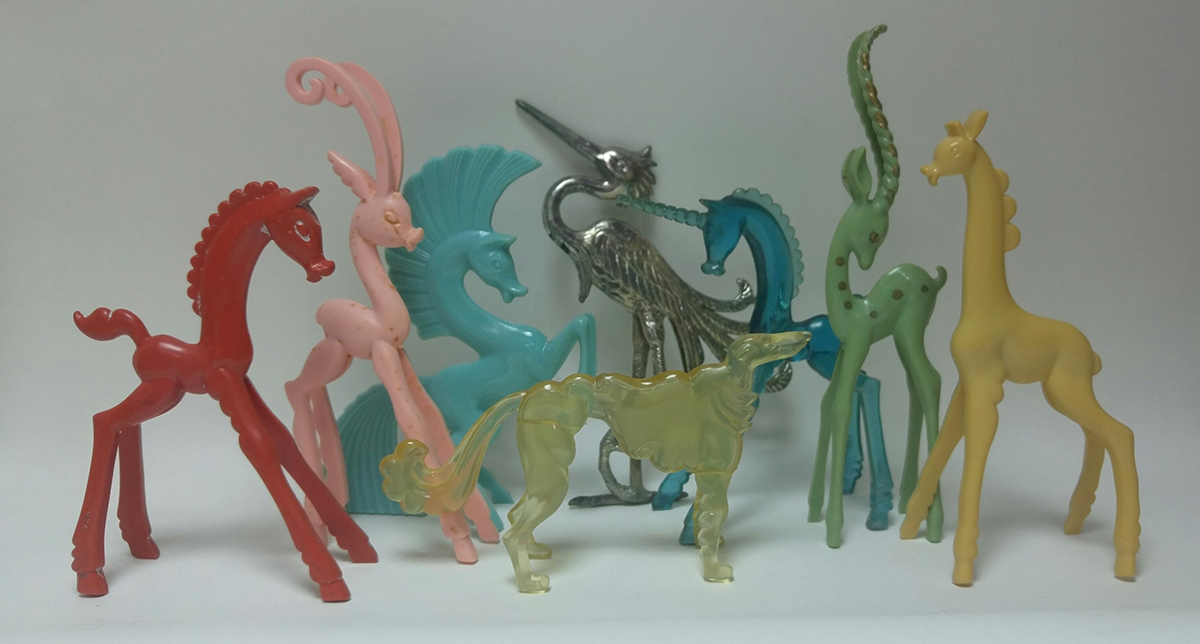
Figuring out the timeline of Manning’s life helped resolve an issue that had puzzled me, to wit, the range of artistic design elements exhibited by Manning’s animals within the fixed style he created. His sculptures are all narrow and nearly all of them are bilaterally symmetrical. They all have a flat inner surface to their legs. A few pieces like the Borzoi and stork have fluid, curvy Art Nouveau stylings while some of the horses, the terrier, and elephant have a carved, geometric Art Deco feel. A couple of his pieces even seem to be a blend of both styles, such as the giraffes and unicorn. Later pieces attributed to Manning have a certain level of mid-century modern kitsch.
The Manning animals were molded in a fabulous assortment of colors, both opaque and translucent. The opaque models seem to be a bit more common than the translucent ones, but both can be found for reasonable prices with patience. The opaque animals appear in a variety of pastel shades like white/cream, tan, pink, sage green, and aqua. Bolder colors like red, maroon, yellow, blue, and black are also common. Some of the opaque pieces test as Bakelite or celluloid using the hot water method though not all. Presumably the celluloid pieces are the oldest, probably molded by Don Manning before Nosco acquired the rights to them. That may be true of the Bakelite pieces as well, but this is only speculation on my part.
 |
| Opaque pieces |
The translucent animals are frequently blue, but you do also see clear, smoky quartz, pale yellow, amber/orange, red, green, and very rarely purple as well. I assume the translucent pieces were made from Lucite or a similar kind of acrylic plastic.
 |
| Translucent pieces |
Some pieces were molded in two-color swirled plastic, a technique that was popular for Bakelite jewelry.
 |
| Swirly black and swirly red |
Both the opaque and translucent models can sometimes be found with painted details---I have seen some with gold accents and some with opaque polka dots, swirls, and flowers.
 |
| Translucent blue and opaque pink with gold trim |
 |
| Opaque red with painted details |
 |
| Two translucent bucks. The frosted version has painted details. |
Some Manning animals were also electro-plated with a chrome-like finish. The ones in my collection were molded from brown or more rarely yellow plastic under the silver finish. They also all have holes in their bellies, presumably because they were dipped for this finishing process. (That is the case with the electro-plated Breyer G1 ASBs anyway.)
 |
| Bright chrome camel and slightly tarnished horse |
Most were just colorful tchotchkes or decorations, but some were made into pins or charms. Both Manning and his brother designed jewelry, so these pieces may be their handiwork.
 |
| Pin |
 |
| Charms |
 |
| Keychain or charm |
 |
| The ornament hooks on these camels may not be original |
The Nosco animals can be divided roughly into the three sizes. Because I have found no other collector resources about these pieces, I’ve taken it upon myself to formalize the names for the scales and the molds. For the latter, I’ve done the best I can to use the names given in the copyright licensing records, and where there are gaps, I’ve used the names that seem to be the most logical.
I have dubbed the three sizes Traditional, Curio, and Mini to help differentiate between them. Categorizing them in terms of size by inches or by generic terms (small, medium, large) is problematic because the antlers on the Curio Buck and Doe pair make them several inches taller than the horses of the same scale, and listing small and medium giraffes implies there must be a large one as well, but there isn’t. My frame of reference is of course the model horse world, so I chose terms that would make sense in that context.
 |
| Traditional, curio, and mini scale |
Traditional Molds
The largest scale consists of just two molds, a Buck and Doe. They look familiar, huh?

A 1946 entry in the Catalog of Copyright Entries (pictured above) lists a license for a buck and doe designed by Don Manning to Nosco Plastics. Presumably this is that pair. They seem to be most commonly found in clear translucent plastic, but I have also seen them in translucent blue, as well as opaque black, red, cream, and matte silver-painted. Other colors likely exist as well. They stand approximately 8 inches tall at the highest point. Mine are marked "Nosco Plastics" on their bellies, "Designed Don Manning" on the inside of one leg, a C in a circle (presumably a copyright symbol) on the inside of one foot, and an N in a circle on the inside of another foot. I also have a completely unmarked clear pair, and some unscrupulous sellers have tried to pass them off as Breyer test runs which of course they are not. There are several key differences between the Nosco and Breyer versions, and if you would like to skip ahead to these, just scroll down the Breyer Connection section below.
Curio Molds
The curio scale consists of 8 molds: a Buck (5.25 inches tall), a Doe (5.25”), a Rearing Horse (4”), a Standing Horse (3.75”), a Unicorn (same mold as the Standing Horse) (4”), a Giraffe (4.25”), a Stork (4.75”), and a Borzoi dog (2.25”). The Borzoi is scaled to fit with the other molds in this group, hence his inclusion here despite his height. These pieces are sometimes marked USA, usually on the outside of a lower leg or hoof, and a few are marked Don Manning as well, usually on the outside of a hind leg. My sister’s Curio Rearing Horse is marked Nosco Plastics on the belly, and my silver Stork has the same notation on the inside of one leg. The Unicorn, Stork, Doe, and Rearing Horse seem to be fairly hard to find.
 |
| The curio scale molds |
This copyright excerpt seems to refer to the Curio Doe, the Mini Rearing Horse, and the Curio Stork based on the measurements of pieces in my collection.
Mini Molds
The smallest Nosco size seems to be the most common. It also consists of 8 molds: a Buck (2.75”), a Camel (2.75”), an Elephant (2.5”), a Giraffe (3”), Rearing Horse (2.75”), a Standing Horse (2.25”), a Monkey (2.75”), and a Terrier dog (1.75”). These pieces are sometimes marked USA, but many of them aren't marked at all. The Monkey is the least common mold in this size.
 |
| The mini molds |
Tiny 12
There is a fourth category of Nosco animals that may or may not be Don Manning designs, but I have not yet found any evidence to direct me one way or the other. I personally am inclined to think that while they are obviously based on Manning's designs and style, and a few are directly copied from his larger pieces, a number of the pieces are probably not be his work. I could be wrong, but that's my gut feeling. These Nosco animals were sold in boxed sets labeled "Tiny 12 Ornamental Figurines," and they are described as "distinctively different what nots." How perfectly apt! The pieces are all miniscule---around an inch tall---and the only sets I've seen so far have been molded in translucent plastic---clear, red, turquoisey-blue, and green. One of the clear sets I have seen has painted details. I believe they were meant to look like the glass animal figurines that were so popular in the 1950s.
 |
| Boxes came in blue or red and say "Mfg. by Nosco Plastics - Erie, PA, USA" along the side |
 |
| A clear set with painted details |
 |
| A close up of the 12 molds |
Stylistically, the animals in this set do bear a resemblance to pieces we know to be Don Manning designs---they're quite narrow and the insides of the legs have the typical flat, unsculpted surface you expect of a Manning piece. And some of the pieces are clearly derived from his designs. The doe and stork are scaled down versions of the curio size pieces discussed earlier, and the monkey is scaled down from the mini version. The giraffe, horse, antelope, and camel are decidedly similar but not quite identical to the mini sized equivalents discussed above. The key design difference, though, is that almost all of these pieces are much more detailed than Manning's typical work. These have fur, feathers, and textures whereas Manning's pieces are sleek, smooth, and mostly lacking in detail. Manning's work is meant to give only a stylized impression of the animal while the Tiny 12 molds are more realistic, albeit in a rounder, cartoony way. Did Manning sculpt them? Did another designer copy his style for these pieces? When were they made in relation to the Manning Nosco animals?
Because they are clearly based on Manning’s style, whether or not he himself had a hand in the design of these specific pieces, I think it’s fairly safe to assume they must date from the 1950s. The packaging does have a certain mid-century modern sort of feel to it. My own set unfortunately offers no copyright dating clues from the text on the box.
Copies of Nosco and Don Manning's Animals
Interestingly, like so many other products in the '40s and '50s, Nosco's designs were copied by various competitors. Some of these copies are apparently still being made in China and Hong Kong.
 |
| Copies of Nosco animals (source: eBay) |
 |
More copies used as drink identifiers. I have seen close-ups of the monkeys,
and they are deliberate (although crude) copies of the Nosco monkey.
(source: eBay) |
Which leads us to the
elephant Buck and Doe in the room.
The Breyer Connection
As described above, Don Manning’s company seems to have gone out of business in 1955. Where he went or what he did after that is a mystery. Nosco Plastics, to whom he licensed some, if not all, of his animal molds, was subsumed by Holgate Brothers in 1959, which was in turn subsumed by White Eagle International. News articles at the time indicated that Nosco was making plastic objects with commercial and industrial uses rather than toys. What then became of the molds for Don Manning's animals? Were they sold? Were they scrapped? Are they sitting in a dusty storage building somewhere waiting to be rediscovered?
Whatever the case, of the many molds discussed and pictured above, only two have ever resurfaced, and very briefly at that. Or did they? The Breyer 1961 catalog supplement pages feature a Golden Buck and Doe that are clearly based on Don Manning designs. Likewise, the 1961 Catalog of Copyright Entries lists the Breyer Buck (#101) and Doe (#102) with copyright dates of March 7, 1961. Interestingly, there is no mention of Don Manning or Nosco.


Breyer catalogs and price lists from the early 1960s are not complete, so some of the dating on this pair is guess work. The Breyer Golden Buck and Doe, generally referred to as the Modernistic Buck and Doe by collectors, may have been available as early as late 1960 to cash in on the Christmas decoration idea despite the 1961 copyright date and catalog. They appear again in the 1963 catalog, but not in the 1966 catalog, the next known full catalog. (The 1964 and 1965 "catalogs" are in fact just supplement pages meant to be added to the previous year's catalog as far as we know.) The last known mention of them is the 1964 price list, so that is likely the last year they were offered. Whatever the case, Breyer's Golden Buck and Doe were only available for a few years at most, and then they disappeared. The molds have never been used again.
It has long been assumed that Breyer bought the Manning molds and used them to produce their own Golden Buck and Doe, and I had no reason to think otherwise until this past Christmas when my sister gave me the translucent Nosco pair mentioned at the beginning of this post. I noticed right off the bat that not only are they slightly larger than Breyer's pair, but they also have turned heads. Breyer's pair is facing straight ahead.
The head turn on the Nosco pieces is easy to see in person, but it's often very hard to discern in photos unless they are seen directly from the front or back or from above. Despite having been collecting and looking for these Nosco pieces on and off for several years, I never noticed this distinction until I had a pair in hand. Now that I know to look, all of the other large bucks and does I've found pictures of appear to have turned heads as well.
 |
| Breyer buck on the left and Nosco buck on the right |
 |
| The Nosco buck's head turns to the left (usually) |
 |
| Nosco doe on the left and Breyer doe on he right |
 |
| The Nosco doe's head turns to the right (usually) |
If Breyer had purchased the Nosco molds at some point, why would they have gone to the time and expense to retool them to straighten the heads? And furthermore, why would the Breyer pieces be smaller than the Nosco pieces if they came from the same plastic injection molds? The only answer that fits is that Breyer never purchased the Nosco molds. They simply altered existing Nosco pieces they acquired and made molds from them as we know
they did with so many other pieces in the 1950s and 1960s. That would explain the smaller size for sure---mold reduction is a well-known result of the re-casting process. The heads may have been straightened to make molding easier and/or because Breyer was still somewhat wary from having been recently
sued by Hagen-Renaker for copyright infringement in 1959. With both Manning and Nosco seemingly out of business or at least no longer in the toy business, Breyer may have felt they could fly under the radar with close-but-not-quite copies.
As far as we know, the Breyer Modernistic Buck and Doe were only ever released in gold---they were molded in white tenite acetate plastic and then painted gold, just like the decorators. They also have the round Breyer mark on the inside of one of the hind legs. As I mentioned above for those who skipped ahead to the Breyer part, beyond the obvious critical differences (size and (usually) turned heads), the Nosco pieces are molded in colored or translucent plastic. Breyer rarely molded anything in colored plastic until the 1970s oil crisis necessitated it, and they used tenite acetate plastic, not Bakelite or celluloid. Furthermore, Breyer never released any translucent pieces until 2006. So while some of the Nosco bucks and does apparently do not have any identifying marks, don't be fooled by uninformed or dishonest collectors trying to pass off unmarked Nosco pieces as Breyer test runs.
I hope you've enjoyed this (unexpectedly) in-depth post about Don Manning, Nosco, and their connection to Breyer. I would love to know more about Manning's Nosco creations, so please feel free to comment below or email me at mumtazmahal (at) gmail (dot) com if you know more. I would be especially interested in old documents pertaining to these pieces like catalog, newspaper, or magazine ads; old packaging; price lists; a boxed Tiny 12 set in a color other than clear, etc. I am also very interested in buying Nosco pieces in colors I don't have (as is my sister), so please also feel free to contact me if you have any pieces for sale.
* (Sorry, Bangles, I won't apologize for this pun. It's awesome.)
** Many thanks to my chief enablers, my sister Sarah who helped me with my research and my friend Diana who helped me track down Manning pieces on eBay under unlikely titles!
----------------------------------------------------------------------------------------------------------------------
Sources cited:
1. Herdie, Isabel. “Eastman Chorus, Symphony to
Present Choral Work; Art Awards Announced.” Democrat
and Chronicle. (Rochester, NY), May 8, 1938.
2. Ibid.
3. Record, Don. “Manning Brothers, Artists, Experts
in Metallurgy Operate Unique Mold Shop.” Democrat
and Chronicle. (Rochester, NY), January 8, 1950.
4. Ibid.
5. Staff. “Firm Here Gets Contract to Build Industry
in Haiti.” Democrat and Chronicle.
(Rochester, NY), October 4, 1947.
6. Record, Don. “Manning Brothers, Artists, Experts
in Metallurgy Operate Unique Mold Shop.” Democrat
and Chronicle. (Rochester, NY), January 8, 1950.
7. Staff. “Erie Firm is Sold to Holgate Bros, Co.” The Kane Republican. (Kane, PA), January
9, 1959.
8. Staff. “News of the Past.” The Kane Republican. (Kane, PA), April 11, 1966.
9. Staff. “Holgate Brothers, One Time Kane Leader,
Is Listed in Erie Deal.” The Kane
Republican. (Kane, PA), May 26, 1961.
10. Notice for merger, The Pittsburgh Press, (Pittsburgh, PA), January 29, 1964.
11. Public auction advertisement, The Los Angeles Times, (Los Angeles,
CA), January 9, 1977.
12. Record, Don. “City Firm Starts Industry in
Haiti.” Democrat and Chronicle.
(Rochester, NY), May 4, 1948.