Tuesday, June 7, 2016

Collectibility test: Good things come in rare boxes

4) List Breyer packaging types in chronological order from earliest to latest (ending with the 1980's brown picture boxes). Provide date ranges to the best of your knowledge.
Examples of vintage Breyer packaging
Any viewer of Antiques Roadshow can tell you that vintage toys and collectibles with their original boxes are usually worth considerably more than those without them. Though this has long been common knowledge to collectors of dolls, toy trucks, vintage piggy banks, and so on, it has been a bit slower to resonate in the model horse hobby.

A few years ago at a large live show, I tried to explain to the show hostess the importance of original packaging as it relates to collectibility showing and judging. When I told her that some rare boxes were worth substantially more than the actual models that came in the boxes, in my case, a Breyer Mountie with the original cardboard picture box, she scoffed and told me she didn't believe that.


I found her attitude quite disheartening, but eBay prices have absolutely borne out my assertion. For example, a mint Mountie set sans box might fetch around $75-100, but the handful of sets with boxes I've seen sell have brought well over $500. Recently, a Mahogany Proud Arabian Mare in a blister seal shadowbox sold for more than $5000. In counterpoint, the mare alone without the box can be acquired for as little as $20-30.


Showcase boxes, most of which feature run-of-the-mill $20 models like Clydesdale Stallions or Family Arabians routinely sell for over $1000. And just to really drive the point home, a touchability box with no model in it whatsoever sold for more than $1200 a few years ago. I could quote many more examples, but you get the point.

That said, this question about original packaging is important for collectibility judges for two reasons: 1) because original boxes are an integral part of the collectibility and provenance of a piece, and 2) because it demonstrates a fundamental understanding of Breyer's history.

1950s mailer boxes with rare grooming kits
So, in the beginning (the 1950s), there were cardboard mailer boxes---usually brown or white. Many of them had nothing more printed on them than Breyer's address and To/From blanks. They were sealed with brown tape, and the model's number and sometimes color or name were stamped on the top, usually on the tape. Most are sealed with heavy staples on the bottom. Some of these early boxes featured line drawings of the models inside. The mailers in general are not wildly rare, but finding them for certain models, especially those made only for a short time, is quite challenging.

A plain To/From mailer with the PAM grooming kit
An example of a mailer with a line drawing
A rare mailer for a Wedgewood Running Foal
In the mid-1950s, Breyer introduced colorful boxes for their models with TV tie-ins. Breyer's horse and rider sets were not directly based on any of the popular cowboy shows then popular (Hartland beat them to that market), but they did produce generic riders on Furies and Western Ponies such as the Indian, Lucky Ranger, and the Mountie seen above. These boxes are quite scarce. Breyer did create licensed reproductions of TV stars like Lassie and Rin Tin Tin as well as Corky the Circus Boy. Lassie and Rinty came in brightly colored illustrated boxes which are hard to find. Interestingly, the only Corky and Bimbo box I know of is a simple mailer with a line drawing of the elephant on it (pictured in the group shot at the beginning of the post).

Lucky Ranger box
These hard to find boxes for TV stars Rin Tin Tin and Lassie were also
boldly colored.
The animal molds issued by Breyer were also sold in cardboard mailers, some with line drawings. Surprisingly, they were sold this way well into the 1990s, almost 10 years after the introduction of the now ubiquitous clear-fronted yellow boxes.

A 1960s Brahma box
The cardboard mailers remained in use for the horses into the early 1970s, but Breyer did experiment with different types of packaging near the end of that period. The 1968 Breyer dealer catalog references a new style of packaging that was first pictured on a January 1969 price list. These so-called "touchability" boxes were an experiment in display packaging that ultimately backfired. The boxes, which consist of a cardboard back surrounded by a raised cardboard frame, were open with no cellophane or plastic covering. The models were secured to the box only with elastic bands around the legs and body. While this did allow buyers to see exactly what they were purchasing, it also meant the models could easily be damaged. Very few examples of these boxes have been found by collectors, and based on information turned up by Breyer historian Nancy Young, only Family Arabians were ever released in this short-lived packaging.

Touchability box and alabaster Family Arabian Stallion
By 1970, Breyer had come up with another new display packaging style, the showcase collection box, that allowed buyers to see the model without being able to handle it. These clear plastic boxes have been found with a variety of models in them, and while they are easier to find than touchability boxes, they are still quite rare and desirable. Unfortunately, the plastic comprising the boxes is rather flimsy and is prone to cracking and yellowing with age or rough handling. These boxes were discontinued in 1972 because, according to Peter Stone, they were too expensive and did not sell well enough to justify their continued use.

Clydesdale Stallion in showcase collection box
An optimistic ad featuring the Showcase Collection

By 1972, Breyer had given up on see-through packaging and had returned to cardboard boxes. These "white" boxes featured a reversed color photo of the model inside against a line-drawing background in various colors.

An assortment of white boxes from the 1975 Breyer dealer catalog
Appaloosa Gelding with white box
Breyer also issued patriotic red, white, and blue boxes for the Elephant and Donkey models during the 1976 election year. Like the white boxes above, these are reasonably easy to find.


The 1970s also saw Breyer's first foray into carry case packaging. These cardboard boxes were the most colorful yet released by Breyer, and their plastic handles allowed kids like me to tote their Breyer models easily to friends' houses for playtime. The cases held individual models as well as sets of multiple horses. Some of the sets came with accessories such as books about the real horses (Lady Phase and Stud Spider), a halter (Proud Arab Mare sets), blankets (Clydesdale Mare and Foal set), a doll and tack, etc.

Hard to find PAM, halter, and carry case set made 1972-1973 only
This Lady Phase gift set came with a book and blue ribbon. Some sets also
included a 45 rpm record with a song by Lynn Anderson.
Breyer issued a number of gift sets featuring a book by Marguerite Henry
and the matching model, such as this Misty of Chincoteague set.
A set featuring a horse, tack, and doll introduced in 1980

A Classic Arabian family with a carry case box
This packaging is unique to the Benji and Tiffany set

In the mid-1970s, Breyer issued a number of their smaller models on "blister cards"---cardboard backing with the model secured under a molded plastic bubble. These included the Classic Arabian and Quarter Horse foals in a variety of colors, the Stablemate line which was introduced in 1975, and Benji the movie star dog. (Benji's girlfriend Tiffany was intended to be released individually on a blister card as well, but it never happened due to poor sales of the paired set above.) This display packaging was a great success and is still in use today for Stablemates and other small models.

Palomino, chestnut, and black Classic Arabian Foals on blister cards
The earliest Stablemate packaging had a plastic tray to help keep the
model in place under the plastic bubble cover. This Arabian Stallion
was sold as a stand-in for Citation whose mold was not ready.
Breyer didn't entirely give up on line-drawing mailers for horses in these years. This rare Stablemate box was sold through the Sears catalog as a special run in 1975.


And this Proud Arabian Mare and English Saddle set was also a special run for Sears in 1977.

The leather of this saddle is too brittle to correct the position of the girth.
The mid-1970s also saw the introduction of the Classic Thoroughbreds and the Lipizzaner which were sold individually in colorful picture boxes with side panels featuring information about the real horses. The boxes were first issued on a white background and later on brown. With the rising popularity of Maureen Love molds, these boxes are becoming harder to find (or at least more expensive to acquire).


In the late 1970s, Breyer experimented with a third style of display packaging for traditional scale models, the blister wrap shadow boxes. They are square or rectangular cardboard shadow boxes in which the model is affixed to the back by a vacuum-formed plastic film. Like the earlier attempts at display packaging, these boxes were also short-lived. Despite instructions on the back of the box on how to safely remove the models, they were very easily broken when collectors tried to remove them from these boxes.

An Overo Paint in a blister box
Breyer returned to solid cardboard boxes once again after this third failure with see-through packaging. From approximately 1978-1981, these boxes were made in shades of orangey or tannish-brown featuring a reversed color photo of the model inside. We can date the change from white bordered boxes to brown to 1978 because San Domingo, a model that was new in 1978, has been found in both styles of box.

An alabaster PAM box
In 1982, while the cardboard box design remained the same, the box art changed in color and design as seen in the photo below. The sides of the box also often had added blurbs about the real horse or the breed the model represented.

A Standing Stock Horse Foal (photo from eBay)

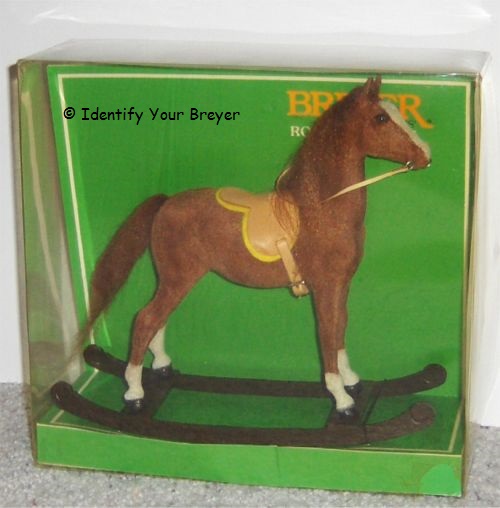
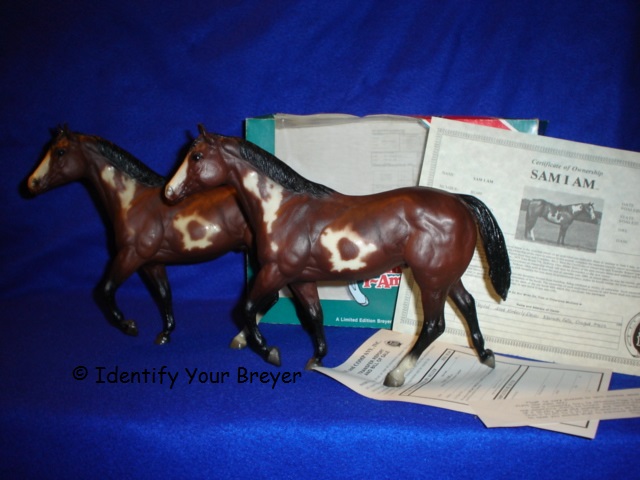
In the 1980s, Breyer once again experimented with see-through packaging. The flocked chestnut Rocking Horse (1985) and Kipper (1986) were both issued in a green backed box made of a clear plastic top that fit over the plastic bottom in the same fashion as the cardboard boxes. The Kipper boxes are the same size as the Rocking horse boxes and were probably left overs. Sam I Am was issued as a special run in a similar (but far more flimsy) box in 1984.

Kipper
Cardboard mailers were used in the 1980s and into the 1990s as well for special runs from the various holiday catalogs. Some featured line drawings and some had labels affixed with color images of the models. These boxes are all fairly common.

In 1986, Breyer introduced the now well-known clear-fronted yellow boxes, their first really successful see-through packaging design for the large scale models. The boxes have become more colorful over the years, but the same basic design has lasted now for going on 30 years.

And there you have it! A (hopefully) mostly comprehensive list of Breyer packaging from the beginning until the advent of the yellow boxes. Coming next will be a post about the rising popularity of vintage customs and how collectibility applies to them (before we return to the judging test questions). Enjoy!

Wednesday, April 27, 2016

Collectibility test: OF flockies vs aftermarket/CM flockies

Flockies have surged in popularity lately, driven largely by some interesting models from the liquidation of the Black Horse Ranch collection last summer, and prices for them have likewise gone astonishingly high. There has been, however, a great deal of confusion about what constitutes an original finish flocked model versus a custom or aftermarket piece. The answer, happily, is pretty straightforward.

If a flocked model appeared as a regular run in a Breyer catalog, as a special run in the Sears, J. C. Penneys, or Montgomery Wards holiday catalogs, or as a BreyerFest special run, it is considered original finish. If it did not, it's aftermarket or custom. The distinguishing factor is the intent behind the models' creation---the catalog issue models were specially ordered by Breyer and retailers in a collaboration with an Indiana company called Riegseckers. All other flockie models were produced produced independently---with no orders or input from Breyer---by a variety of family business and hobby customizers including Riegseckers, Eighmeys, the Diercks and Algyre family, and many others.

1984 Sears SR Flocked Misty and Stormy
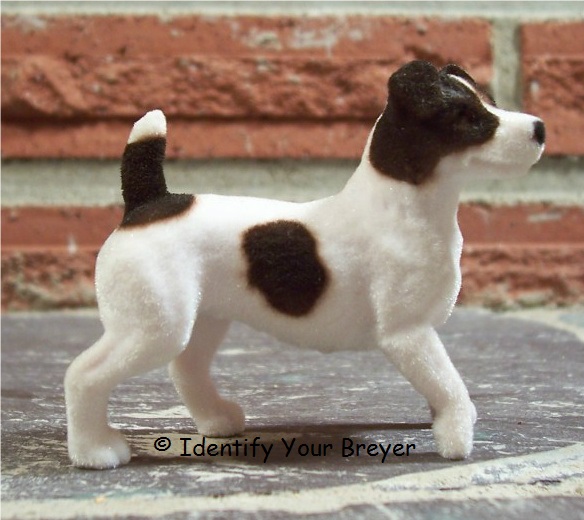
The official OF flocked models feature fuzzy coats, haired manes and tails, and sometimes glass eyes. (The Stablemates and Jack Russell from BreyerFest 2001 may have been flocked by a company other than Riegseckers. I'll update this post if I can find the answer.) The following is a list of all of the OF flocked models with links to pictures on the wonderfully handy Identify Your Breyer website.


Traditional Scale Flockies

Clydesdale Mare
---1983 (Sears): Flocked bay with ribbons and bridle

Fighting Stallion
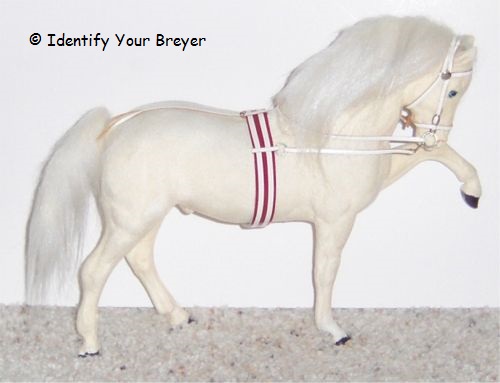
---1985 (J.C. Penneys): Flocked white with bridle, surcingle, red plume, and ringmaster Ben doll

Legionario
---1985 (J.C. Penneys): Flocked white with bridle, surcingle, red plume, and tutu Brenda doll

Misty
---1984 (Sears): Flocked palomino pinto sold with foal, Stormy (pictured above)

PAS (bay, chestnut, buggy)
---1983 (Montgomery Ward): Flocked chestnut (same as the one sold with the buggy below)
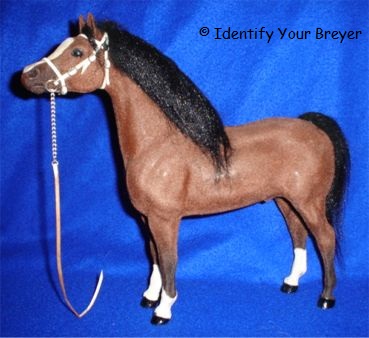
---1984 (Montgomery Ward): Flocked bay with bridle and lead rope
---1984 (Montgomery Ward): Flocked chestnut with harness and buggy

Rocking Horse (Saddlebred Weanling mold)
---1985-1987 (Regular Run): Chestnut with bridle and saddle on rockers
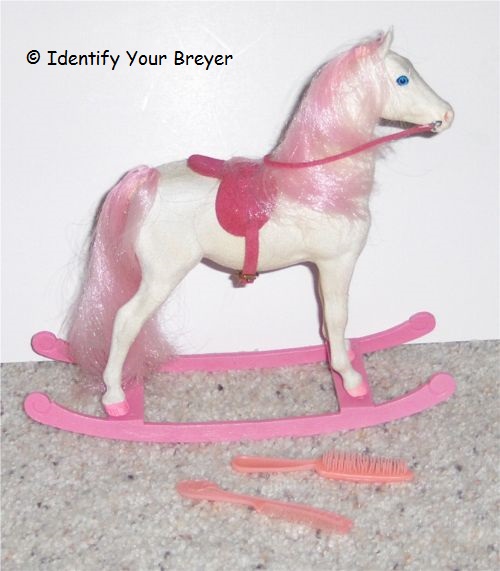
---1985 (JCP): White with pink mane and tail, pink tack
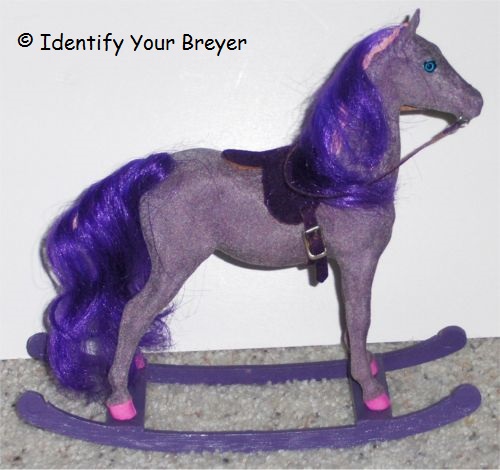
---1985 (JCP): Lavender with purple mane and tail, purple tack
---1985 (Sears): Black blanket appaloosa, black tack

Running Foal
---1984 (JCP): Flocked Palomino (sold with matching mare)
---1985 (JCP): Flocked white with pink mane and tail (sold with matching mare)
Running Mare
---1984 (JCP): Flocked Palomino (sold with matching foal)
---1985 (JCP): Flocked white with pink mane and tail (sold with matching foal)

Running Stallion (Unicorn)
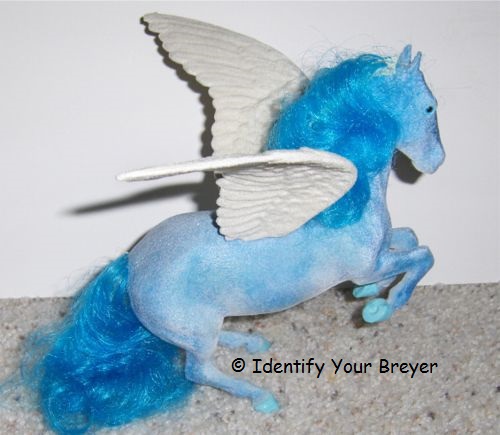
---1985 (JCP): Flocked turquoise/light blue unicorn with darker turquoise mane and tail

Smokey
---1984 (JCP): Flocked white unicorn with light grey mane and tail

Stormy
---1984 (Sears): Flocked chestnut pinto sold with mare, Misty (pictured above)


Classic Scale Flockies

Black Beauty
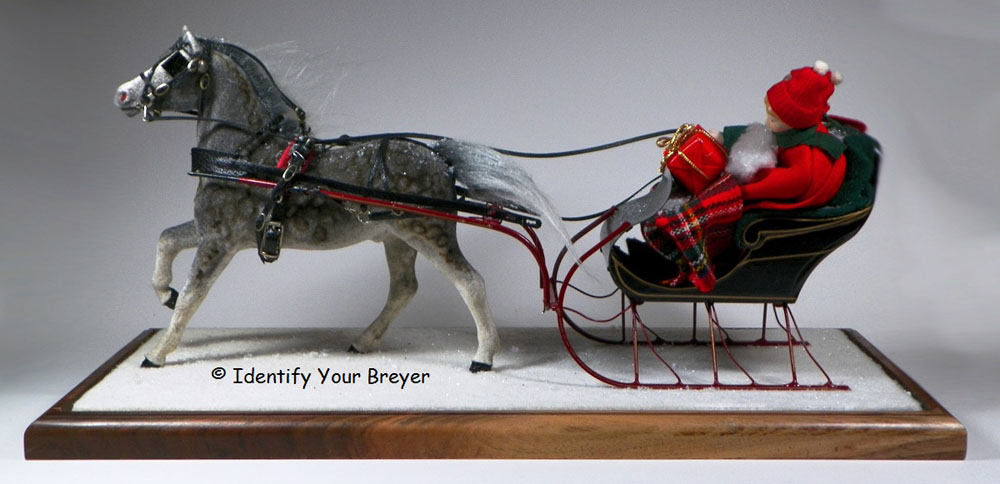
---1984 (JCP): Flocked dapple grey with sleigh

Black Stallion
---1984-1987 (RR): Flocked bay with doctor's buggy

Duchess
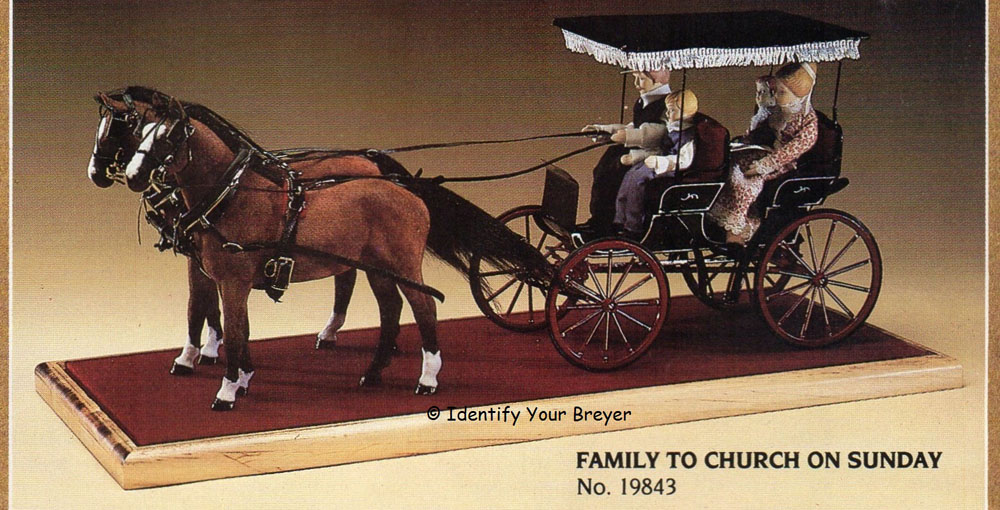
---1984-1987 (RR): Flocked bay (with matching teammate flocked bay Jet Run) and 4-wheeled Sunday church buggy

Jet Run
---1984-1987 (RR): Flocked bay (with matching teammate flocked bay Duchess) and 4-wheeled, roofed Sunday church buggy

Johar
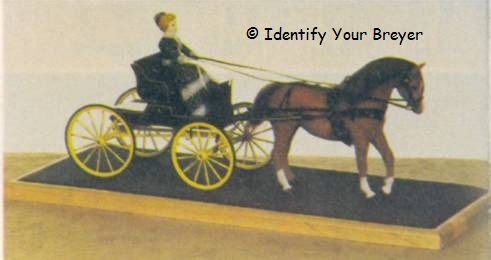
---1984-1987 (RR): Flocked chestnut with 4-wheeled open buggy

Keen
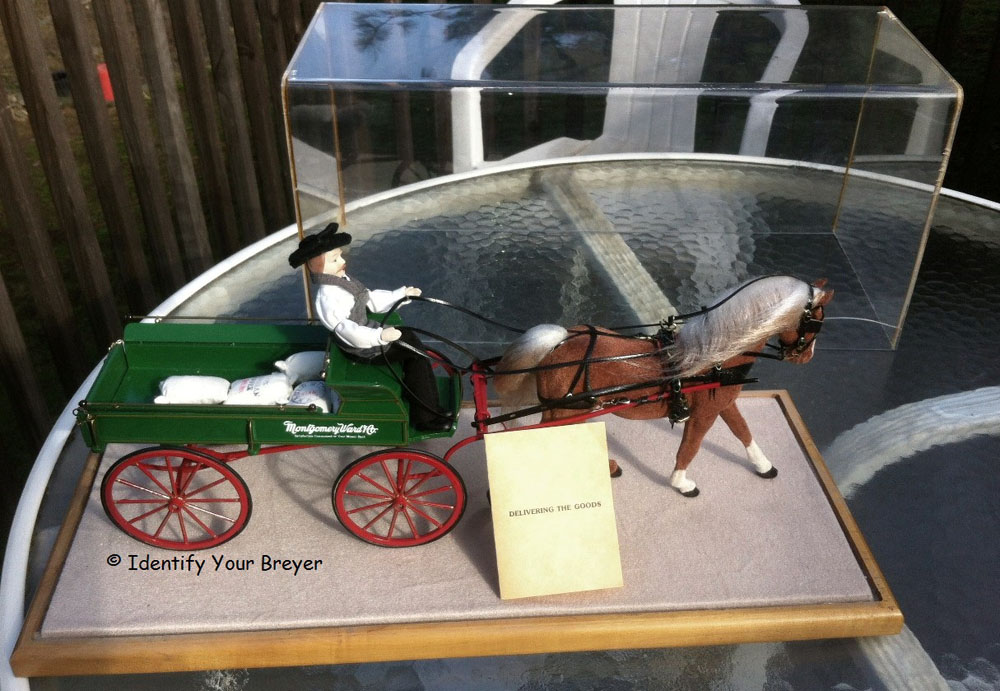
---1984 (MW): Flocked flaxen chestnut with green delivery wagon (says MW)
---1987 (RR): Same as above, but wagon is painted solid green

Lippizan (Pegasus)
---1985 (JCP): Flocked turquoise/light blue unicorn with darker turquoise mane and tail

Merrylegs
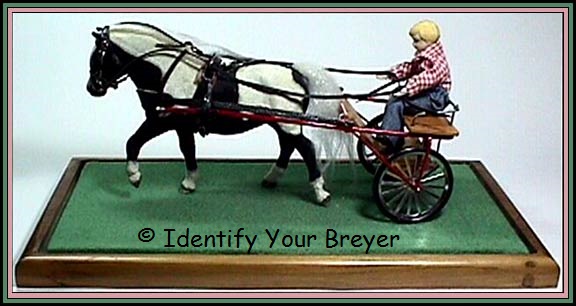
---1985 (MW): Flocked black pinto with pony cart
---1987 (RR): Same as above


Other Scales

Companion Animal Jack Russell
---2001 (BreyerFest): Flocked brown and white (came with flocked SM G2 Morgan)

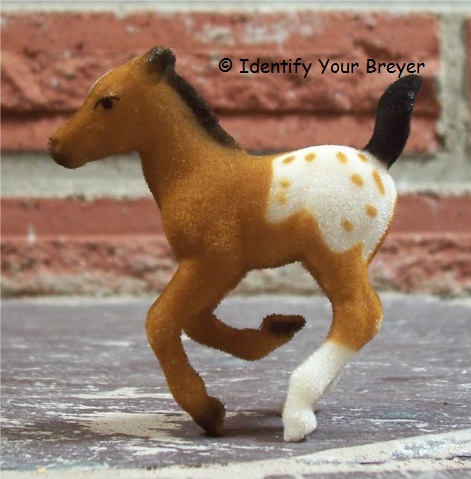
Stablemate G2 Arabian (Rearing)
---2001 (BreyerFest): Flocked chestnut pinto (came with flocked SM G2 Galloping Foal)

Stablemate G2 Galloping Foal
---2001 (BreyerFest): Flocked buckskin blanket appaloosa (came with flocked SM G2 Arabian)

Stablemate G2 Morgan
---2001 (BreyerFest): Flocked steel grey (came with flocked Jack Russell companion animal)


Custom/Aftermarket Flockies

Many collectors are not familiar with the history of flocked models in the hobby, and in my experience, that's been the source of confusion about what is or is not an OF flockie. As I mentioned above, a number of companies, families, and miscellaneous hobby customizers made flockies. Because of this, aftermarket flockies probably outnumber OF flockies by quite a bit. Riegseckers is best known because they produced the OF runs for Breyer, but they made thousands of aftermarket flockies as well. Mel Riegsecker, the company founder, grew up on a farm near Shipshewana, Indiana, but rather than continue in that business, he became an entrepreneur. His family now runs a cabinet making business, a restaurant, and more. Mel got his start though making miniature harnesses and vehicles that he hitched to Breyer models. Riegseckers often flocked models, sometimes customizing them first with lowered heads or mule ears and the like. Their models were available in the '80s and '90s, and if you could dream it, they could make it for you.

Similarly, Eighmey's Wagon Shop flocked thousands of models and produced harnesses and vehicles as well. They used to have a booth at BreyerFest in the early 1990s, and I regret not taking a picture of it when I had the chance. Suffice it to say, it was an impressive sight with stacks of flocked Adios mules, Quarter Horse Gelding mules, all of the draft horse molds in any color you could think of, and more. The Diercks and Algyre family likewise produced many similar models, but their models usually had flocked over manes and tails rather than flowing mohair like Riegseckers or Eighmeys. Various customizers dabbled in flocking as well, some even creating dappled models. Because the highest volume producers were making and selling their models in farm country (Indiana, Iowa, etc) the vast majority of flockies to be seen are draft horses or mules.

Not surprisingly, owing to confusion about what constitutes an OF flockie, I've seen more than a few collectors claiming that their aftermarket flockies are test runs, OOAKs, or rare runs of only a few models. Hopefully, most are not doing so with the intent to deceive, but a few are. Without irrefutable documented provenance---at this point, I wouldn't accept anything less than a letter from Mel Riegsecker or Peter Stone certifying that a particular model was a test submitted to Breyer for approval---all of these so-called tests or rare flockies are just aftermarket customs. So do your homework and don't be fooled!

Now, that said, an aftermarket flocked model is not a bad thing by any means. As we've seen, prices for them are sky high, and with vintage custom collectibility becoming a thing (more on that in a future post), there will absolutely be a place for them at live shows and in collectors' herds. I show my own aftermarket flocked mule (below) in vintage custom classes, and she gets lots of admiration even if she doesn't win. (She is adorable after all.)


A pair of customized and flocked Belgians, possibly by Reigseckers (source: eBay)

Many hobbyists tried their hand at flocking as well, and they didn't just stick to horses!
Aftermarket flocked cow (source: eBay)
Some aftermarket models do not have haired manes and tails. They're
just flocked over the sculpted mane and tail. Probably D &A. (source: eBay)

Some aftermarket models are more popular than others. Drafters, Adios models, and Stablemates seem to be of particular interest to collectors.

Adorable flocked G1 SM Drafter (source: eBay)
Stay tuned for a blog about rare Breyer packaging next time around. Thanks for reading!

Monday, October 5, 2015

Collectibility test: Companies Breyer copied

Question 2 from my sample Breyer collectibility test. 

2) Name four companies Breyer copied models from in the 1950's and/or 1960's.

This is a bit of a trick question in that there are more than four answers. 

Hartland: Though the exact details remain a bit murky, we know that Breyer took over a contract with Mastercrafter Clocks in 1950 to produce a plastic horse to stand over said clocks on a faux-marble base. The contract originally belonged to Hartland, and while the reason for the split between Hartland and Mastercrafter has been lost to time, the horse clocks remain. We don't know if Breyer was asked to duplicate the Hartland horse as closely as possible or if they simply chose to do so, but whatever the case, Breyer's Western Horse is a very, very close copy of Hartland's "Victor" horse. The differences are subtle, but they include slight differences in the hooves, mane and tail, bridle, and breastcollar. (But more on that in an upcoming post.)
Hartland on the left; Breyer on the right

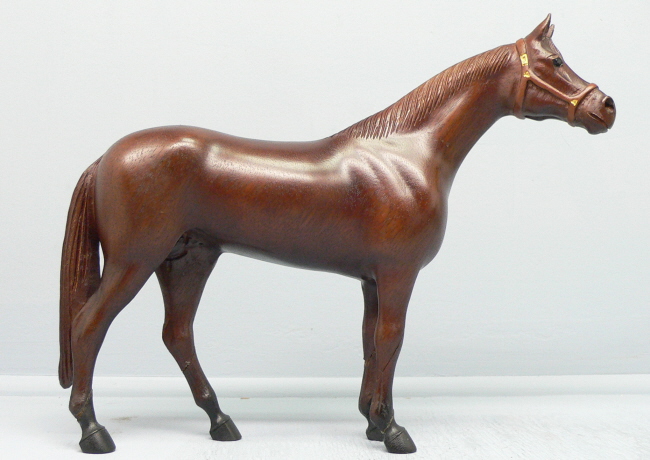
Grand Wood Carving: The Grand Wood Carving Company of Chicago began producing a line of wooden horses in 1939. A number of them were portraits of famous racehorses from the 1930s, 1940s, and early 1950s, such as War Admiral, Armed, and Native Dancer. At some point in the 1940s, they produced a model of Whirlaway, the 1941 Triple Crown winner. And in 1954 or 1955, Breyer released their Racehorse, an obvious copy of the GWC piece. A few years later, they also debuted their woodgrain color, very likely inspired by the real mahogany GWC pieces.
GWC Whirlaway on the left, Breyer Racehorse on the right
Breyer's traditional Man O' War model, first issued in 1967, was also obviously inspired by GWC's own portrait model of the great horse. More on that here.

Boehm: Though probably best known for his birds, Edwin Marshall Boehm also sculpted a number of animals for production out of his New Jersey porcelain art studio. One such was a Boxer dog first issued circa 1952. Only two years later, Breyer issued a copy directly molded from the original Boehm piece. Though the Breyer Boxer's paint job was not as detailed as that of the Boehm piece, it too was clearly copied from the original.
Boehm on the left, Breyer on the right (Photos via etsy)
In 1950, Boehm produced a walking Hereford Bull which will also be familiar to Breyer collectors. Breyer's copy was first released in about 1956 and was a direct copy like the Boxer. Some of Breyer's Herefords were chalky and glossy to duplicate the look of porcelain.
Boehm on the left, Breyer on the right
In about 1956, Breyer also released their Brahma bull which while similar to the earlier Boehm piece was not an exact copy. Perhaps Breyer was not able to acquire a Boehm to copy? Maybe Boehm had issued a cease and desist? Whatever the case, Breyer's Brahma has very similar foot and tail placement, but small differences are present---the Boehm has a turned head, slightly different horns, different detail in the wattle of the neck, etc.
Boehm on the left, Breyer on the right
Rumor has it that Breyer's Small Walking Angus was also copied from a Boehm piece, although this is the least similar of the four pieces mentioned here. Boehm's Angus is standing while Breyer's is walking, the Breyer Angus has a halter, and Boehm's piece is a trifle crude in comparison. Breyer's Angus in fact looks like a pointed down and slightly modified copy of the Walking Hereford. Breyer's Angus was not released until 1960, after Breyer had dealt with a copyright lawsuit from Hagen-Renaker, so perhaps they did not copy the Boehm closely so as not to repeat that experience.


Boehm on the left, Breyer on the right
Lastly, Boehm copies can not be discussed without mentioning Adios. Contrary to popular opinion, Breyer did NOT copy Boehm's Adios model. In fact, both the Breyer and Boehm piece were copied from the James Slick statue of the horse at the behest of his owner, Delvin Miller, at the same time.


Hagen-Renaker: Speaking of Hagen-Renaker, it is well-known that Breyer's Proud Arabian Mare, Proud Arabian Foal, and Family Arabian Stallion were copied from Hagen-Renaker's Large Zara, Zilla, and Amir. HR sued Breyer mostly successfully in 1959, resulting in the discontinuation of the PAM and PAF. The FAS was deemed not similar enough and remained in production.
HR Zara on the left, Breyer PAM on the right (Zara photo courtesy of Ed Alcorn)
In the 1970s, Breyer legally re-released the PAM and PAF, and they also obtained a lease from HR to produce a number of other HR designs in plastic. These include the Classic Arabian, Mustang, and Quarter Horse families, Kelso, Man O' War, Terrang, Swaps, Silky Sullivan, and the G1 Stablemates. The Little Bit Thoroughbred model sculpted by Chris Hess was probably loosely based in the G1 Seabiscuit.

Rosenthal: Breyer's (Large) Poodle, released in 1958, was another direct copy, this time of a piece sculpted for Rosenthal by Professor Theordor Kärner at an unknown earlier date. Rosenthal's Poodle was for sure available in the early 1950s in white and dark grey/black, colors which Breyer also copied.

Rosenthal Poodles in white and dark grey/black
Breyer Poodles in white and black
Next time, I'll tackle Breyer packaging from the 1950s-1980s. Lots of interesting and weird stuff to be discussed!

Monday, September 14, 2015

The best week ever

On June 6th, American Pharoah raced into the history books with a five length romp in the Belmont Stakes, securing the first Triple Crown victory in 37 years. As a lifelong horse racing fan, his win was an incredible thrill that I will never, ever forget. I shrieked, I cried, and I rewatched the race over and over that week. It still gives me chills---it always will.

The following Friday afternoon, still happily buzzed by an event I had begun to despair I would ever witness, I found myself noodling around on the internet and chatting with my mom. She asked me to take another look at an item that was part of the Hagen-Renaker archives estate dispersal, and as the eBay home page loaded, it flashed up a group of suggested auctions based on my interests and buying habits.

My heart nearly stopped as I glanced at the most recently listed items. There, staring me in the face with a buy-it-now of $15.99, was a random horse-shaped-object paired with my holiest of holy grails, a woodgrain Proud Arabian Foal. My hands went clammy and started to shake, but my fingers flew across the keys and completed the sale in seconds.

The few days that followed waiting for USPS to deliver the box felt like the longest I'd ever endured. I was terrified the foal would somehow be lost or misdirected or broken in transit. On Tuesday of the next week, the box was listed as out for delivery, and I was on edge all morning waiting for the mailman to reach my work place. Just after lunch, I heard the telltale rattle of a hand truck exiting the elevator. I grabbed my key to the mailroom and flew up the stairs. Sure enough, my box was waiting. 


My family has had some amazing luck finding rare models over the years in flea markets and antique malls, but this little filly is hands down the best find of my life. I can still hardly believe it. Somebody pinch me!

Wednesday, September 9, 2015

Collectibility test: Breyer history timeline

Here is the first question and answer from the sample Breyer collectibility test I wrote about in my last post.

1) Create a Breyer history time line including the following information (please provide the year or years as close as possible): First Breyer horse issued, Reeves takeover, chalky era, decorator era, blue ribbon sticker era, first JAH issued, first BF, woodgrain era, general introduction of round Breyer stamp, general introduction of USA stamp, catalog year each of the four major scales was released (traditional, classic, little bit, stablemate)

When I posted the list of test questions on Facebook, I was bit disappointed to see some responses from collectors who couldn't understand the importance or relevance of this question. In my opinion, how can a person understand the collectibility of the models a company has produced if they don't have a fundamental understanding of the history of the company and the events that drove the changes to its product line?

Knowledge of Breyer's history is ultimately how we determine rarity after all. This question serves to provide a basic, baseline point of reference to determine how knowledgeable a judge is likely to be about the finer points of collectibility. In my opinion, anyone who wishes to judge Breyer collectibility should be able to reel off the answers to this question quickly and easily.
The very beginning, the Western Horse Clock

They are as follows:

1950 - First Breyer horse issued (which was the traditional scale Western Horse)

1959-1973 - Woodgrain era

1960 - General introduction of round Breyer stamp

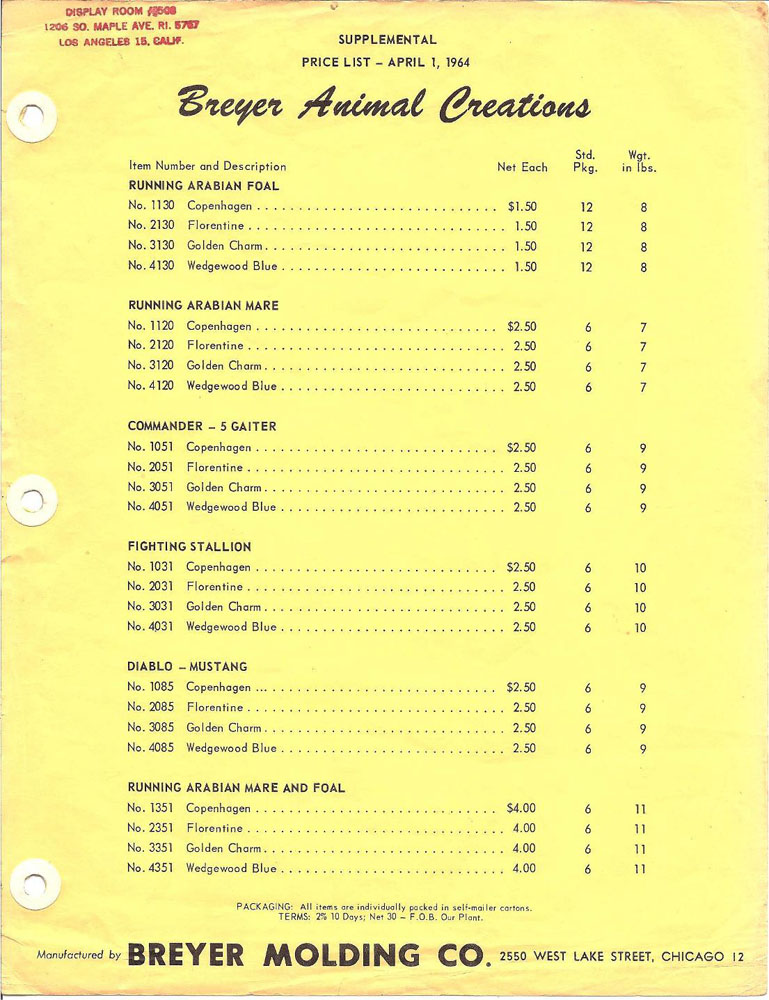
1964 (approximately) - Decorator era (For sure they were available in 1964 as we have a price list and sales sheet from that year listing them. They may have been available as early as 1963. The decos however were duds and were likely discontinued at the end of 1964 after poor sales.)

Early 1960s - 1971 - Blue ribbon sticker era (The smaller stickers came first; the larger stickers were later.)

1970 - General introduction of USA stamp

1973 - First classic scale models introduced (Classic Arabian Family)

1973-1975 (roughly) - the chalky era (triggered by the 1970s oil crisis)

1975 - First Just About Horses issued; first Stablemates released

1984 - Reeves takeover (The factory subsequently moved from Chicago to New Jersey.); Little Bits released

1990 - First BreyerFest


Next time, a look at some of the molds that Breyer copied from other manufacturers.

Tuesday, August 25, 2015

Judging Breyer Collectibility: Basic Required Knowledge


Recent discussions on Facebook about judging (triggered by great disparity in NAN results, a subject for another day) have once again brought up the topic of judging certification and what criteria we should be using to judge various divisions at shows. While these conversations do produce useful discussion, they have a tendency to stall out because a certain segment of the hobby demands to know who has the right to assess their knowledge (or lack thereof).

I find this incredibly dismaying because it suggests to me that those who make these complaints are likely not confident in their abilities as a judge and that they are unwilling to acknowledge it or to seek greater education to remedy it. This attitude is sadly what killed off Project '88, the hobby's best attempt at a program to provide basic judging certification. This attitude is frustrating as well because education is absolutely key in this hobby---there is always something new to learn. Our knowledge of equine color genetics has improved radically in the last 15 years for example, fashions and trends are forever changing in the real horse show world, and new, previously unknown models or documentation surface periodically via eBay, estate sales, etc. But I digress.

To move the FB discussion along, Lesli Kathman devised a sample judging test for breed halter with basic knowledge questions about anatomy, bio-mechanics, and color that any reasonably knowledgeable judge should be able to answer. I decided to follow suit and composed a sample test for Breyer collectibility because that is the subject I know best.

Note that this is NOT intended to be a comprehensive test of Breyer minutiae; instead, these questions are meant to demonstrate that a judge has a solid grasp on Breyer history and a good understanding of collectibility judging criteria, both essential qualities in a good Breyer collectibility judge. In my opinion, as a long-time collectibility shower and judge, these are questions that any competent Breyer collectibility judge should be able to answer easily.

I will follow this up with a series of posts answering the questions for any who are interested, and link the answers below. (I've already covered a few of the topics, so I will go ahead and link to those blog posts.) Be warned that some of these are trick questions!

1) Create a Breyer history time line including the following information (please provide the year or years as close as possible): First Breyer horse issued, Reeves takeover, chalky era, decorator era, blue ribbon sticker era, first Just About Horses issued, first BreyerFest, woodgrain era, general introduction of round Breyer stamp, general introduction of USA stamp
http://modelhorsecollectibility.blogspot.com/2015/09/collectibility-test-breyer-history.html

2) Name four companies Breyer copied models from in the 1950's and/or 1960's.
http://modelhorsecollectibility.blogspot.com/2015/10/collectibility-test-companies-breyer.html


3) Explain what a chalky is and why they exist.
http://modelhorsecollectibility.blogspot.com/2015/02/what-is-chalky.html

4) List Breyer packaging types in chronological order from earliest to latest (ending with the 1980's brown picture boxes). Provide date ranges to the best of your knowledge.
https://modelhorsecollectibility.blogspot.com/2016/06/collectibility-test-good-things-come-in.html

5) Explain the history of the PAM, FAM, and In-Between Mare.
http://modelhorsecollectibility.blogspot.com/2013/04/pams-fams-and-in-between-mares.html

6) Name the five rarest woodgrains.

7) Describe which of the following you factor into collectibility judging and why: condition, age, rarity, desirability, breed standard, documentation, presentation, conformation, color

8) Explain how you would place a class containing small runs (under 30 made or known) and OOAKs. Cite examples as desired.

9) Correctly identify the Breyer Western Horse from the 5 models pictured below. Bonus points if you can correctly identify the manufacturers of the other Western Horse Shaped objects. This turned into a massive research project and four blog posts. They are all linked here:
http://modelhorsecollectibility.blogspot.com/2020/11/western-horse-shaped-objects-wrap-up.html

10) Explain the difference between an official Breyer flockie and a custom flockie.
https://modelhorsecollectibility.blogspot.com/2016/04/collectibility-test-of-flockies-vs-cm.html

Stay tuned!

Friday, June 5, 2015

Thelwell's Kipper: A Leg at Each Corner

One of my favorite memories of visits to my grandparents' farm was going into the study to look through Grandma's horse books. I inevitably selected her boxed set of Thelwell books as my reading material for an afternoon and curled up on the couch to giggle at the cartoons. Norman Thelwell, a British writer and cartoonist, had a unique and hilarious perspective on country life and a particular insight into the minds of small, clever ponies and their often unwitting victims riders. Thelwell's ponies were delightfully fat, hairy, and naughty.


Thelwell's first pony cartoon was published in 1953, and his first book of humorous pony illustrations, Angels on Horseback, followed soon after in 1957. The demand for his work, especially the ponies, was tremendous, and not long afterward, licensed Thelwell pony models were introduced to the market.

The earliest I know of were made by a company called Plastech and were probably made in the 1960s and/or 1970s. I've seen examples in grey, brown, and palomino. They all have rooted hair, tack, and a cute little rider (Penelope, perhaps?).

Check out the pony's expression. Classic.

In the 1980s, Beswick and several other ceramics companies made a variety of Thelwell ponies in porcelain and sometimes resin.
A seemingly well-behaved Beswick Thelwell.
Beswick's "Point of Departure," rather less well-behaved

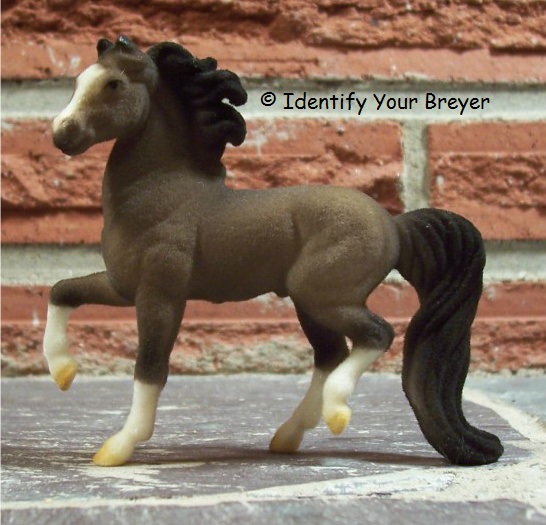
But for the purposes of this post, I am primarily interested in the "Kipper" Thelwell model made by Breyer as there has been some misinformation about the piece floating around lately. Kipper debuted in 1986 and was of great interest to my young self, but apparently was less so to adult collectors at the time (the models did not sell well). The 1986 dealer catalog featured only Kipper but alluded to the production of two other ponies, Midget (pinto) and Pumpkin (palomino).

1986 Breyer dealer catalog
 The smaller 1986 "box catalog" featured a picture of all three ponies.

1986 box catalog

All four ponies pictured in the catalogs appear to have the same bodies, but the heads and ear positions vary a bit. According to Breyer historian Nancy Young, as per a conversation with Peter Stone, these ponies were resin-cast prototypes, not plastic models. The dappled brown Kipper in the dealer catalog was auctioned off at the first BreyerFest, and Peter noted at the time that it was one of two, the other of which was in his personal collection. Presumably, the pony Peter kept is the true bay shown in the box catalog photo. The Midget and Pumpkin prototypes probably also still belong to Peter.

UPDATE: Interestingly, during the BreyerFest 2021 live stream of the factory archive room, Kelly Weimer and Kelly Keracher, the hosts, showed off this set of Thelwells to collectors. They are made of vinyl, not resin, so it would seem the other Thelwell models made it past prototyping after all. What a shame they weren't all produced!

Screen capture of archive live stream


The Kipper model that Breyer ultimately produced had a very similar head to the prototypes but a different body.

The production Kipper is standing square and has much shorter legs, and the model is made of a vinyl-like hollow plastic with a rooted nylon mane and tail. They sold in clear plastic boxes with a green backing card as seen above. The models are marked "© 1986 thelwell." Approximately 5,000 were made, but the line was discontinued due to poor sales, and neither Pumpkin nor Midget ever went into production. Leftover Kippers were sold by several Breyer dealers. My own Kipper came from Mission Supply House in Florida. 
Photo courtesy of Melissa Heijmans
In the last few years, I've seen a few Thelwell-like toy ponies being advertised at shows or for sale as purported test runs for Breyer's partially unreleased Thelwell line. These ponies certainly do look similar stylistically, but they are clearly not the same quality as Breyer's Kipper. They are less well sculpted (especially the legs and hooves), they are made from cheaper materials, and the real kicker is the way they are marked. The wannabe ponies are stamped "© BBC WW 1999, Licensed by S4C Intl, Made in China" which should make it clear they not Breyer Thelwell test runs (nor Breyer pieces of any sort) for a number of reasons, the date being the most glaringly obvious.

Click to enlarge image. Clearly not Breyer nor Thelwell.
A bit of quick research and some help from the British Model Horse Collectors group on Facebook revealed that these little Thelwell wannabes are actually toys based on a BBC children's program called "Star Hill Ponies" which ran for several seasons beginning in 1998. It was also broadcast in Welsh in Wales, hence the "Licensed by S4C" bit of copyright on the pony's belly. Episodes can be found on Youtube.

Star Hill Ponies "Molly" (Photo from eBay)
Star Hill Ponies "Scruffy" (Photo from eBay)
The back of the packaging card showing the various ponies.
The Star Hill Ponies are undeniably cute, but they are definitely not Breyers nor are they related to Thelwells in any way. They can often be obtained on eBay for less than $10 each.

I hope this post clears up some of the confusion about what is and is not a Breyer Thelwell. All of the ponies shown here, regardless of maker, are collectible in their own fashion, but hopefully my little bit of sleuthing will save collectors from paying far too much for a models that are not Breyers.