Showing posts with label decorators. Show all posts

Tuesday, November 5, 2024

Blue Monday, er, Tuesday

Blue Monday is an expression that means, according to Merriam-Webster, "a Monday that is depressing or trying especially because of the return to work and routine after a weekend." I think we all feel that way returning to work, especially after a time change, whether we spring forward or fall back. An extra hour of sleep this past weekend was helpful, but not enough! (Blue Monday is incidentally also an excellent New Order song.) Today however is now Tuesday, and because I really love blue decorator models, this feels like a good excuse for a pretty pony picture post.

When Breyer offered their decorator line in 1963, the models sold poorly, so much so that they were discontinued after not much more than a year in production. Some were even painted over by the factory and resold in realistic colors. Collectors who remember seeing decorators in stores as kids have said they weren't interested in them because they weren't real horse colors. Decorators have become wildly collectible in the intervening decades because of their rarity, but I think also because most collectors now appreciate their beautiful fantasy paint jobs, too.

Having grown up with My Little Ponies and Fashion Star Fillies, unrealistic colors have never phased me, and I have a decided weakness for models painted in varying shades of blue. I love the traditional decorator colors of Wedgewood and Copenhagen, both the vintage originals...

1960s Wedgewood Running Foal and
Copenhagen Running Mare


...as well as modern takes on these colors.

2014 Web Special "Glacier"

2024 Stablemate Club Gambler's Choice "Miguel"

I also like models molded in blue plastic, both opaque...

Mostly stripped former battleship grey Donkey
molded in blue plastic

...and especially clearware! I don't have any pictures of Breyer clearware handy, so this lovely Nosco Buck is a good stand-in. (Breyer copied this mold for their Modernistic Buck.)


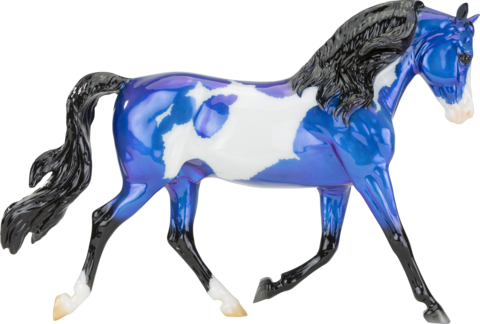
Sometimes, a nice blue paint job on a model can induce me to buy a mold I don't otherwise collect, like this Show Jumping Warmblood.


Washington, a current regular run


My blue horse addiction isn't limited to just Breyers---I have Hartlands, too. This blue 9" Polo Pony and blue 11" Quarter Horse were both made in 1967 only. I'm not sure if their limited production was due to lack of popularity for the color or possible financial struggles for Hartland (the company was sold a few years later).


I have dabbled in blue Stone horses as well. While I sold most of the ones I had to pay bills a few years ago, this stunning Morgan is a keeper---I love all of the shifting metallic shades of blue, turquoise, and green.


Believe it or not, I even have a few blue ceramic horses. This turquoisey-blue Hagen-Renaker Retro was a colorful re-release of the Black Bisque Horse mold. He was offered in a run of 1000 pieces in 4 colors from 2005-2021, but the run did not sell out so only a few hundred were made. This turquoise example is #2 from the run.


I'm not sure if this lovely old Rosenthal piece was meant to be dappled blue rather than dappled grey, but he's a delightful piece regardless.


I'm casually on the hunt for more blue horses. I still need the 2021 holiday blue Croi Damsha Sprice Drop, and even though I don't collect the mold, I kind of love the 2020 holiday blue clearware Icelandic Pony. It's like blue kryptonite. Eventually, I also hope to add Peplum, the rare turquoise 2018 event Foalzilla, and the 2021 BreyerFest blue Ansel variation to my collection, but both of those will have to wait while I (try to) save up money.

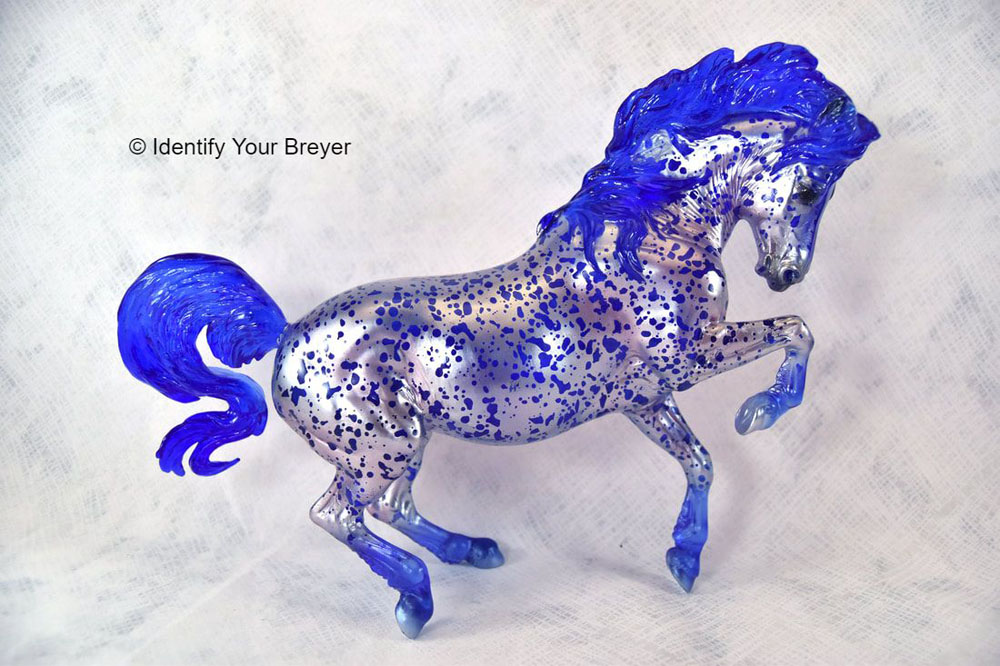
In the meantime, I'm looking forward to more affordable fixes of blue horse dopamine, like this gorgeous silvery blue-ish clearware piece due out next year for Breyer's 75th anniversary. Rural King has a sneak peek on their website. It is stunning!


Mink mold + clearware + pretty color =


Saturday, May 6, 2023

Secretariat, the Return of the Decorators, and a Missing Link Test Run?

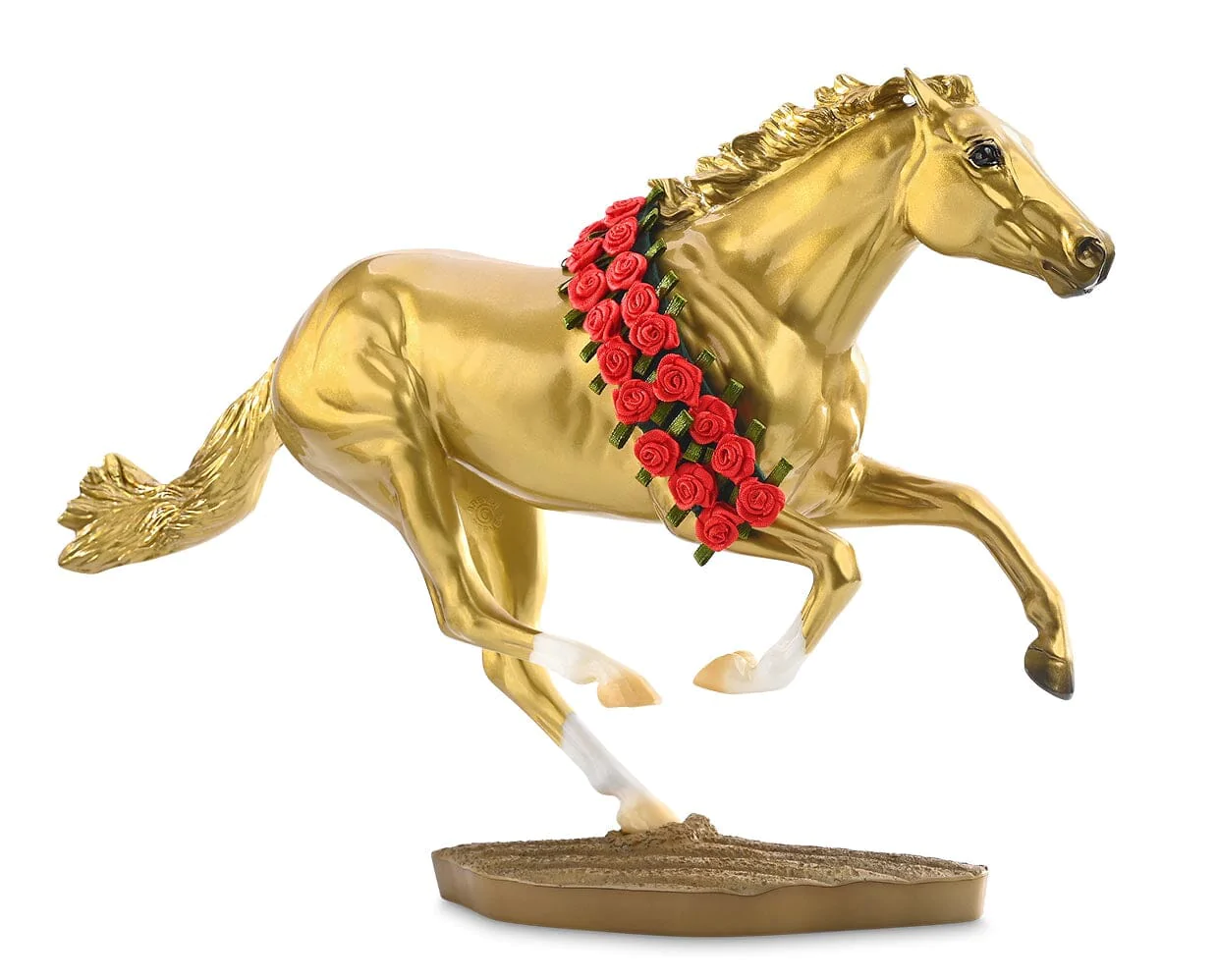
This year marks the 50th anniversary---the golden anniversary no less---of Secretariat's Triple Crown victory in 1973. To celebrate, Breyer has produced a new gold charm Secretariat model on the Smarty Jones mold reminiscent of the one they released almost 25 years ago on the original Secretariat mold. And they have also recently debuted a classic scale gold charm Secretariat for the Vintage Club on the Man O' War mold. So it seems particularly fitting therefore that a gold charm test run model possibly related to that first gold charm Secretariat model came to light just a few months ago.
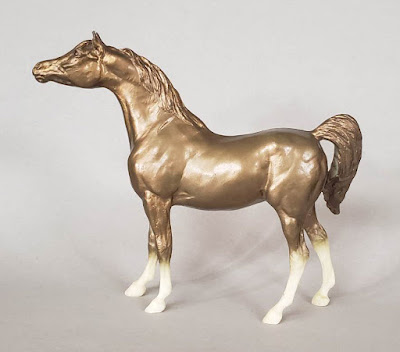
Unfinished test run gold charm Classic Black Stallion

But first, a little backstory. As everyone knows, Secretariat swept the Triple Crown in 1973 in dramatic fashion, winning the Kentucky Derby and Preakness in stakes record times before smashing the Belmont by 31 lengths in a new world record that still stands to this day.

As I've mentioned here and on my studio blog, I have been a horse racing fan my whole life. I learned to read with C. W. Anderson's horse stories, and I was always enthralled by his memories of great horses like Native Dancer, Stymie, Exterminator, and especially Man O' War. Despite all the talented horses he saw in his lifetime, Anderson never wavered from his opinion that the original Big Red was the greatest of them all. He died in 1971 however, two years before the mighty Secretariat swept the Triple Crown, and I have always wondered what he would have written about the second Big Red.

While I'm too young to have seen Secretariat, I do nonetheless have a very clear memory of the evening news reporting Secretariat's death on October 4, 1989. I was only eleven at the time, but I had seen his Triple Crown races on a VHS tape my parents had bought for me of the (then) eleven Triple Crown winners. I knew he'd been a phenomenal racehorse, and Lady's Secret and Risen Star had proved that he was a good sire as well only a few years earlier.

Breyer did not release a Secretariat model until 1987, almost 15 years after the great horse's Triple Crown triumph. Breyer historian Nancy Young wrote that Breyer had approached Penny Chenery, Secretariat's owner, shortly after his great victory to make a model, but Penny had declined, feeling that a toy was inappropriate. Peter Stone finally won her over years later with an appeal of "what about the children?" Secretariat debuted as part of the Artist Series, a line of small traditional scale models by well-known equine artists like Chris Hess, Rich Rudish, and Jeanne Mellin Herrick. It was the last model Hess sculpted for Breyer before he passed away.

I honestly don't recall a thing about buying my regular chestnut Secretariat model, but I do very well remember acquiring one of the next colors released on the mold, the gold charm.
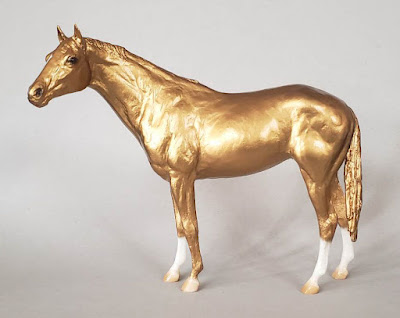
This model was in storage for 30 years, hence his bright,
untarnished gold color

In the late 1980s, after Reeves International bought Breyer, Peter Stone continued to work for the company and travel the country promoting Breyer models. For several years, Breyer hosted a series of signing parties at various toy stores where Peter would visit for an afternoon and sign any models customers purchased or brought in from their own collections. In 1990, a special run gold charm Secretariat model was offered to signing party attendees. My dad very sweetly drove me and my little sister Sarah to a toy store in downtown Atlanta where we stood in line to buy a gold Secretariat and have it signed by Peter.

 
At that time, it had been more than 25 years since Breyer had produced the original decorator models, and needless to say, the gold charm Secretariat caused a bit of a stir. While we stood in line, my dad and I chatted with other collectors about it, and part of the excitement was the reintroduction of a decorator color after so long, and part of it was due the fact that it was not quite a traditional gold charm model. Instead of having a white mane and tail, bald face, and four white feet like the '60s gold charm models, the new Secretariat was gold all over with a blaze and 3 socks like those of the real horse. And as a run of only 3500 pieces, he was considered somewhat limited in those pre-internet days.
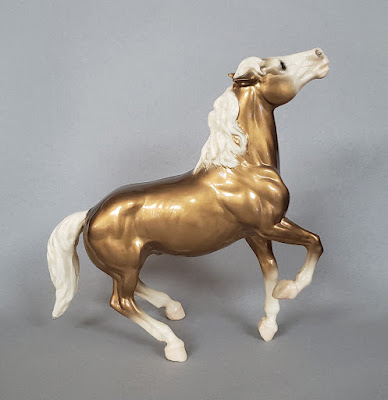


A 1960s gold charm Mustang for comparison

Later that summer in July 1990 at the inaugural BreyerFest, yet another new decorator was released, a florentine Misty raffle model limited to 21 pieces. The color and style of this model were a close match to the florentine models of the 1960s.
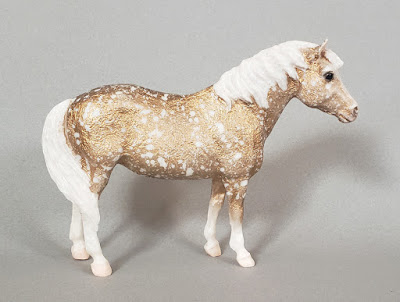
1990 BreyerFest raffle model florentine Misty

A 1960s florentine Mustang for comparison 

The following year, Breyer held BreyerFest events at four locations---in Lexington at the Kentucky Horse Park as they done the year before, as well as in Redmond/Bend, OR; York, PA; and Pomona, CA. Each location had a different decorator raffle model, and unlike the florentine Misty from the previous year, none of the 1991 decorator raffle models were a match for their 1960s counterpoints.
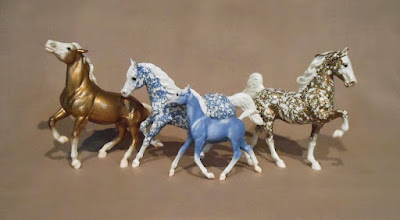
The 4 original 1960s decorator colors

The florentine Legionario does not have a white mane and tail, has only two socks and no bald face, and has grey hooves instead of pink. The copenhagen San Domingo does not have a white mane, tail,  socks, or bald face, and he also has grey hooves. The gold charm Man O' War is gold all over except for his star to match the real horse. And the wedgewood Sham has a white mane and tail and four socks but no bald face, and grey hooves instead of pink.
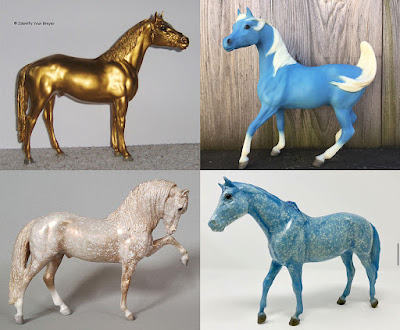
The 1991 BreyerFest raffle decorators (Man O' War photo
from Identify Your Breyer, Sham photo by Mel Grant,
Legionario photo by Sarah Wellman, San Domingo photo
by Molly Bates)

Subsequent decorator models such as the 1996 BreyerFest raffle model Malibu, a wedgewood Hackney, returned to the style of the 1960s models with white manes, tails, bald faces, socks, and pink hooves.

So when this gold charm Classic Black Stallion turned up in an online auction a few months ago, it immediately caught my attention because it reminded me strongly of the gold charm Secretariat and the 1991 raffle models. I was certain he was original finish because everything about the way he was painted, from the way the gold on his legs fades into white socks to the distinctive way the underside of his tail is not painted, suggested he was absolutely factory original. After 40 years of collecting, you just know that OF look.
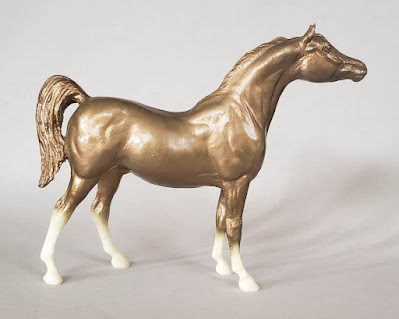
Interestingly, he escaped the factory unfinished (his hooves and eyes are not painted). His gold paint has oxidized ever so slightly in the 30 or so years since I believe he was created. The Classic Black Stallion mold was introduced in 1983, and until about 2002, it had some rough pimply spots on the barrel. The mold was smoothed out in 2003. This gold charm model does have the pimpled barrel, so he had to have been made sometime between 1983-2002. But I think the window for his creation date can be narrowed down to just a few years, probably sometime between 1989-1991.

Because he was painted with a gold mane and tail and a solid gold face and because he is a small standing model, I can't help but wonder if he was painted when Breyer was testing options for the gold charm Secretariat release. The models are of a similar size in a similar pose, and the non-traditional gold charm paint job is very alike in terms of style. He also bears a strong resemblance style-wise to the unconventional 1991 raffle models.

While I can't prove that this model is the missing link that brought decorator colors forward into modern production after a long hiatus, I think it's highly likely that he dates from the right time period. Furthermore, we do know of a few other oddball decorator colors on classic scale molds from this period, such as the wedgewood Classic Man O' War and the wedgewood Classic Kelso that were sold at the 1997 and 1999 BreyerFest auctions respectively. At the time, the models sold in the BreyerFest auctions were true factory tests plucked from the archive shelves, not one of a kind models made deliberately for the auction as they are now. Both of those models were likely painted several years earlier around the same time as the 1991 raffle models. Could this gold charm Classic Black Stallion be a part of that series of test models, too? I'm not sure we'll ever know for certain. And that is part of the thrill of collecting and hunting for rare Breyers. You just never know what unexpected things will turn up! 

Thursday, December 24, 2020

Breyer Mysteries: Christmas decorators

Since I have a bit of extra free time this week, I thought it would be fun to tackle another holiday related blog topic, the infamous Breyer "Christmas decorators" rumor. While Breyer has blessed us with a variety of modern holiday decorator offerings in the last few years, everything from dappled red and green horses to clearware to candy cane striped zebras, the subject of vintage Christmas decorators always sparks a debate. Do they exist or don't they? Has anyone really seen one? Can anyone prove it one way or another?

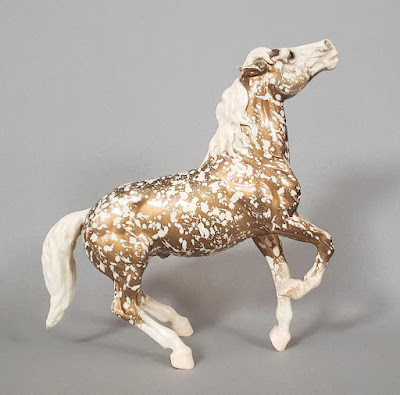
Before we tackle that subject, it's useful to consider the history of the traditional Breyer decorators, the blue and gold beauties that collectors prize so much. In 1964, Breyer offered four decorator colors---gold charm, florentine, wedgewood, and copenhagen---on five molds, the Running Mare and Foal, the Five-Gaiter, the Mustang, and the Fighting Stallion. Very little documentation for them exists, but they were offered for sale in holiday catalogs like Aldens, in department stores like Montgomery Wards, and in five-and-dime stores like Ben Franklin. They did not sell well however, and were probably discontinued by 1965. Despite not having been made very long, the Breyer decorators do seem to have been issued in fairly large quantities. They remain rare to be sure, but a patient collector will find multiple decorators for sale every year on eBay or social media. 

Gold charm Mustang, copenhagen Running Mare, 
wedgewood Running Foal, and florentine Five-Gaiter

Which brings us to the purported vintage Christmas decorators. By the late 1990s, a few collectors reported rumors of Christmas decorators possibly spotted when they or someone they knew were children in the 1960s. These models were supposedly either dappled red and green much like the florentine and copenhagen models, or they were solid red and green with white points like the gold charm and wedgewood decorators. Nancy Young mentions these observations in her Breyer Molds and Models books with a good deal of skepticism, and interestingly, she notes that there is no mention of them at all in Marney Walerius' book published several years earlier.

This is significant for several reasons. The first is that Marney began visiting the factory and acting as a consultant to Breyer in the late 1960s, only 2 or 3 years after the decorators were released. She had kept records of seeing the blue and gold decorators in stores near her home in the Chicago suburbs, so if red and green decorators had been available, she would have been ideally placed to have observed them, either in stores or at the factory. In addition, Marney did not shy away from including information in her book that trended more toward rumor than observed fact, and it's interesting to me that the Christmas decorator rumor was apparently not circulating when she published her book in 1991. I myself never heard it until I read about it in Nancy's book though I was familiar with other persistent hobby rumors at that time (more on those in a future post).

Nancy Young also mentioned that the late blogger and Breyer historian Andrea Gurdon had been told by another collector that they had found old Christmas catalogs that contained red and green decorators. This person never did provide Andrea with any proof of these claims, and pretty much all of the Sears, Penneys, and Wards catalogs are now scanned online in their entirety. None of them have red and green decorators, although a Copenhagen Running Mare and Foal can be seen in a the 1964 Aldens catalog and a trio of Gold Charm decorators have popped up in another catalog from that year. Andrea wrote about the Christmas decorator rumor several times and likewise remained skeptical of their existence.
 
As of this writing in December 2020, not one credible scrap of evidence of the existence of vintage Christmas decorators has yet come to light. No models have ever turned up, no photos have been discovered, and not a single ad, price list, or catalog entry has been found. As far as I know, there are no mentions of them in vintage hobby publications either. There are of course gaps in the paper trail of Breyer history, especially in the early years of the company, so it is possible that any documentation has simply been lost to time. After all, only a few documents pertaining to the blue and gold decorators are known.

1964 decorator dealer sheet

But while the lack of documentation is not surprising, I do think it's odd that no models have turned up in the last 55+ years. Other small runs from the 1960s are known, even in multiples, like the wedgewood Fury Prancers, the wedgewood Longhorns, and the In Between Mares. Had red and green decorators really been available in stores as reported, you would think at least one or two would have survived and turned up in an estate sale or antique mall. Also, given that the traditional decorators were only available for about a year and given that they did not sell well, would Breyer really have added red and green horses to the unsuccessful blue and gold line up?

It has been suggested by other collectors that the Christmas decorators may be the hobby's equivalent of the Mandela effect, and I suspect they're right. Human memory is of course fallible and definitely persuadable and changeable. The power of suggestion and confabulation of memories are common and well-known phenomena, and they are something pretty much all of us experience. I know I have absolutely misremembered things I thought I was certain of! This might also explain why this rumor doesn't appear to have begun circulating until the late 1990s.

So with all of this in mind, I remain skeptical of the existence of vintage Christmas decorators. We can't prove their existence any more than we can disprove it, but as more time passes without one coming to light, the less likely it seems that any ever will. I sure would love a dappled red or green Five-Gaiter like the modern test pair that exists in the Breyer sample room. Maybe Breyer will bless us with some some vintage molds for their Christmas morning special run one of these years. Maybe even tomorrow? A girl can dream!

Stephanie Macejko in the archive room at Breyer with
the test run 5-Gaiters painted in the 2000s