Showing posts with label test run. Show all posts

Thursday, October 31, 2024

Weird Finds: Halloween Edition!

As much as I love Halloween, I don't really collect much in the way of holiday themed models. Horses with scenes painted on them are not generally my thing. But I do however love weird and obscure collectibles, and with the wind gusting and dead leaves skittering across the ground here, this seems like the perfect opportunity to blog about a mysterious, spoooooky oddity. That's right, a test run Breyer creepy kitten in black with terrifying green eyes!


Be not afraid though! This sweet kitty is a lucky black cat---I'm sure any collector would love to have her cross their path! She is a test run from the 1990s when many oddball models escaped from the New Jersey Breyer factory. Security back then (and also especially in the Chicago factory years) was pretty lax, and a number of models went home with Breyer employees or were sneakily liberated from Breyer dumpsters. Some of these oddities subsequently turned up in New Jersey flea markets or on eBay. Naturally, they are highly prized by collectors---my sister and I are thrilled to be the caretakers of this goofy kitten!

Wishing you all a Happy Halloween and Spooky Samhain! If a black cat crosses your path tonight, be sure you pet it!


Saturday, May 6, 2023

Secretariat, the Return of the Decorators, and a Missing Link Test Run?

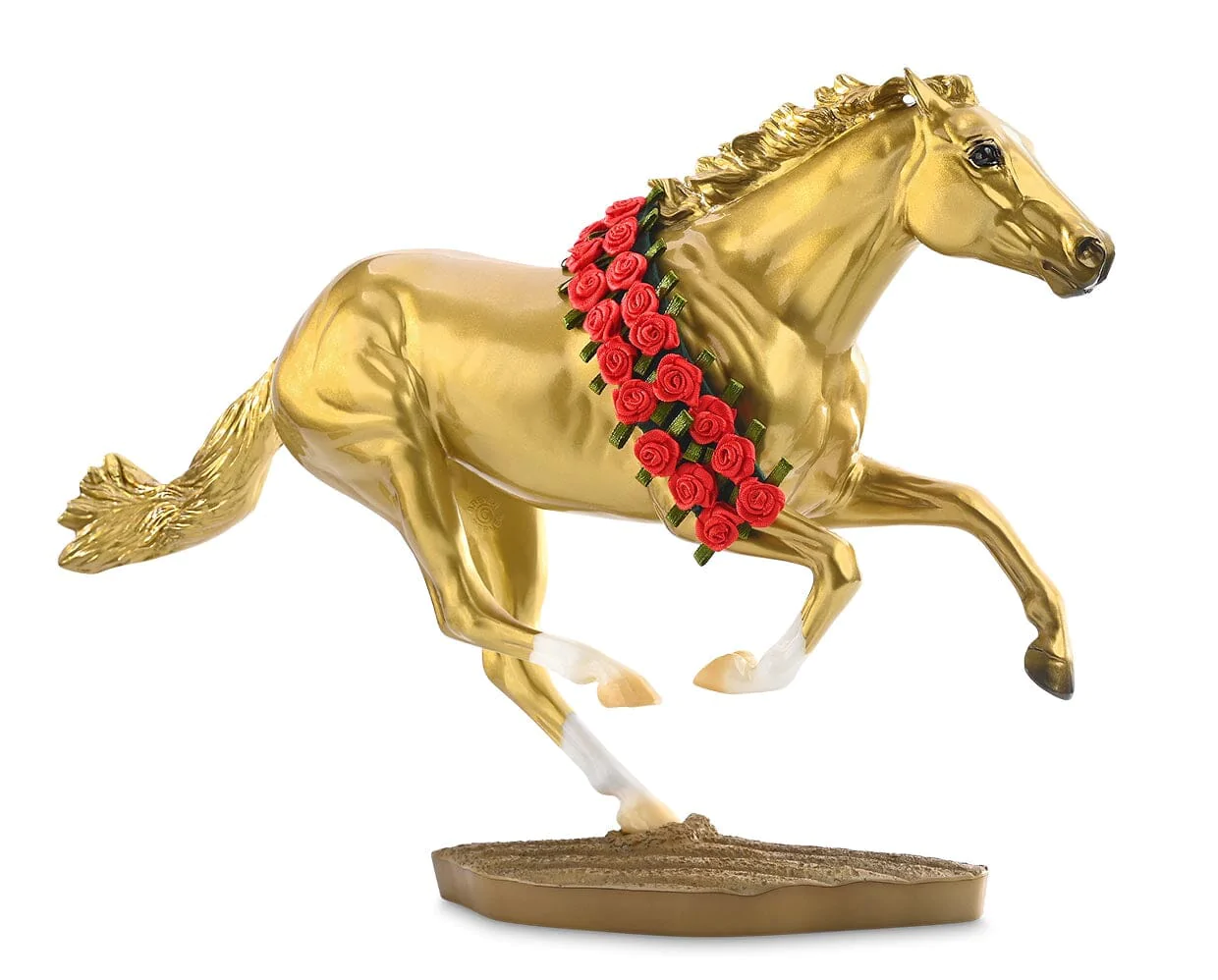
This year marks the 50th anniversary---the golden anniversary no less---of Secretariat's Triple Crown victory in 1973. To celebrate, Breyer has produced a new gold charm Secretariat model on the Smarty Jones mold reminiscent of the one they released almost 25 years ago on the original Secretariat mold. And they have also recently debuted a classic scale gold charm Secretariat for the Vintage Club on the Man O' War mold. So it seems particularly fitting therefore that a gold charm test run model possibly related to that first gold charm Secretariat model came to light just a few months ago.

Unfinished test run gold charm Classic Black Stallion

But first, a little backstory. As everyone knows, Secretariat swept the Triple Crown in 1973 in dramatic fashion, winning the Kentucky Derby and Preakness in stakes record times before smashing the Belmont by 31 lengths in a new world record that still stands to this day.

As I've mentioned here and on my studio blog, I have been a horse racing fan my whole life. I learned to read with C. W. Anderson's horse stories, and I was always enthralled by his memories of great horses like Native Dancer, Stymie, Exterminator, and especially Man O' War. Despite all the talented horses he saw in his lifetime, Anderson never wavered from his opinion that the original Big Red was the greatest of them all. He died in 1971 however, two years before the mighty Secretariat swept the Triple Crown, and I have always wondered what he would have written about the second Big Red.

While I'm too young to have seen Secretariat, I do nonetheless have a very clear memory of the evening news reporting Secretariat's death on October 4, 1989. I was only eleven at the time, but I had seen his Triple Crown races on a VHS tape my parents had bought for me of the (then) eleven Triple Crown winners. I knew he'd been a phenomenal racehorse, and Lady's Secret and Risen Star had proved that he was a good sire as well only a few years earlier.

Breyer did not release a Secretariat model until 1987, almost 15 years after the great horse's Triple Crown triumph. Breyer historian Nancy Young wrote that Breyer had approached Penny Chenery, Secretariat's owner, shortly after his great victory to make a model, but Penny had declined, feeling that a toy was inappropriate. Peter Stone finally won her over years later with an appeal of "what about the children?" Secretariat debuted as part of the Artist Series, a line of small traditional scale models by well-known equine artists like Chris Hess, Rich Rudish, and Jeanne Mellin Herrick. It was the last model Hess sculpted for Breyer before he passed away.

I honestly don't recall a thing about buying my regular chestnut Secretariat model, but I do very well remember acquiring one of the next colors released on the mold, the gold charm.

This model was in storage for 30 years, hence his bright,
untarnished gold color

In the late 1980s, after Reeves International bought Breyer, Peter Stone continued to work for the company and travel the country promoting Breyer models. For several years, Breyer hosted a series of signing parties at various toy stores where Peter would visit for an afternoon and sign any models customers purchased or brought in from their own collections. In 1990, a special run gold charm Secretariat model was offered to signing party attendees. My dad very sweetly drove me and my little sister Sarah to a toy store in downtown Atlanta where we stood in line to buy a gold Secretariat and have it signed by Peter.

 
At that time, it had been more than 25 years since Breyer had produced the original decorator models, and needless to say, the gold charm Secretariat caused a bit of a stir. While we stood in line, my dad and I chatted with other collectors about it, and part of the excitement was the reintroduction of a decorator color after so long, and part of it was due the fact that it was not quite a traditional gold charm model. Instead of having a white mane and tail, bald face, and four white feet like the '60s gold charm models, the new Secretariat was gold all over with a blaze and 3 socks like those of the real horse. And as a run of only 3500 pieces, he was considered somewhat limited in those pre-internet days.


A 1960s gold charm Mustang for comparison

Later that summer in July 1990 at the inaugural BreyerFest, yet another new decorator was released, a florentine Misty raffle model limited to 21 pieces. The color and style of this model were a close match to the florentine models of the 1960s.

1990 BreyerFest raffle model florentine Misty

A 1960s florentine Mustang for comparison 

The following year, Breyer held BreyerFest events at four locations---in Lexington at the Kentucky Horse Park as they done the year before, as well as in Redmond/Bend, OR; York, PA; and Pomona, CA. Each location had a different decorator raffle model, and unlike the florentine Misty from the previous year, none of the 1991 decorator raffle models were a match for their 1960s counterpoints.

The 4 original 1960s decorator colors

The florentine Legionario does not have a white mane and tail, has only two socks and no bald face, and has grey hooves instead of pink. The copenhagen San Domingo does not have a white mane, tail,  socks, or bald face, and he also has grey hooves. The gold charm Man O' War is gold all over except for his star to match the real horse. And the wedgewood Sham has a white mane and tail and four socks but no bald face, and grey hooves instead of pink.

The 1991 BreyerFest raffle decorators (Man O' War photo
from Identify Your Breyer, Sham photo by Mel Grant,
Legionario photo by Sarah Wellman, San Domingo photo
by Molly Bates)

Subsequent decorator models such as the 1996 BreyerFest raffle model Malibu, a wedgewood Hackney, returned to the style of the 1960s models with white manes, tails, bald faces, socks, and pink hooves.

So when this gold charm Classic Black Stallion turned up in an online auction a few months ago, it immediately caught my attention because it reminded me strongly of the gold charm Secretariat and the 1991 raffle models. I was certain he was original finish because everything about the way he was painted, from the way the gold on his legs fades into white socks to the distinctive way the underside of his tail is not painted, suggested he was absolutely factory original. After 40 years of collecting, you just know that OF look.

Interestingly, he escaped the factory unfinished (his hooves and eyes are not painted). His gold paint has oxidized ever so slightly in the 30 or so years since I believe he was created. The Classic Black Stallion mold was introduced in 1983, and until about 2002, it had some rough pimply spots on the barrel. The mold was smoothed out in 2003. This gold charm model does have the pimpled barrel, so he had to have been made sometime between 1983-2002. But I think the window for his creation date can be narrowed down to just a few years, probably sometime between 1989-1991.

Because he was painted with a gold mane and tail and a solid gold face and because he is a small standing model, I can't help but wonder if he was painted when Breyer was testing options for the gold charm Secretariat release. The models are of a similar size in a similar pose, and the non-traditional gold charm paint job is very alike in terms of style. He also bears a strong resemblance style-wise to the unconventional 1991 raffle models.

While I can't prove that this model is the missing link that brought decorator colors forward into modern production after a long hiatus, I think it's highly likely that he dates from the right time period. Furthermore, we do know of a few other oddball decorator colors on classic scale molds from this period, such as the wedgewood Classic Man O' War and the wedgewood Classic Kelso that were sold at the 1997 and 1999 BreyerFest auctions respectively. At the time, the models sold in the BreyerFest auctions were true factory tests plucked from the archive shelves, not one of a kind models made deliberately for the auction as they are now. Both of those models were likely painted several years earlier around the same time as the 1991 raffle models. Could this gold charm Classic Black Stallion be a part of that series of test models, too? I'm not sure we'll ever know for certain. And that is part of the thrill of collecting and hunting for rare Breyers. You just never know what unexpected things will turn up! 

Thursday, October 10, 2019

Jane Addiction: Been Caught Collecting*

I conga a handful of Breyer molds because it's reasonably affordable to do so, and acquiring interesting variations to fill out a particular collection can be lots of fun. (For example, I posted about my herd of dapple grey Proud Arabian Mares a while ago.) But conga collecting clinkies has never really been something I've pursued. Chinas tend to be quite a bit more expensive than your average plastic model, they're often much harder to find, and most were never released in a wide variety of colors and patterns like you see with plastic models.

Nevertheless, I seem to have sort of accidentally-on-purpose acquired a scurry of Hagen-Renaker Designers Workshop Jane (B-720) squirrels. Jane was masterfully sculpted by Maureen Love, and at a little over 5 inches tall, she's almost life size.


This inquisitive critter was first produced at Monrovia from spring of 1960 to fall of 1961 and again from fall 1965 through spring 1966. In spite of this fairly short production timeline, variations abound. The Monrovia production colors were glossy solid red with a bit of white on the muzzle and chest and matte grey with white highlights. Jane doesn't seem to crop up for sale very often, so the only Monrovia red I have seen is my own.


Two distinct versions of the Monrovia grey Jane exist. The first is a soft matte grey with glossy white highlights on the chin, chest, front legs, and tail. The amount of white varies from piece to piece.

My first grey Monrovia grey Jane came from the Hagen-Renaker archive sale. She has a Monrovia oval name sticker.


My next Jane was purchased from a fellow collector. She looks quite similar, but has slightly less extensive white on her underside and tail.


My third grey Jane came from the same collector, and she has much more extensive white on her legs and the side of her face, but she has almost no white at all on her underside. I believe that her decoration style may represent a transitional period between the earlier Janes above and the later ring-eyed Jane pictured below.


I don't know this for certain, but I am guessing this darker grey ring-eyed Jane dates to the second Monrovia production period from Fall 1965-Spring 1966. She lacks any white on her underside, and her heavy, dark grey glaze combined with the oddly ringed eyes look rather crude compared to the softer grey Janes above. If my dating of these color variations is correct, this later, somewhat cruder work coincides with a time when the HR factory was in the process of moving from Monrovia to San Dimas. Because she came from the collection of Karen Grimm, it was suggested to me that she might be a test, but I know of at least one other ring-eyed Jane pictured in the Charlton guide. (Does anyone reading this blog have a Jane like this?)


Jane was also produced at San Dimas from Fall 1969 to Fall 1972. She was again offered in glossy red but this time with white on the belly, legs, and face. She was also produced in a solid glossy grey color with lighter grey highlighting on the tail. The red squirrels varied a bit in the intensity of their red-brown color and in terms of how much white they have on the faces and legs.

San Dimas red #1: more white on face, less on front legs
San Dimas red #2: less white on face, much more on front legs

San Dimas grey
Despite being offered for a little over 6 years altogether, Jane is not a very easy piece to find. I imagine she might have been a challenge to mold, so it seems possible that production numbers were limited during the years she was available. Or, despite her charm, perhaps Jane simply didn't sell well. (I can't imagine why---she's adorable---but some people do view squirrels as pests.)

Mostly through luck, I have added a surprising assortment of test run Janes to my collection. The first two are from the Hagen-Renaker archives which were sold on eBay throughout 2015 after John Renaker passed away in November 2014.

This grey test Jane looks very much like the Monrovia release, but she has a completely white tail. She also has a great deal of white over-spray on her body under her tail that was not cleaned up before firing.


Jane was never officially produced at the San Marcos factory, but nonetheless, several tests from those short years in the 1980s do exist. This glossy solid white Jane also came from the Renaker estate archive sale.


A second glossy white Jane came out of the collection of a former employee and now belongs to my sister.


This glossy solid red Jane came from the same collection, and interestingly, it was cast in white slip rather than brown.


Likewise, this glossy solid black Jane from the same collection was also cast in white slip.


Probably the oddest Jane in my collection is this matte grey-ish brown critter. I found her on eBay from an Arizona seller for the bargain price of $6, and as you can see from the pictures, she has had a hard life. Based on the dirt caked into her crazing, I believe she must have spent some time outdoors, possibly as a garden or yard decoration as Maureen Love was wont to do with her creations.

She was poured in greyish-brown slip and has a bit of subtle shading to bring out the mold detail. But what is she? My first thought was that maybe she was a matte version of the San Dimas grey that escaped the factory without being glossed. But she is definitely not the same base/slip color as my glossy San Dimas grey Jane. And she doesn't match the slip color of my Monrovia matte grey Janes either. Maybe she was poured, either deliberately or accidentally, in the wrong slip color and then finished and sold or was taken home by an employee. Similar instances with other models are definitely known. Could she be a test? Maybe. I'll probably never know, but I think she's a pretty neat find even in her damaged state.


After Maureen Love passed away in 2004, many of the sculptures and sketches she kept for herself were dispersed by her family the following year on eBay. I was a poor grad student at the time, and I deeply regretted not having the means to purchase any of the art from her estate. Last fall, however, Maureen's granddaughter offered up several hundred more sketches on eBay. Given my Jane addiction, it should come as no surprise that this particular sketch came to live with me.


I have yet to get it framed (it's double-sided), but one of these days, it will hang next to a display of my Janes. And probably some other squirrels. I may have inadvertently started collecting more...

Monrovia Betty sculpted by Maureen Love
Monrovia Peggy sculpted by Maureen Love
Hagen-Renaker Mrs. Chatter sculpted by Robyn Sikking and brown baby
"Chat" mold probably sold by Robyn directly

* (with apologies to Perry Farrell, Dave Navarro, et al. Oh, who am I kidding. That was an amazing pun.)

Friday, September 8, 2017

Friday Featurette: Elephants with Howdahs

One of the rarest Breyer oddities is #94, the Elephant with Howdah. This model appears only in the 1958 Breyer catalog and price list, and though records from the 1950s are spotty and incomplete, given the scarcity of the howdah, it seems to be a safe bet that this set was made in 1958 only. In fact, it's so rare that I would postulate it was probably only in production for a few months (if that) in 1958.


The 1958 catalog does not specify the color of the howdah (nor the baskets carried by the companion #82 Donkey with Baskets), but until quite recently, it was presumed to be red and only red. The handful of known examples of both howdahs and baskets are molded from slightly soft reddish plastic. To date, all examples have been found on the battleship grey variation of the elephant (or donkey in the case of the baskets). Both the howdah and baskets are sculpted to appear as though they are woven of straw. The belly band on the howdah is patterned, perhaps to simulate cloth or tooled leather?

Owned by Kim Haymond (Photo by me)
In June of 2014, my friend Ellen Vogel found an elephant and howdah set that turned the "only red" theory on its ear. She attended an estate sale near Chicago, and based on the models she purchased there, the estate was very likely that of a former Breyer employee. Several of the models Ellen acquired were vintage tests, seconds, and unfinished models. Included in her stellar haul was this amazing elephant with a blue howdah! To date, it is the only example known in this color, and presumably, it's a test.

Owned and photographed by Ellen V.
An elephant with a howdah has long been a Breyer grail for me, my sister, and my mom, so we were beyond thrilled to win an auction lot earlier this spring that included one. Interestingly, it too was molded in a previously unknown color. Our set features a yellow basket with a red belly band---perhaps the design intent was a straw colored basket set off by a red cloth- or leather-like band? As with the blue howdah, this is the only known example in this color, and it too came from a Chicago-area estate. Some of the other models in the lot were odd variations and production seconds, so I believe the original owner must have been a former Breyer employee as well.

Photo by Sarah W.
So this begs the question---are there donkeys with non-red baskets floating around out there somewhere? Wouldn't that be an exciting find!

Thanks for reading! Hope you all have a great weekend!

Tuesday, June 6, 2017

Kentucky Horse Park pictures

More pictures from the park---enjoy!

Welcome to the Kentucky Horse Park!

Man O' War

A neat test run (1 of 2) from the Breyer archives room that was auctioned off

More test runs in the silent auction

A very pretty Vanner. Love that pattern!

Out for a drive

Champion pacer Staying Together gets a bath at the Hall of Champions

Two time Breeders Cup Mile winner Da Hoss having a roll

Kentucky Derby and Preakness winner Funny Cide

Alysheba's grave

John Henry's grave

Cigar's grave

Thursday, April 13, 2017

Long overdue update: Hoosier Pony Live pix, part 1!

Yikes! I am fairly horrified that I haven't updated this blog in almost a year! :( Work and real life have kept me too busy and too worn out to have much motivation left for writing, but I am trying to change that and get back to blogging regularly both here and on my studio page. That said, I recently returned from my first trip to the west coast where I attended BreyerWest in Albany, OR. But before I post pictures from that event, I feel like I should play catch-up and share photos from the shows I've attended in the last year.

The first of those is Hoosier Pony Live, an all yellow card show that Sarah Townsend held in Bloomington, IN, last April. I was invited to judge OF Breyer Collectibility, and I was really excited to see how many hard-core collectibility fans turned up with an amazing array of rarities. Here are some of my favorites.

Pretty Old Mold Glossy Bay PAM
Rare Glossy Appaloosa and Chalky Bay PAFs
A wonderful clock and night light combination

A beautiful dapple black Belgian
Incredible and unusual shading on a Glossy Alabaster Mustang
A very rare example of the "five-gaiter sorrel" Fighting Stallion. Note the
grey hooves and brown mane and tail which distinguish it from the common
bay version (which has black hooves and a black mane and tail).
Woodgrain Five-Gaiter with a "tenite" sticker
Rare Woodgrain Stretch Morgan
Rare Woodgrain PAM
Beautiful Gold Charm Running Foal
Wedgewood Fighting Stallion and friends
Copenhagen Mustang, probably the most sought-after decorator
Stunning vintage Indian Ponies in pinto and rare alabaster
And buckskin, too
A very hard to find chalky Alabaster Fighting Stallion
A test run matte Charcoal Running Stallion from the Francis Collection
A test run black Five-Gaiter from the Francis Collection
Another Francis Collection test run
And another
And one more
Hoosier Pony Live also featured proper collector's classes (no nonsense, just the models, a subject for a future blog) which were set up during lunch. Kelly Engelsiepen and Kelly Weimer tied for first place with their incredible Mustang and Fighting Stallion (respectively) collections.


My callback table at the end of the day held some really impressive rare models, old and new.


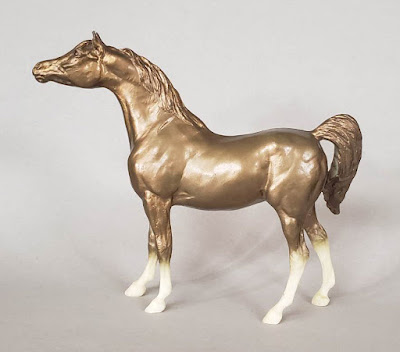
But my eventual overall champion was this amazing 1950s test run gold/bronze Race Horse from the estate of a former Breyer employee now owned by Ellen Vogel.


Tomorrow, I'll post some of the chinas, vintage customs, and other fun OF oddities from the show.