Showing posts with label woodcut. Show all posts

Friday, November 8, 2013

Friday Featurette: Hartland grail achieved!

My dad travels a lot for work, and about 20 years ago, he came home from a trip with a special find. While on the road, he stopped for lunch and then decided to look through a nearby antique mall. When he arrived at the house later that evening, he came up the front steps grinning and said he'd found "a decorator." And he was right. It wasn't a Breyer decorator, but it was a gold Hartland 9" Mustang which was just as exciting. We didn't know much about it at the time, but eventually we learned that it had been made as a special run for a brewery. It was meant to be affixed to a sign that would have been on display in a bar.

For most of the intervening years since then, I focused mostly on collecting Breyers, but I happily bought old Hartlands when I could find them at reasonable prices. I've always liked their stylized look, especially the horses made in the 1960s, and for the last few years, I've been actively filling in gaps in my collection of horses from that era. I've also been filling in the gaps in my knowledge about Hartlands.

So, in my post about Hartland woodcuts earlier this summer, I mentioned the elusive gold woodcut 9" Mustang and included a photo of a partial set I found on Google.  According to Gail Fitch's book Hartland Horses and Dogs, the gold Mustang was issued as a special run in the late 1960s for the Pittsburgh Brewing Company in Pittsburgh, PA, who distributed Mustang Malt Liquor. No one knows how many were made or even exactly when they were made, but the horses are found often enough off the beer sign that I suspect there are a reasonable number to be had. Finding models still on the beer sign and with the original beverage container is however much more unusual. I see horses with the bases only very occasionally and complete sets hardly ever. So that said, I was really pleased to be able to add this set to my Hartland collection.


Unlike the other Hartland woodcuts which were molded in colored plastic, this model is molded in white plastic and was then painted gold. The base on this example is lettered on both sides, but some are only lettered on one side. I believe the piece was meant to come with the empty glass bottle as shown here, but I have seen at least one with an aluminum can instead. I'm not sure if it came both ways or if the can was a replacement for a presumably broken or lost bottle. Either way, it's a fun bit of breweriana and Hartland history.

Wednesday, July 17, 2013

(Almost) Friday Featurette: Wooden Horses Part 3

It's not quite Friday, but with BreyerFest rapidly approaching, I thought I'd make another post in the series about wooden horses and wooden wannabes.

In the 1960s, Breyer was not the only company producing plastic model horses that were finished in a faux-wood style. Hartland Plastics of Hartland, Wisconsin, a town about 25 miles west of Milwaukee, introduced a line of models called "woodcuts" beginning in 1964.These models differed from Breyer's faux-wood models in that they were sculpted to look as though were whittled or carved from wood rather than just painted to look that way.

The Hartland woodcut look was achieved in three different ways. Some models have an angular surface meant to look like carving marks:
Walnut 9" TWH

Some are both carved and marked with incised graining (in horizontal bands in this case):
Ebony 7" Saddlebred Stallion

Carved (subtly) and grained (in swirls):
Cherry 9" Mustang

Only one mold shows graining but not carving:
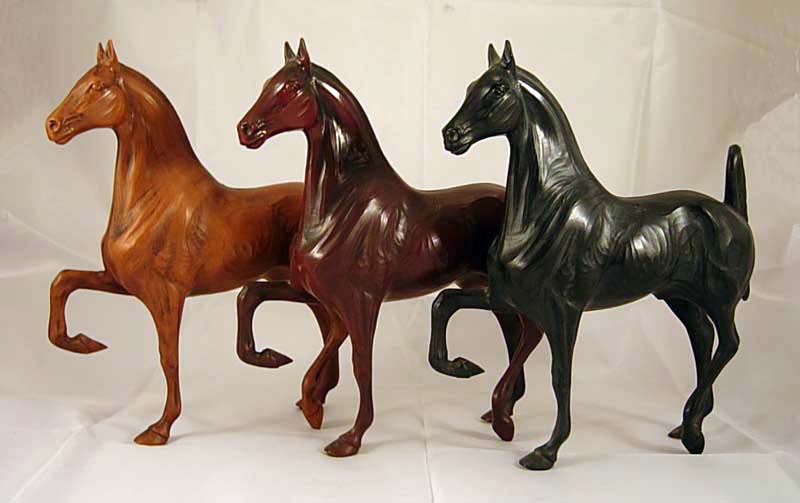
Test Run Walnut 9" Five-Gaited Saddlebred (more on this one below)

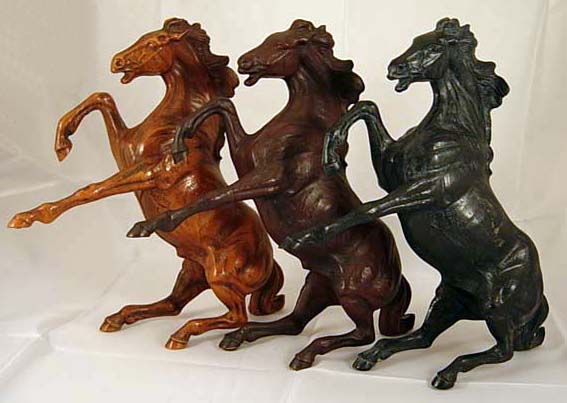
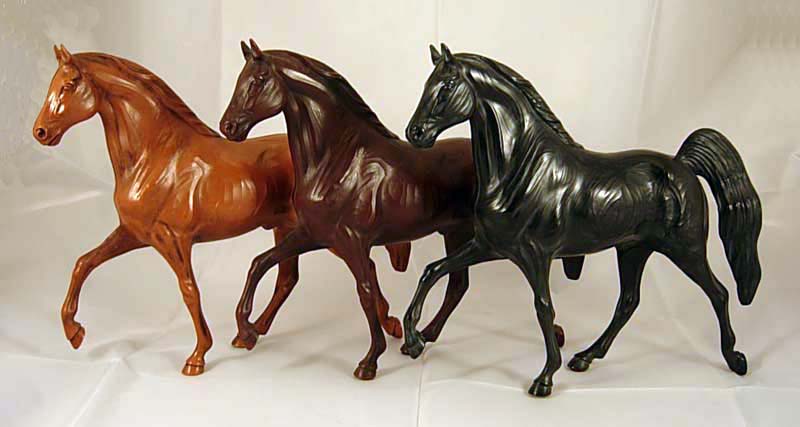
The woodcut molds are unique molds separate from the corresponding smooth body versions. They were sculpted by Roger Williams, and the carving and/or graining was added by Alvar Bäckstrand. The models came came in three shades: walnut (tan), cherry (dark reddish-brown), and ebony (black). They were usually cast in tan, reddish-brown, and blue-grey or black plastic respectively and had a wash of darker shading rubbed over the surface to highlight the woodgraining look. Some models, especially the later walnut pieces, have very little of the contrasting color applied.

 Walnut, Cherry, and Ebony TWHs

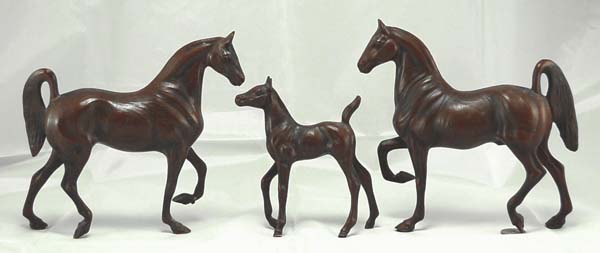
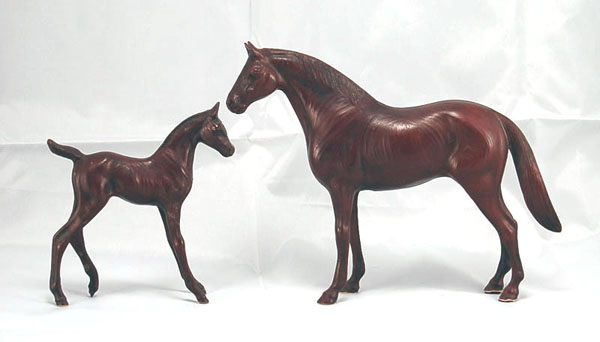
Hartland issued the following molds as woodcuts in the mid-1960s: 9" Mustang (subtly carved and grained), 9" Tennessee Walking Horse (two mane variations, both carved), 9" Three Gaited Saddlebred (carved), 7" Saddlebred Family (carved and grained), 7" Thoroughbred Mare and Foal (carved and grained), and the 6" Arab Stallion (carved). All of these models were available in all three woodcut colors. The ebony and cherry colors were only issued between 1964-1966 whereas the walnut models were almost all available for 3 or 4 years in the mid- to late-1960s, and the 9" Mustang and Three Gaiter were also re-released in walnut from 1970-1973 when Durant took over the company.

Despite relatively short productions runs, the 9" models are all fairly common, the Mustang most of all. The 9" models bring around $20-40 depending on color and mold with the Mustangs tending more toward the $5-10 range because they are so easily found. The 7" and 6" models are considerably more scarce, having been limited in production in all colors to only 1 or 2 years. The Thoroughbred Mare and Foal for example were issued in 1965 only, making them the rarest of the bunch. The family sets often sell for around $100.

In the late 1960s, Hartland issued the woodcut Mustang in gold. Most were mounted on promotional Mustang Malt Beer signs to be displayed in bars.

Hartland has passed through several owners and has therefore been in and out of business a number of times since the 1960s. Under two new incarnations, those headed by Paola Groeber from 1987-1990 and Sheryl Leisure from 2000-2007, the 9" Mustang and TWH woodcut molds were issued in several realistic horse colors. The woodcut models painted and sold by Paola were all test runs as far as I know. The models sold by Sheryl were a mix of small regular runs and test runs. For more information on these models, I highly recommend Hartland Horses and Dogs and Hartland Horses: New Model Horses Since 2000 by Gail Fitch, both of which are available directly from the author.

An unpainted 9" woodcut TWH molded in swirled black and grey plastic
Less than 10 were sold by Sheryl Leisure in August 2002

The rarest woodcut, to the best of my knowledge, is a one-of-a-kind test run 9" Five-Gaited Saddlebred. She came from the collection of a former Hartland employee and probably dates to the mid-1960s. She was sold mounted on a base as shown and is grained only, not carved. My best guess is that she was possibly a one-off prototype that was never put into put into production, perhaps because she was too similar to the 9" Three Gaiters. 


Some woodcut Hartlands were issued with gold stickers, a factor that can make an ordinary model extraordinary if found with the sticker still in place. I have seen two different styles---a round sticker and a rectangular sticker. Both indicate the models have a "hand-rubbed, wood carved finish."

Ebony 9" Mustangs with two sticker variations 
(The rectangular sticker on the left is partially missing.)
 
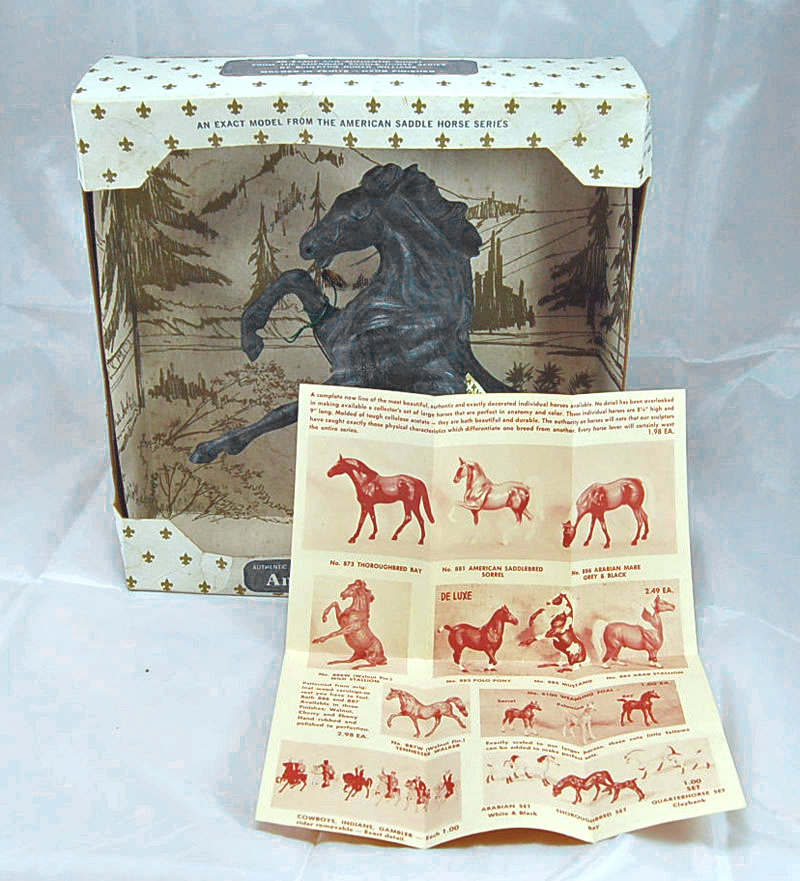
Finding Hartlands, especially woodcuts, in their original packaging is also unusual and adds significantly to their value. 
 
Ebony 9" Mustang with original box and catalog
 
If you enjoyed this post and want to learn more about Hartlands, Gail Fitch's books are the best source of information. I am still educating myself about Hartlands, and her books have been hugely helpful in learning about the company and the models produced under its various owners. Because they are highly stylized, Hartlands aren't to everyone's taste, but I find them charming, and I hope more hobbyists will take an interest in them.

The last installment featuring Peter Stone woodgrains will be posted after BreyerFest. Hope to see you there!

Friday, July 5, 2013

Friday Featurette: Wooden Horses Part 1

Most model horse collectors are aware of the various faux wood models that have been sold over the years by the major model horse producing companies. Both Breyer and Stone created plastic models painted to look as though they were made of wood called "woodgrains," and Hartland similarly made plastic horses sculpted to look as though they were carved from wood known as "woodcuts."

Breyer, Stone, and Hartland woodgrains/woodcuts

Few collectors however are aware of the company that very likely inspired the creation of all of these models, Grand Wood Carving of Chicago, IL. Chicago, you say? Yes, indeed, the original home of the Breyer Molding Company as well, and interestingly enough, the factories for both companies were located little more than a mile apart. But more on that later!

Grand Wood Carving got its start in 1939, producing a variety of horses and other animals carved from primarily Central and South American mahogany as well as a few other types of wood. Though they produced a variety of portrait horses and breeds, a large part of their equine line was devoted to racehorses, both Thoroughbreds and Standardbreds.

GWC's "Whirlaway" and "Dan Patch"

Because GWC horses are actually made of wood, they are of course all carved rather than injection molded like the plastic models inspired by them. To achieve a consistent look for each individual "mold," GWC utilized 24-spindle Salstrom carving machines which worked off patterns for each horse or animal. (For more information on these neat machines, please click here.) The pieces were all then hand-finished, a process that included sanding as well as staining. Because of this, GWC horses can vary a bit from piece to piece, particularly in leg thickness, stain color, and markings.

Many of the horses were issued with descriptive stickers, hang tags, or belly bands, and all of these bits of paper ephemera are decidedly rare today. Even the horses themselves are incredibly hard to find despite the company remaining in business until 1983. I suspect this scarcity is the result of several factors: 1) the models were probably never issued in large numbers, 2) they were expensive even when originally available, and 3)  most importantly, GWC pieces were not physically marked. I would guess that this lack of identifying marks  means many of them go undetected by people not familiar with the company. Happily, for those collectors interested in these quirky and charismatic folk art horses, Ed Alcorn has an amazing array of GWC models  displayed on his website here. Breyer collectors should find both the Whirlaway and Man O' War models familiar. More on their inspiration from GWC next Friday!