Showing posts with label breyer western pony. Show all posts

Sunday, May 24, 2026

Kroll Western Pony Mystery Solved

I am shamefully late getting this post written up, but here at last is the story of the Kroll copy of the Breyer Western Pony...and his racehorse friend! (This feels like a They Might Be Giants hobby filk song? Iykyk.)

Anyway, dumb jokes aside, when I wrote my multi-post series on Western Horse and Pony shaped objects back in 2020, I included what little was known about the copies of Breyer's Western Ponies marked "KROLL." A few years later when I happened to be in Shipshewana for Stone Horses Country Fair, I received a fascinating email from the daughter of one of the men who founded the Kroll company. I had every intention of writing this up sooner (story of my life), but I have had so much on my plate that time got away from me, and other subjects pushed ahead of this one. But having received another email last week asking about Kroll ponies, I decided it was time to pull this post out of the draft folder and finish it up. So, without any further ado, here is the Kroll story.

Like so many other plastic manufacturing companies, the Kroll Trading Company was started in the 1950s. It was founded by brothers Jack and Walter Kroll, and their first injection molding factory was located on Greene Street in New York City. The email I received came from Jack's daughter, and she and her cousins believe that the Western Pony copies were made at that location at that time because the handful of Kroll boxes that have been found by collectors say "NYC" on them. This timeline is also corroborated by the presence of a two-digit postal zone number in the address on the boxes rather than a five-digit zip code. (Postal zone numbers were used in large cities beginning in 1943 and were replaced by zip codes in 1963. Breyer introduced their Western Pony in late 1952, so the Kroll ponies likely date to the mid- to late -950s.)

In the 1960s, the factory moved to Long Island where the Kroll brothers began to make other toys and products with molds they bought in Hong Kong. They were no longer making ponies at this point, and instead were focused on beach toys like sand pails and shovels as well as practical products like record racks. Jack and Walter retired in the mid-1970s and sold the company. 


My interest in Kroll ponies began in the early 1990s when my mom and I would go out to the Lakewood flea market on the south side of Atlanta to look for model horses. I have a very distinct memory of wandering down an aisle in one of the buildings and spotting a gold horse about 20 feet ahead of me. One of my nerdy superpowers is model horse shape recognition from a distance or from weird angles, so I could see right away that this gold horse was Western Pony shaped. I made a beeline for it, but as soon as I picked it up, I could feel that the weight of the plastic was wrong. It was too light. I also realized that the model had the mane sculpted on both sides of the neck instead of just the left like a Breyer, and it was marked KROLL on the belly. I wasn't buying knock offs at that point, and $15 was a lot of stall cleaning money back then, so I left it behind, but it made an impression on me. Thirty-odd years later, I paid a lot more to get my hands on the gold pony pictured above. Hindsight, etc etc!

As I wrote on my Western Horse copies post, the Kroll ponies come in several colors, but they are not painted---they are instead molded in different colors of plastic. Most are just solid colors, but occasionally, some were made from swirly plastic. Black and dark brown seem to be the most common colors. Here's my little conga of black, brown, swirly ochre, and gold. (The black pony's bridle was painted silver by a previous owner.) 


To the best of my knowledge, the ball chain reins are original, and the ponies may have come with slip-on saddles that were copies of Breyer's snap saddles for Western Ponies (but sans girth). I have only seen one example owned by another collector that has such a saddle, but it looks as though it could be original. I'm honestly not sure though, and I would love to hear from any collectors that have found ponies with saddles like this. I suspect some---maybe many?--- of these ponies were sold without saddles. I haven't ever come across saddles in this style that match the gold or white ponies for example. (Or if they had saddles, maybe they were a different color than the pony?)

Owned and photographed by Sharon Peden


Mold mark on my swirly pony

Double mane


Close up of my swirly pony


A swirly white pony owned by Sharon Peden

Some Kroll ponies seem to have a molding flaw along the side of their rump. It's not an open crack, but it looks a bit gnarly. It's most easily seen on the gold ponies. I can't help but wonder if the molding flaw led to their discontinuation.


Kroll ponies were also sold mounted on a display base as seen with this model pictured on the Model Horse Gallery website. Interestingly, the box illustration shows a pony with reins but no saddle. It came with a little slip of gold leaf to personalize the base. This pony and the base are molded in black plastic. (Incidentally, the gold leaf packet is the same brand that was sold with the Breyer Proud Arabian Mare grooming kit in the 1958 Sears holiday catalog.)


A good friend clued me in to one of these ponies on the base on eBay, and I was delighted to finally get one in hand to examine closely. My pony is brown plastic on a black base. It has a gold souvenir sticker affixed to the front that is unrelated to the gold leaf slip that is shown with the boxed set above.


The pony is marked Kroll as usual, but the base is just marked "Enterprises" and "USA" on the underside. Above the word Enterprises is a scratched out space that appears to have been another word. It's possible that the base was one of the molds the Kroll brothers bought, and they simply removed the name of the previous maker. Kroll Western Ponies are somewhat hard to find, and I'm only aware of two of them on a base like this at the moment. If you have one, too, especially in a different color, I'd love to know about it!


As far as I know, Kroll only made one other horse, and as best I can tell, they seem to be hard to find. They are however entirely unmarked, so it may just be that they're flying under the radar. The model is a race horse, and both of the examples I've seen are molded in brown plastic. They came in this spiffy illustrated box, and like the mailer box above, it also has a two-digit postal zone number printed on it, so it presumably dates to the 1950s as well. 


The racetrack illustration on the front of the box appears to be Aqueduct...


...and the grandstand in the background of the inner box panel appears to be Belmont. What could be more apropos for a company originally based in New York City?


The Kroll Western Pony copies must have been made no earlier than about 1954 and likely no later than about 1963. The Race Horse model presumably falls into that same date range. I hope to someday come across an ad for these models or maybe even an old Kroll price list or catalog. In the meantime, I'd love to hear from anyone who has an interesting Kroll model to share (or sell!). I hope you enjoyed this post!
 
And many, many thanks to Susan and her family for sharing their memories of the Kroll Trading Company with me!

Monday, February 10, 2020

Western Horse Shaped Objects, Part 1: Mastercrafters Clocks

Several years ago, I put together a list of basic questions that I felt any Breyer collectibility judge should be able to answer. It's taken me longer than I'd planned to get around to answering all of the questions, but I'm finally ready to tackle the one about how to differentiate between the various Western Horse shaped objects out there---Breyers, Hartlands, Ohio Plastics, Hong Kong knock offs, metal horses, and more. What had been in conception a very simple post with some pictures has morphed into something much bigger, and it will probably take me three or four posts to cover everything I want to discuss. Understanding the histories of these companies and their various imitators is just as important as recognizing the unique features of their models. 


The Beginning: Mastercrafters

Our story begins in 1939 with the advent of the Mastercrafters Clock and Radio Company founded by Ben and Kate Lerman in Chicago, lllinois. They made a few clocks early on, but when WWII broke out, their production shifted, like that of so many other companies, to aid the war effort.  After the war, the company returned to clocks and patented a number of popular designs including ships, airplanes, a girl on a swing, and so many more. Some manufacturing and 
assembly were done at the Mastercrafters factory in Chicago, but they did also contract out with other companies for part molding and even clock movements. (This is why some Mastercrafters clocks have Sessions movements.)1 Mastercrafters’ array of clocks show a particularly savvy understanding of post-war tastes, beginning with ships and planes and moving on to more abstract, mid-century modern styles. As all things Western grew in popularity in the late 1940s, Mastercrafters saddled up and hopped on board that trend as well, debuting a horse clock in late 1948 or early 1949.2 


According to Mastercrafters experts W. Clarke Eldridge and William F. Keller in a 2004 article in the National Association of Watch and Clock Collectors Bulletin, Kate Lerman herself was the artistic genius behind many of the company's most popular clock designs.3 A quick patent search shows she was responsible for a number of interesting clocks including the Melody Cruiser, a combined clock and radio in a stylized sailing ship housing. I have yet to track down the patent records for the Mastercrafters horse clocks (if they exist; the patent numbers referenced in Nancy’s book pertain only to the clock mechanism), but it stopped me in my tracks to think that maybe, just maybe, Kate Lerman dreamed up the horse clocks. Wouldn't it be something if we owe all of our plastic horse collecting obsessions to a woman?

The exact history of the Mastercrafters horse clocks has been lost over the years, but collectors have been able to piece together a reasonably solid timeline. For many years, what we now know to be Hartland Victor horses (as well as a variety of copies!) were all believed to be Breyers, but in the early 2000s, a group of collectors led by Hartland expert Mike Jackson and Breyer expert Nancy Young began to suss out the truth based on a variety of small clues.

Mike has an exhaustive explanation of this research with relevant pictures and evidence on his website here, and I highly recommend that all model horse history nerds read it if they haven’t already done so. The gist of this research is that Mastercrafters turned to Hartland Plastics to produce the plastic injection molded horse and base for their clock design in early 1949 or possibly the year before. Yes, the Hartland came first!

The earliest examples of these clocks feature what we now know to be the Hartland Victor model, and the evidence collected by Mike and his fellow researchers proved that this horse was available into 1950. Near the end of that run, Hartland introduced a similar horse with a wavy tail now known as the Hartland Large Champ. Why they switched to a new sculpture is unknown. At some point in 1950, Breyer replaced Hartland as the manufacturer of the horse models for the clocks.

Left to right: Hartland Victor clock, Hartland Champ clock, Breyer Western Horse clock
(Champ clock owned and photographed by Barrie Getz)

Why this change came about is unknown. The general consensus though is that Mastercrafters was unable to pay Hartland and gave them the horse mold to use in lieu of payment. Perhaps Hartland found that selling free-standing models as toys was more lucrative. Or it may be that Breyer, which was located only about 2 miles from Mastercrafters, was a more convenient option (Hartland was located several hours north in the far western suburbs of Milwaukee, WI). It may even be that Breyer undercut Hartland with the offer of a cheaper model. We’ll probably never know. Whatever the case, Breyer began producing a very similar horse standing over the clock in 1950. By 1951, Mastercrafters had switched to a style of horse clock featuring a longer base on which the horse was mounted at an angle beside the clock. (Other Western Horse shaped models made by different companies have been found mounted beside Mastercrafters clocks as well, but I'll discuss those in subsequent posts.)


Hartland Victor Clocks and Horses

Hartland Victor clocks are not exactly common, but of the three styles of horse-over-the-clock, they are by far the most easily found. They exist in two basic colors with variations known to each, white/cream and palomino/sorrel-turned-green. The white/cream horses usually have dark brown shading or antiquing in their manes and tails (often referred to as the “cream puff” version), but some do appear to be all white other than their eyes, hooves, and some tack detailing. The shading/antiquing is extremely fragile however, and it’s possible that some (maybe even all?) of the solid white horses found by collectors may have simply been cleaned over-zealously at some point. (A soft toothbrush, soap, and water will take the color right off; more than one collector has accidentally done so.) 


Hartland Victor horse over clock in white/cream
The palomino/sorrel-turned-green horses, dubbed “bile green” by Nancy Young, are usually an unfortunate shade of yellow or green with softer greyish-brown or brown-black shading. Light and dark versions exist, suggesting that the originals may have been two different shades of tan or brown. Or they may simply be examples of color variations within the run. We don’t know for sure. They are less common than the white/cream Victor horses.

Hartland Victor over the clock in bile green
Many of the white/cream Victor models have stains under their saddles where the brown saddle color bled into the white plastic of the horse. Conversely, many of the green horses have patches of their original color hiding under the saddles.

Hints of the original sorrel color under the saddle on the green Victor. The
delineation between brown and yellow-green is pretty distinct.
As seen in the pictures above, Victor horses came on two different colors of clock base: marbled  brown or pale yellowy-green with reddish faux marbling. (The lighter color when used on other Mastercrafters clocks was referred to as "onyx.) I have seen white/cream horses on both bases, but so far, the only bile-green examples I’ve seen have been on the light-colored bases. In general, the white/cream horses also usually have dark brown saddles with gold or white washing on the skirts while the bile-green horses generally have saddles molded in white plastic and painted in similar shades of (what has become) yellow, green, and grey/brown to match the horse. Most of these saddles are the slip-on style with no girth, but a few in both colors have been found with a vinyl girth that buckles rather than snaps. The girth is attached to the saddle with what appear to be small nail heads (rather than the hollow grommets seen on Breyer saddles). 


No girth on my Victor clock horse on the left vs a girth with nail head on
Barrie's free-standing Victor on the right. Note also the variations in yellow
and green shades and saddle decoration.
The bits on most Victor horses are a solid metal bar with a small hole in each end through which O-link reins are attached with small clips. The reins on a few are attached to a wire bit with small round jump rings instead (as is more typically seen on early Breyer Western Horses). These may be late examples. Some have no bit at all, and the reins are just passed through the mouth and held together with a small round ring. Interestingly, a few Victors have been found with no holes in the mouth at all for a bit.

Standard bar bit with clip attachment to reins
While there are some subtler sculptural differences between the Hartland Victor and the Breyer Western Horse, such as the angle of the hooves and the contours of the mane and tail, the easiest way to tell the difference is the shape of the conchos on the bridle. Hartland horses have several pointy, “diamond-shaped” conchos while Breyers just have round ones.

The pointed "diamond" conchos on the Hartland Victor

And the round Breyer conchos

Some free-standing Victor models---with no pegs or no holes drilled in the feet for clock assembly---are known. Again, of the examples in collectors’ hands, the white/cream horses outnumber the bile-green ones.


Hartland Champ Clocks

The Hartland Champ clocks were probably only made for short time in 1950. About a dozen are known to collectors. All of the ones I’ve seen are cream colored with shading/antiquing in the mane and tail like the earlier Victor horses. The most obvious difference between these horses and the Victor or Breyer Western Horses is the wavy tail and the mane on the right side of the neck. 

The Champ models do differ from the Victor horse in other ways. The musculature of the body is subtly more refined as is the head. The conchos on the cheekpieces of the bridle are a bit smaller, and the breastcollar is scalloped on the bottom edge only instead of being comprised of full conchos.

Barrie's Hartland Champ clock
Known examples have brown slip-on saddles, usually with a white/gold wash on them, and though later Champ models were sold with simple ball-chain reins, the examples on clocks generally have O-link reins with bar bits and clip attachments. So far, I have only seen Champs on brown bases.

After its short stint on the clocks, the Hartland Champ model was eventually sold free-standing in a variety of colors, some with generic cowboy or cowgirl riders, and in about 1954, a smaller version was released (after Breyer had released their Western Pony apparently). There are far too many for me to address here, and the clock Champs are the only ones relevant to this series of posts for the time being. For more information about non-clock Champs, Gail Fitch has an excellent book available called Hartland Horsemen


Breyer Horses Over the Clock

Like the Hartland Victor models they were copied from, Breyer’s first Western Horse models came in alabaster or palomino. The alabaster horses usually have antiquing in the mane and tail like the Victors, and it is likewise quite fragile. Solid white examples are also known, but they may or may not be formerly antiqued models. As with the Hartland Victors, we just don’t know because so few examples are in the hands of collectors. The palominos happily have retained their original color unlike their Hartland brethren. The alabaster horses over the clocks usually have black hooves, but I have seen both black and grey-hooved palomino examples. (The grey-hooved example may not have been original to the clock.) A number of these early Western Horses are made from chalky plastic.

Breyer Western Horse clock in palomino
Breyer horse-over-the-clock Western Horses, regardless of color, only seem to have been issued on brown bases. Both the palomino horses and the alabasters usually had brown high grommet snap saddles. Like the Victors, they have been found (rarely) with bar bits and clips, and more typically with the O-link reins attached to a wire bit with round jump rings. A few are bitless as described above. The sample size for these clocks is small, so more variations may come to light.


Breyer Western Horses Beside the Clock


By 1951, Mastercrafters had begun selling the more commonly found clocks with horses standing beside them. The clocks are inserted in an enameled metal, horseshoe-shaped frame decorated with a bas-relief of a cowboy roping a steer. The bases are a marbled brown color that resembles tortoise shell. As usual, the horses may be either alabaster or palomino. These clocks were likely made for several years because they exist in far greater numbers than any of the other styles.

The earliest examples have black hooves, and the alabasters had the usual antiquing. They also usually have O-link reins and high grommet saddles. Later examples have grey hooves, although again, these may not be original to the clocks. A number of them have been found with cream colored felt saddle pads. We don't now for sure how long these clocks were made, but probably until 1953. (Nancy Young found however that by late 1953, Breyer had made the switch from O-link reins to the twisted chain reins still used today, so that likely gives us a pretty solid end date.)4

An antiqued alabaster version
A solid white alabaster version

A palomino version
Like Hartland, Breyer began to offer free-standing horses for sale soon after their deal with Mastercrafters. By late 1952, Breyer had produced their mini me Western Pony mold (predating Hartland's Small Champ),5 and within a few years, both Breyer and Hartland had expanded their lines to include a variety of riders and other horses.

While models by both companies have been copied over the years, the Hartland Victors and Breyer Western Horses seem to have been copied particularly often by a number of companies. Collectors  have been able to identify a number of these copies and make reasonable guesses about when they were made, but a few are still mysteries. Interestingly, some of these copies are of surprisingly good quality and are becoming collectible in their own right. More on those oddities and how to spot them in the next installment!

Part two about Hartland Victor copies can be found here.

-----------------------------------------------------------------------------

1. Eldridge, W. Clarke, and William F. Keller. The Mastercrafters Story: 1939-1988. National Association of Watch and Clock Collectors Bulletin, August 2004.


2. Mike Jackson's article on Mastercrafters Clocks: https://myhartlands.com/?page_id=276

3. Eldridge and Keller.


4.Young, Nancy A. Breyer Molds and Models: Horses, Riders, and Animals
(Schiffer Publishing Ltd: Atglen, PA), pg. 345.

5. http://modelhorsecollectibility.blogspot.com/2022/04/turning-back-clock-on-breyer-western.html

Monday, November 11, 2019

Breyer Grooming Kits

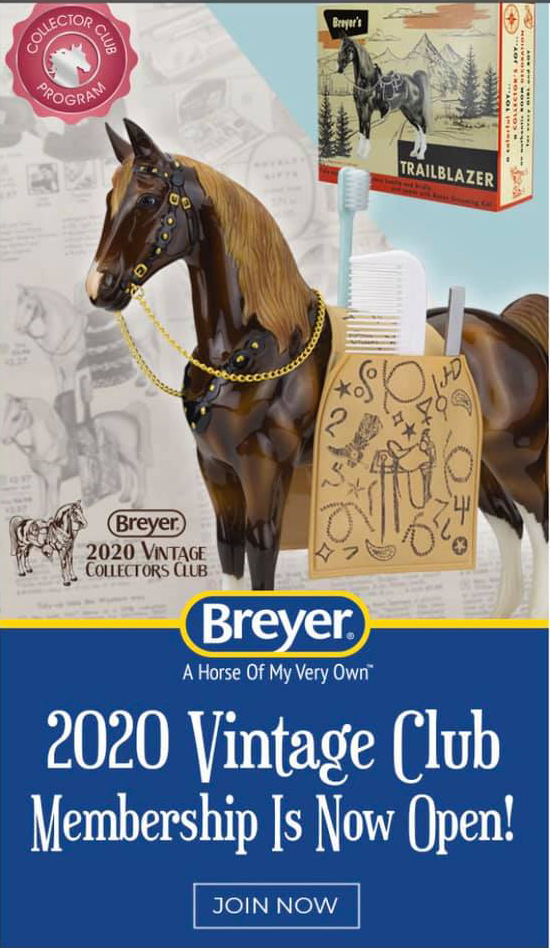
When I first saw the announcement for Trailblazer, Breyer's 2020 Vintage Club retro grooming kit Western Horse, I may have squealed out loud. (Who am I kidding, of course I did!) Not only is he a fun homage to the (hilariously named) Giant Palomino Groomer of the 1950s, but he also comes with a very cool vintage-style box based on the old Breyer horse and rider set boxes. It's an absolute smorgasbord of Breyer vintage nerdiness, and I must have one. I've been meaning to blog about Breyer grooming kits for quite a while, and now that Trailblazer has been announced, this seems like the perfect opportunity.


In the early 1950s, Westerns were at the height of their popularity. The genre had been lucrative for decades for writers from Zane Grey to Louis L'Amour, and for movie producers from the days of silent films, but as televisions became more common in American homes in the boom years after World War II, Westerns became a true pop-culture phenomenon. Many companies cashed in on this trend with all manner of "Cowboy and Indian" themed toys, child-sized cowboy boots and hats, toy six-shooters, and much, much more. Holiday catalogs were full of all sorts of these items catering to both boys and girls, and Breyer of course was right in the thick of it with horse and rider set offerings like Kit Carson, an Indian brave and chief, several cowboys, and Western Horses and Ponies in a variety of colors.

Breyer offered their horse and rider sets for play, but they also offered some spin off items like the Fury Prancer music boxes (more on those in a future blog) and various grooming kits, most with a Western theme. I don't have a full library of old catalogs at my disposal, so this post may not contain an exhaustive list of Breyer grooming kits, but as far as we know, the first grooming kits debuted in the 1954 Sears holiday catalog. They consisted of a regular run palomino Western Pony, but in place of the usual plastic snap saddle, the pony sported a vinyl "pack saddle" instead. Each pack saddle had a snap girth and several pockets on either side to hold a toothbrush, plastic comb, nail file, and nail clipper. My family acquired several different old grooming kits still sealed in the box in the 1990s at our favorite flea market, so we know that while Sears very likely supplied the vinyl grooming kit saddles and the little accessories for the grooming kits, they were packaged and sealed at the Breyer factory. (Sears of course is also a Chicago business, and at that time, its main ordering and distribution hub was less than 2 miles from Breyer, making collaboration between the companies an easy venture.) These Western Pony grooming kits constitute some of the earliest special runs that Breyer offered. (The Mastercrafters clocks technically have the distinction of being the very first.)

A 1956 Sears holiday catalog ad
A typical Western Pony grooming kit found with the original box
Interestingly, Breyer used regular Western Pony cardboard mailer boxes for their grooming kits. The only thing to indicate there was something other than a normal pony with the standard plastic saddle inside was the item number stamped on the box. By the early 1960s, grooming kits were also available on alabaster and black and white pinto Western Ponies. Some came with different accessories, such as the rifle-shaped pen, ruler, and eraser with the alabaster pony below. The Western Pony grooming kits were available off and on in the 1950s and 1960s and were last seen in the 1973 Sears catalog.

A 1962 Sears holiday catalog ad
Another 1962 Sears holiday catalog ad
As you can see from the photo below, the vinyl pack saddles came in varying shades of tan and brown, and some were smooth while others had an embossed surface meant to mimic leather tooling. The designs include steers, lariats, spurs, bucking broncos, cowboy boots, etc. Several tooling patterns have been observed, and some of these pack saddles have dark "tooling" on the designs while others have shading all over.

The black saddle came with the rare My Lady Fair sets discussed below
In 1956 and 1957, the Sears catalog offered the palomino Western Horse with a grooming kit saddle and accessories as the Giant Palomino Groomer. Like his smaller compatriot, the Giant Groomer has been found with a smooth or tooled pack saddle, and they contain a toothbrush, plastic comb, nail file, and nail clipper. The Western Pony grooming kits are fairly common which is not surprising given how long they were offered. The Giant Groomer sets are much harder to find.

Two styles of "tooled" grooming kit saddles
In 1956 and 1957, Sears offered a feminine twist on the Western Pony grooming kits. The My Lady Fair grooming kit featured an alabaster Western Pony with a black pack saddle that had loops on the side to hold barrettes as well as pockets for a comb and nail file. The 1957 Canadian Simpsons-Sears catalog also featured a My Lady Fair set, but on an alabaster Fury rather than a Western Pony. These black pack saddles are exceedingly rare. My sister and I have three---one each found on an alabaster Western Pony, an alabaster Fury, and surprisingly, a black and white pinto Western Pony. I know of only a few other saddles like this in the hands of collectors.

1956 Sears holiday catalog ad
This set has the very rare original barrettes

1957 Simpsons-Sears catalog ad

The barrettes in this set are reproductions.


The 1958 Sears holiday catalog featured some of the most rare and desirable of the grooming kits, the alabaster Proud Arabian Mare and Foal sets and the Western Pony with the houndstooth blanket. The PAM and PAF set were offered in 1958 only because, by mid-1959, Breyer had been sued by Hagen-Renaker for copyright infringement. Hagen-Renaker won, and the PAM and PAF were discontinued before the next holiday season. The Western Pony with the unique blanket grooming kit was offered in 1958 and 1959, but he, too remains exceedingly scarce. I know of only two mares, both found new in the box in the Atlanta area (now owned by my sister and me), around ten foals in boxes, and about six of the Western Ponies with houndstooth blankets (two of which were found with boxes and are in our collection). I'd to love to hear from anyone who might have a PAM or Western Pony grooming kit like these!

1958 Sears holiday catalog ad

The PAM grooming kit features a uniquely shaped powder blue vinyl saddle with pockets for a plastic comb, nail file, nail clipper, pen, and notebook. The set also includes a strip of gold leaf so kids could emboss their name on the notebook (or saddle or horse or sibling).


The PAF grooming kit has a matching blue saddle on a smaller scale with pockets for the cute tortoiseshell barrettes included in the set.


The Western Pony has a most unusual grooming kit saddle, a checked vinyl blanket with a smooth saddle-like section complete with stirrups. It snaps under the belly like all of the other grooming kit saddles. The stirrup leathers are attached to the blanket portion and have loops to hold a plastic comb, toothbrush, nail file, and a ballpoint pen. Like the more common Western Pony grooming kits, it came in a box with a line drawing of a regular pony, and only the item number stamped on the box indicates it's not a normal Western Pony.


Another very rare grooming kit is the bay Rearing Stallion set pictured below. I have only seen one example in person which is in our collection. The saddle is about the same size as the Western Pony saddles, but the pockets are cut at an angle (rather than being rectangular), and this set came with the less common accessories, a ruler, rifle pen, and eraser. As I mentioned above, we don't have a complete record of holiday catalogs, so as of this writing, the Rearing Stallion set has only been spotted in the 1966 Sears holiday catalog. (I don't have a photo of my Rearing Stallion set yet, but I'll add one after the holidays.) Do any of my readers have this unusual groomer, too?

1966 Sears catalog ad
A Western Pony grooming kit saddle on the left
and the Rearing Stallion saddle on the right.
The 1969 Gamble Aldens catalog also advertised a hard to find grooming kit, an appaloosa Running Stallion set that held a comb, toothbrush, nail clipper, and file. The saddle and accessories are identical to the ones sold with the Giant Palomino Groomers. My own set came with a smooth saddle. (Real picture forthcoming on this one, too.)


Interestingly, at least one knock-off of the Breyer grooming kits was made. I have seen several examples of a pseudo-bay Hong Kong horse, a crude copy of the Breyer Western Prancer, all wearing brown vinyl grooming kit saddles with a name printed on them---Tammy, Rusty, Mike, etc. My sister and I actually own three of them. We bought the first one thinking that perhaps the saddle might have been meant for a Breyer and had just ended up on the wrong horse at some point over the years. But having seen multiple identical sets now, I'm certain these are not Breyer saddles. The construction of the saddles is very similar to the Breyer saddles however, so whichever company made them may have been the source for both the Breyer sets and the knock-off sets. I would guess these Hong Kong copies were also offered through a mail order catalog, and while the horses were manufactured overseas, the saddles and accessories were probably sourced here in the US. The saddles all bear different names, either in print or in cursive, which suggests to me that the sets could be ordered with personalization for the recipient.

Hong Kong grooming kit personalized for Tammy
Breyer's Western Prancers were first issued in 1963, so these copies must of course be later. I would guess they date from the late 1960s or early 1970s.

Hong Kong copy personalized for Mike (photo from eBay)
The Western genre was on the decline by the 1970s, so I would guess these sets, along with the ones Breyer made, were discontinued by the mid-1970s at the latest. As I mentioned above, the last appearance of the Breyer grooming kits came in 1973. The world by that point had moved on technologically and culturally by leaps and bounds since the 1950s, and the toy market was geared more towards the space race than a nostalgic look back at the Old West.

My parents grew up in the 1950s, and so as a kid growing up in the early 1980s, they happily encouraged my cowgirl phase with a Clip-Clop horse, a hat, boots, and little cap guns. I have never really outgrown my fondness of Westerns---everything from classics like the Lone Ranger and The Good, The Bad, and The Ugly to Longmire and Firefly---and I am delighted that after almost 50 years, Breyer will be offering a new grooming kit for us. I can't wait!