Showing posts with label breyer history. Show all posts

Tuesday, April 7, 2026

The History Between Hagen-Renaker and Breyer, Part 2: The Classic Scale Families and Racehorses

In my last post, I wrote about how the relationship between Hagen-Renaker and Breyer began with Breyer's unauthorized copies of Hagen-Renaker's large Arabian family, Zara, Zilla, and Amir. After negotiating to re-release the Proud Arabian Mare and Foal in the early 1970s, Breyer also came to an arrangement with Hagen-Renaker to produce some of their smaller molds in plastic, what we now know as the Classic and Stablemate lines. This post will cover the Classic scale models. 

In the early 1970s, Hagen-Renaker sent Breyer a variety of bisque horses from their Designer's Workshop and Miniatures series to consider for inclusion as plastic models in the Breyer line. These models were all sculpted by Maureen Love and are often referred to as "Love molds" by collectors. Some of these bisque pieces survived and have happily made it into the hands of several collectors. The horses pictured below are owned by Liz Cory who received them from longtime Breyer retailer and company friend Stuart Bentley. Liz said that some of the bisques were "marked up for production but were never created in plastic. Instead, as Peter Stone told me, they were kept on a shelf in the 'executive men’s room' until the Breyer Chicago factory closed. Stu Bentley visited the factory when they were closing up and he saw these bisques about to go into the trash. He took these bisques home, where he and Mrs Bentley proudly displayed them in their Des Plaines living room for decades until the house was sold. This group then came to me, and they joined additional bisques that I got from Marney [Walerius]." [1]

Photo by Liz Cory

Breyer ultimately chose 14 Designer's Workshop Hagen-Renaker molds to produce in plastic for their Classic series, the first three being Sheba, Sherif, and Fersyn. Breyer issued them as the Classic Arabian family beginning in 1973. 


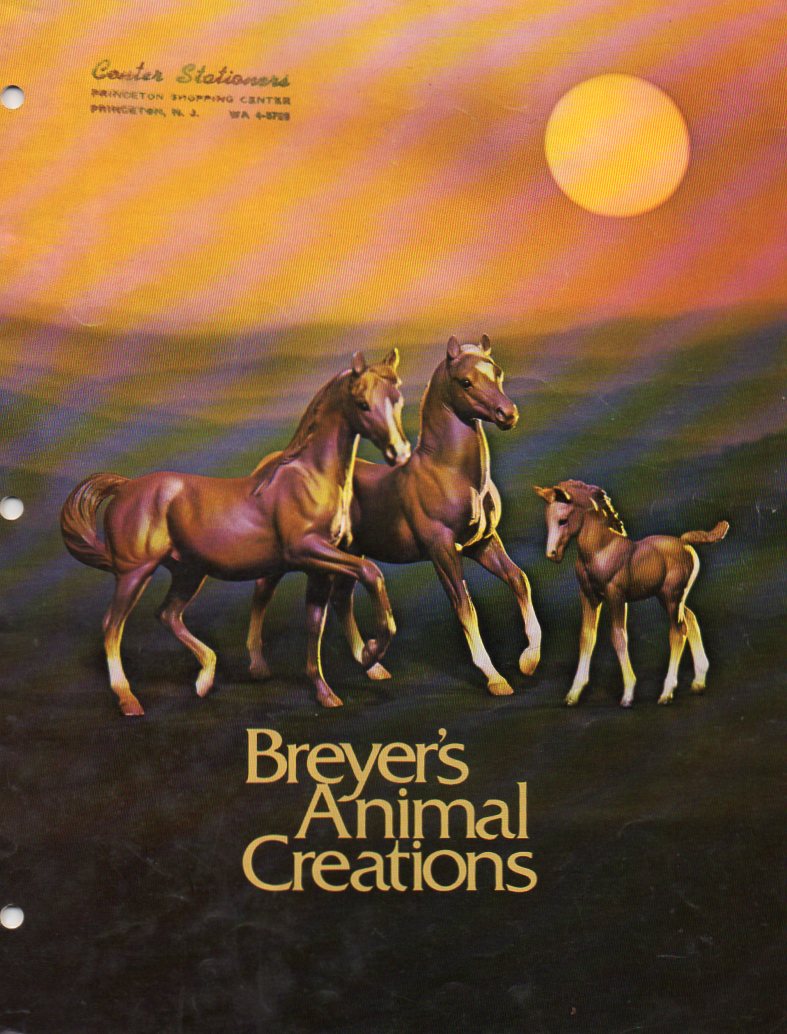
Unlike the Proud Arabian Mare and Foal before them, the Classic scale horses are exact copies of their Hagen-Renaker antecedents, but the Hagen-Renaker originals are a smidge larger than their Breyer counterpoints. The Classic Arabian Family was featured in a beautiful color photo on the cover of the Breyer dealer and box catalogs the following year (1974). 

HR Sheba (left) and Breyer Classic Arab Mare (right)


HR Ferseyn (left) and Breyer Classic Arab Stallion (right)


Breyer Classic Arab Foal (left) and HR Sherif (right)


In 1974, the second Classic scale family, the Quarter Horse Mare, Stallion, and Foal, was released based on Hagen-Renaker's Erin, Two Bits, and Shamrock models. And just like the Arabs, the Quarter Horse family got their color photo glamor shot on the cover of the following year's catalog in 1975.

I've always found the Breyer Classic Quarter Horse Mare to be a little wonky, especially for a Maureen Love sculpture. Her body and neck seem a bit too long and thin for her short legs. When we finally  acquired a Hagen-Renaker Erin a few years ago, I was fascinated to see the differences between the two pieces. It appears that the Breyer mold ended up slightly skewed proportionally from the HR original which is far more attractive in my opinion. 

Breyer Classic QH Mare (left) and HR Erin (right)


Happily Two Bits seems to have translated to plastic without any problems. Likewise for the foal, but unfortunately, we don't have a Hagen-Renaker Shamrock in our collection yet, so I don't have a comparison photo to share at the moment.

HR Two Bits (left) and Breyer Classic QH Stallion (right)


In 1975, Breyer released five new molds based on the exquisite Thoroughbred portrait models Maureen Love sculpted for Hagen-Renaker---Man O' War, Swaps, Terrang, Sillky Sullivan, and Kelso. 

HR Man O' War (left) and Breyer MOW (right)
 
HR Swaps (left) and Breyer Swaps (right)
 

HR Terrang (left) and Breyer Terrang (right)


HR Silky Sullivan (left) and Breyer Silky (right)


HR Kelso (left) and Breyer Kelso (right)


The last of the Hagen-Renaker molds to debut in plastic for the Classic series was the Mustang family in 1976 based on Daisy, Comanche, and Butch. (Apologies for not consistently keeping the HRs and Breyers on the same sides for the photos!)


Breyer Classic Mustang Stallion (left) and 
HR Comanche (right)


HR Daisy (left) and 
Breyer Classic Mustang Mare (right)

 
HR Butch (left) and 
Breyer Classic Mustang Foal (right)


As I wrote in my last post, these Hagen-Renaker derived molds remained in Breyer's line up for the next 30 years until a dispute over licensing royalties in 2005 brought the arrangement to a screeching halt. Though the companies "settled," whatever the terms were precluded Breyer from continuing to use their molds based on Hagen-Renaker's designs. By 2006, the Hagen-Renaker molds available the previous year had been swapped out for other molds sculpted by other artists. For example, the red roan Classic Arabian Mare and dark bay Classic Arabian Foal in the #62003 Arabian Mare and Foal set were switched out in favor of the Classic Johar mold sculpted by Chris Hess and the Classic American QH Foal sculpted by Kathleen Moody as seen in these photos from the 2005 and 2006 Breyer dealer catalogs.


And then in August of 2014, Breyer suddenly announced a new web special available only to Collector Club members on the Classic Arabian Mare mold, a lovely chestnut tobiano named Cosette. The following year, a matching stallion and foal were issued, also as web specials. In the 10+ years since then, the Classic scale Love molds have slowly reappeared as Breyer web exclusives and Vintage Club editions. They have all been limited releases until 2025 when the Classic Arabian Mare trailblazed her way back into brick and mortar stores just in time for Breyer's 75th anniversary. I was delighted to be able to pick one out over the holidays from the hobby shop my dad frequents.


As of this writing in early April 2026, all of the Classic scale Love molds have reappeared except for Kelso and Silky Sullivan. Perhaps we'll see them in a future Vintage Club release, a limited web special, or maybe even back in stores once more? I am definitely ready for some new Thoroughbreds for my congas! 

_________________________________________________

Sources:

1) Online conversations with longtime collector and former Breyer employee Liz Cory in February 2023 and February 2026

Tuesday, February 24, 2026

The History Between Hagen-Renaker and Breyer, Part 1: The Large Arabian Family

The subject of the history between Hagen-Renaker and Breyer comes up fairly regularly on Facebook, and since it can be confusing for newer collectors, I thought this would be a fun topic to tackle. Breyer collectors discovering Hagen-Renakers for the first time are often surprised to find that some of their beloved plastic models bear a striking resemblance to ceramic models made by Hagen-Renaker. And they are further surprised to find out that the Hagen-Renaker models actually came first, not the Breyers. A little history of both companies is helpful to understand the sometimes contentious relationship between the two.

Hagen-Renaker was founded in 1945 in Culver City, CA, before later moving to sites in Monrovia, San Dimas, and San Marcos. They began by molding and selling cute functional ware like dishes, but they quickly realized that small animal figurines were far better sellers. Of particular interest to model horse collectors, Hagen-Renaker hired local artist Maureen Love in 1951, first as a decorator, and when her immense talent was recognized, as a designer and sculptor. Maureen's first horse sculptures for HR were issued in 1953.

A notation from the Hagen-Renaker mold book dated July 1953
next to the entries for Maureen's first DW horses, the Morgan family
(Heather, Thunder, Clover, Scamper, and Roughneck)


Breyer meanwhile began as a plastic molding company in Chicago in 1943. They made a variety of car, airplane, and radio parts for the government during World War II, and they then branched out to simple toys like checkers and money managers in the later 1940s. In 1950, Breyer began molding the Western Horse (and a clock base) for the Mastercrafters Clock and Radio Company, also in Chicago. They soon began to sell the horse free-standing as well before expanding their line to include other horses and animals. The majority of the models produced by Breyer before 1958 were copied from other manufacturers like Hartland, Boehm, Rosenthal, and Grand Wood Carving.

The sometimes fraught relationship between Hagen-Renaker and Breyer began in the mid-1950s. In Fall 1956, Hagen-Renaker began the roll-out of their large Arabian family, Zara, Zilla, and Amir. The foal Zilla was the first piece available in Fall 1956, Zara the mare followed in Spring 1957, and Amir the stallion came last in Fall 1957. 


Left to right: HR Amir, Zilla, and Zara


By late 1957 or for sure by 1958, Breyer had begun molding very close copies of Zara and Zilla that we now know as the Proud Arabian Mare and Foal. The most notable differences are that the Hagen-Renaker mare and foal have slightly turned heads while the Breyer pair face straight ahead. There are also other more subtle differences in positioning, size, and detail that I hope these pictures show. 

Breyer PAM on the left, HR Zara on the right

Differences in body and tail width, slight 
position changes, etc


Zara's whole body is slightly curved 

Just like the PAM and Zara, the PAF is essentially a simplified version of Zilla. 

Breyer PAF on the left, HR Zilla on the right


Just as with the mares, Zilla is more complex 
while the PAF is straight and simple


So similar and yet so many nuances

The matching stallion, now known as the Family Arabian Stallion, was not pictured in the 1958 Breyer catalog and probably was not released until late that year or in early 1959. Interestingly, the Family Arabian Stallion was much less closely copied from the Hagen-Renaker Amir than the PAM and PAF were from their Hagen-Renaker counterparts. (Which is honestly a shame because Amir is such a knock out, but I digress.) As you can see, the FAS is somewhat of a mirror image of Amir, at least in terms of his legs, and he is decidedly less finely detailed. He is much more a Chris Hess original and less a Maureen Love copy than the mare and foal are.

It does make you wonder why the FAS is so different. If I had to hazard a guess, it would be that Hess had an example of the Hagen-Renaker Large Zara and Zilla on hand to work from, so he was able to study them closely for the purpose of copying them. I would also surmise that Hess did not have access to a Large Amir and perhaps was working only from a photo of the piece.


HR Amir on the left, Breyer FAS on the right 
(notice the reversed raised legs)

Whatever the case, by 1959, Hagen-Renaker was fighting a growing tide of imported as well as domestic knock offs of their designs. Sometime in mid to late 1959, they unsurprisingly sued Breyer for copyright infringement over the unauthorized use of Zara. (Hobby lore has it that Zilla and Amir were included as well, but the only extant legal documents available to me are from 2005, and by that point, both parties had apparently forgotten the exact specifics of the original lawsuit.) The dispute was resolved, and Breyer discontinued production of the Proud Arabian Mare and Foal, but not the Family Arabian Stallion. (They then created the Family Arabian Mare and Foal (after the hiccup that was the In Between Mare) to replace the PAM and PAF in their line in 1960.)

The 1960s were initially a boom time for Breyer, and their plastic horse and animal line grew exponentially. With only a few exceptions, Breyer seemed to have learned their lesson, and most of their new models were original sculptures by Chris Hess, not copies of other companies' works.

Hagen-Renaker in contrast faced a serious sales slump that almost put the company out of business in 1960. Cheap imported copies of their figures made in Japan were flooding the market, and the company was forced to lay off all but a handful of employees. They limped along on a skeleton crew until business began to pick back up in the mid-1960s.

The Large Arabian family was issued sporadically in the late 1950s and into the 1960s, but production of all three molds ended for a number of years after Spring 1968. Around this same time, Sam Stone, the owner of Breyer and father of Peter Stone, was considering closing down their horse and animal molding division of Breyer as not profitable. Peter begged his dad to reconsider and began traveling the country to promote the line. [1] 

In 1971, Breyer heeded collector demand for a more modern Arabian stallion sculpture and released the instantly popular Proud Arabian Stallion mold. When collector and hobby consultant Marney Walerius reminded Peter Stone of the existence of the Proud Arabian Mare and Foal molds, Breyer opened negotiations to arrange a licensing agreement with Hagen-Renaker to reissue the molds as companions to their new stallion. [2] The PAM and PAF remained in steady production until about 2005 when a new dispute arose between Breyer and Hagen-Renaker. 

The root of the issue was a disagreement between the parties over the contours of the 1970s arrangement to re-release the Proud Arabian Mare. In 2005, Reeves (Breyer's parent company after a buy-out in 1984) sued Hagen-Renaker, asserting that Reeves owed no royalties for their Zara-derived model because Breyer had purchased her ownership rights from Hagen-Renaker years before. For its part, Hagen-Renaker countersued and alleged that due to the omission of Zara (the PAM) from a 1990s written licensing agreement, Breyer had relinquished any right to produce her.

The court record indicates that this 2005 dispute was "settled." We do not know the terms of the settlement, but we know as collectors that Breyer did cease production of the Proud Arabian Mare and all other Hagen-Renaker sculptures for about ten years thereafter. (The only exceptions were a handful of one of a kind models painted for BreyerFest auctions, the 2008 Velvet Rope Event micro run PAM "Celebrity," and a 2009 Fun Foals micro run palomino appaloosa PAF. (I assume these were produced on already molded ware, and therefore fell into some sort of loophole (or flew under the radar.))

Happily, the companies were apparently able to reach some manner of satisfactory arrangement again, and starting in 2014, Hagen-Renaker molds returned to the Breyer line. Interestingly, most have been fairly limited releases like BreyerFest special runs, web specials, and Vintage or Stablemate club releases. In fact, I think the 2025 silver dapple bay Classic Arabian Mare release "Ariana" is the first Love mold to be widely available in brick and mortar stores in about 20 years.

Most excitingly, a new chapter in the Hagen-Renaker and Breyer relationship opened in 2025 with the release of the Stablemate Club model "Madonna." She's a scaled down scan of Hagen-Renaker's Large Zara mold (not the Proud Arabian Mare!), making it the first new Maureen Love sculpture to be introduced to the Breyer line up in 50 years. How very fitting! I can hardly wait to see more colors on this mold!

Left to right: Breyer Proud Arabian Mare, Madonna, and 
Hagen-Renaker Large Zara

This new relationship between Hagen-Renaker and Breyer gives me hope that we might someday see new mini versions of other Hagen-Renaker molds issued in plastic. A matching mini Zilla and Amir would be so exciting! Maybe we can even dream of new Classic scale models based on Designer's Workshop molds Breyer rejected for leases in the 1970s. I would lose my mind for accessible, repaintable, plastic versions of Hagen-Renaker's Comella and Vanguard. But more on that in the next post!


___________________________________________________

Works Cited:

1) Young, Nancy Atkinson. Breyer Molds and Models: Horses, Riders, and Animals 1950-1997. (Atglen, PA: Schiffer Publishing Ltd, 1999), pg. 5.

2) Walerius, Marney J. Breyer Models: Reference and Insurance Guide. (Barrington, IL: Self published, 1991), pg. 5.


Friday, October 4, 2024

My Own Money Manager Manifested!

I mentioned in a recent post that my family likes to joke that if we talk about or think about a certain model enough, we can manifest it. So that said, I spent the last several months working on and researching my early history of Breyer post, and I most definitely had Breyer's My Own Money Manager bank on the brain because of it. I've wanted one for years, but they're very hard to find, and they're usually expensive despite often being in rough shape when they do turn up.

So, not surprisingly, I was very excited to see a Money Manager pop up on eBay mere days after my Breyer history post went live a couple of weeks ago. Manifested? Maybe! I stalked the auction impatiently for a week, won it for a song, and then refreshed the tracking number for the box frequently once it was shipped. As soon as I got the text notification that it had arrived, I flew out of my office, slapped a sign on the door that I was "at lunch," and ran over to the campus mail room to retrieve the box.

The auction did give the dimensions of the Money Manager, not much more than 4 inches tall, but it's smaller than I've always imagined it. It's so tiny and cute!

Yay! Silly grail achieved!


According to the "New Toys On Parade" feature in the February 1950 issue of Toys and Novelties, a Chicago toy industry magazine, the My Own Money Managers were sold exclusively by Gimbels in New York for the holidays beginning in 1949 with more general distribution of the item planned for 1950.  The Money Managers were described as "authentic, miniature office file[s]," and they were advertised as having "sales potential to adults, teen-agers, careerists, for office petty cash, and unlimited other purposes," although they were primarily marketed for kids. Each one came with printed labels for the drawers, "12 popular headings for children, 8 for adults, and 4 blanks for personal projects." The Money Managers  also came with a booklet entitled "Grow A Self-Reliant Child."

February 1950 Toys and Novelties

The Money Managers came in "flag red" or "forest green," according to Breyer's advertising, and they were molded in Tenite plastic, just like the horses that would follow soon after. They were highly touted by Parents magazine and seem to have been popular sellers initially. Peter Stone, son of company founder Sam Stone, recalled that the Money Managers were sold in Walgreens drug stores (and likely other drug stores and five-and-dimes of the time). He also remembered seeing commercials for them on TV featuring a local Chicago celebrity. [1] The ad on the left below shows a child watching just such a commercial on TV.

March 1950 Toys and Novelties ads

In June 1950, an ad for a 6-drawer Money Manager was featured in Toys and Novelties. It was priced at $2.98, the original price for the 4-drawer model (which was reduced to only $1.98). Interestingly, the ad also includes model numbers for the Money Managers, 0044 for the 4-drawer and 0046 for the 6-drawer. There aren't many Money Managers in the hands of collectors, and the majority of them are 4-drawer examples. I think I recall seeing a 6-drawer example owned by another collector in a photo on Facebook several years ago, but I can't find it again, so I'm not sure I'm remembering correctly. Whatever the case, the 6-drawer Money Manager was only advertised once in Toys and Novelties as best I can tell (my local archive was missing some issues from the early 1950s), and they are even harder to find than the 4-drawer version.


For the holidays in 1950, Sears offered the usual red and green Money Managers as well as a tortoise shell version marketed as a Cigarette Host for adults. Collector Andrea Gurdon found one in the original box some years ago---you can read about it on her blog here. Peter Stone said that his father and his business partner came up with the idea for the cigarette host first, but it didn't sell well, so they rebranded it as a children's bank. [2]

1950 Sears ad

As of this writing, it's known that some Money Managers are just marked "Pat. Pending" while others say "Breyer Molding Co., Chicago, Ill., Pat. Pending, Made In U.S.A." Presumably, the earliest pieces had only the short patent pending text while the later versions included the Breyer name. Andrea's Cigarette Host has the full text, so it seems likely that Breyer continued to sell those along with the Money Managers at least as late as December 1950. I haven't found any other ads for the Cigarette Host, so that may suggest that it was only sold for about a year which is in keeping with Peter's recollection that it sold poorly. That would also suggest the text on the Cigarette Hosts and Money Managers was expanded from "Pat. Pending" to the full wording by late 1950. If that's the case, I would assume that Money Managers like mine that are only marked "Pat. Pending" are presumably from the first few months of production.

Some of the earliest ads for Money Managers in magazines like Toys and Novelties and Playthings featured palomino and alabaster Western Horses on one side of a page with the Money Managers on the back. I didn't have either of those color horses handy today for photos, so this well-loved old pinto WH who hangs out in my office got to be the scale model.


The last ads for Money Managers appeared in 1953 magazines, and after that, there were no further mentions of them from Breyer. By that time of course, Breyer had discovered that plastic horses sold really well, and their toy line had taken off in a more fun direction. More on that soon when I post part two of Breyer's early history in the 1950s.

Money Managers initially sold for $2.98 in 1950 which is the equivalent of $38.92 in 2024 (according the the US Inflation Calculator website), so they were not inexpensive items. Even when they were marked down to $1.98 in mid-1950 and then $1.69 in the Sears 1950 holiday catalog, that was still $25.86 and $22.07. A more reasonable price to be sure, but perhaps not low enough to keep them a viable product.

When Nancy Young published the last edition of her Breyer Molds and Models book in 1999, she was not aware of any Money Managers in the hands of collectors. [3] In the intervening years, a few of them have come to light, but they remain pretty elusive despite having been available for about 4 years from late 1949-1953. This is likely due in part to the fact that some of them are not marked Breyer, and they probably fly under the radar unidentified on sites like eBay. Also, though Money Managers are fairly solidly constructed---mine is heavier than I expected---they are a bit fragile. The doors on the drawers fit snugly and can be hard to open and unlock for coin retrieval. If handled roughly, they can chip, crack, and break. The cases are also prone to warping, making the drawers inaccessible and the product useless. I would guess a lot of these ended up in land fills long ago.

The handful of other Money Managers owned by collectors that I've seen seem to be evenly split between green and red, and all of the ones I could find pictures of have 4-drawers. If someone reading this had a 6-drawer example, I'd love to see a photo! As for the Cigarette Host, I have not seen anyone mention finding one besides Andrea. This isn't entirely surprising. Since the Money Managers are not horses or animals, they have a pretty limited audience among Breyer collectors. But I would hope there are more lurking out there, waiting to be found in the collection of early toy enthusiasts or tobacciana collectors. I will certainly be on the hunt for Money Manager variations now!

------------------------------------------------------------------------------------------------------------

1) Young, Nancy Atkinson. Breyer Molds and Models: Horses, Riders, and Animals 1950-1997. (Atglen, PA: Schiffer Publishing Ltd, 1999), pg. 332.

2) Ibid.

3) Ibid.

Wednesday, September 18, 2024

The Early History of Breyer: 1943-1952

  "There's a great future in plastics. Think about it. Will you think about it?"


These lines from the 1967 movie The Graduate---advice offered to Dustin Hoffman's character at his college graduation party---have always stuck with me (even when little else from the film did). I watched the movie for the first time some 30 years after it was released, and I thought the lines were kind of funny at the time. I mean, duh, plastic is ubiquitous in modern life, right? But while plastic is a part of everyday life that we often take for granted, it absolutely revolutionized life as we know it after World War II. In the 1960s when The Graduate was made, the plastic industry was still booming and growing.

The history of plastic dates back to the 1830s, but it took decades for the process to be refined and perfected. Some of the earliest uses included billiard balls (ivory had become expensive and rare) and then film and phonograph records.[1] The dawn of the 20th century saw greater leaps in manufacturing technology, and plastic became more accessible, appearing as nylon in tooth brush bristles, as the ever-popular Bakelite jewelry, and in celluloid vanity sets (hairbrushes, hand mirrors, etc) and other decorative wares. Simple celluloid toys became available by the 1930s, most of which were manufactured in Germany, the largest importer of toys to the United States before World War II.[2]

As tensions in Europe rose in the late 1930s however, imports from Germany slowed to a trickle, and wood, composition, and metal toys produced in the United States began to grow in popularity and numbers. Plastic technology continued to improve, but with the advent of World War II, most American plastic manufacturing was diverted to the war effort. Manufacturers learned a great deal during those years, and when the war finally ended, the plastic industry truly took off. Toy magazines and catalogs from the late 1940s clearly show the swift transition from wood, composition, and metal toys to plastic---by 1950, the switch was pretty much complete. Injection molding technology had also arrived which revolutionized the process of making goods in terms of speed, cost, and safety. [3]

The post-war baby boom and the advent of television and all the advertising tie-ins that came with it produced a huge audience for new plastic toys. And this is where the Breyer Molding Company comes into the picture. New plastic manufacturers were sprouting up all over the country in the late 1930s and 1940s, especially once the US joined the war. Plastic production increased by 300% during those years to meet the huge demand [4], and Breyer was one of the companies that rose to the challenge.

The Breyer Molding Company as model horse collectors know it began in 1943 at 2536 W. Lake Street just west of downtown Chicago in the heart of the city's manufacturing district. Peter Stone (yes, that Peter Stone) related to Breyer historian Nancy Young that his father Sam Stone and business partner Barney Smith bought the company for $15,000 knowing nothing at all about the plastic molding business.[5] Smith died unexpectedly in November 1947, and Charles Schiff joined the company in his place.

Many collectors have wondered where the Breyer name came from, and despite the company being in business for more than 80 years, it's been an enduring mystery. To the best of anyone's knowledge, there was never an "old man Breyer" who started the company. Stone and Smith purchased the company with the Breyer name from a family called Shoecraft, and Peter's best recollection was that the name honored "a 19th century German chemist who invented a type of cellulose plastic."[6] I have spent months digging through archives, contacting museums and historical organizations devoted to preserving the history of chemistry and plastic, and reaching out to various academic institutions around the world in hopes of finding some clue as to who this chemist was, but all of my searching has come to naught. No one has any record of a chemist named Breyer, not even one without a connection to early plastic experimentation.

I did however find a Nobel prize winning 19th century German chemist by the name of Adolf von Baeyer who was primarily known for his work synthesizing indigo dye, but who is also famous for inventing a precursor to what later became Bakelite. The name is off by one letter, but it's easy to confuse a capitalized A with a capitalized R (and Breyer's logo is capitalized), so Baeyer might have accidentally been misspoken, misread, misspelled, mistranscribed, or misremembered as Breyer. I can't prove that von Baeyer is the inspiration behind the Breyer name, but he is the only 19th century German chemist whose name and work comes at all close to matching Peter's recollection, so I think this is a plausible source for the name.

That said, it is also possible that the story about the German chemist was apocryphal. For all we know, the Shoecraft family had a relative, friend, mentor, or financial backer named Breyer. We'll probably never know. But if Peter's memory was correct, Adolf von Baeyer might just be the namesake we've been looking for all these years.

With World War II in full swing in 1943, there was a tremendous need for plastic parts for the war effort for airplanes, various military vehicles, and other equipment, and Breyer was commissioned to make everything from radio housings to steering wheels.[7] After the war ended and the demand for parts from the government waned, Breyer continued to design and mold items for other companies like RCA and Zenith [8], and they began to develop their own products as well, such as checkers, poker chips, and other simple toys. As you can see from the 1946 ad below, the Breyer factory was a one-stop-shop for plastic production from concept to creation---they designed items, made molds for said items, and produced plastic items from their molds.

A Breyer ad from the 1946 edition of The Buyers' Guide
and Industrial Directory of Chicago


Breyer's earliest forays into the toy market were vaguely educational. Peter Stone related to Nancy Young how as a boy helping out at the factory, he would load the warmed plastic pills for molding poker chips and checkers into the compression molding machines [9]. Breyer also briefly sold a Money Manager bank from 1949 to about 1953. They were molded in "superior quality acetate Tenite" [10] as per the ad below and came in "flag red or forest green" with 4 or 6 drawers. They included labels so children could save their money for different things like presents, charity, and savings.

March 1950 Toys and Novelties ads

The 1950 Sears Christmas catalog also advertised a Breyer-made Cigarette Host molded in "tortoise shell color plastic" right alongside the Money Manager. (Perhaps not the best product arrangement for the page.) All of these early non-animal Breyer products are hard to find.

 
As I wrote in my posts about the history of the Western Horse, the Breyer factory was located only a few miles from the Mastercrafters Clock and Radio Company. In 1950, Breyer was commissioned by Mastercrafters to take over some molding work that had formerly been done by Hartland Plastics of Wisconsin. This work resulted in the iconic Western Horse, the very first Breyer model. As I discussed in the Western Horse blog series, the Breyer Western Horse was a very close copy of the Hartland Victor, and it was also Chris Hess' first horse sculpture for Breyer. Though no one knew it at the time, this sideline of plastic horses would eventually eclipse all of the other practical plastic goods Breyer made and become the company's primary product and main claim to fame.

The very first Breyer models, the Western Horses Over Clocks


Breyer provided horses for Mastercrafters for a few years, first to stand over the clocks (probably 1950 only) and later to stand beside the clocks (circa 1951-1952). By 1951, Breyer also had begun to sell the Western Horses as freestanding models in palomino and alabaster. Early records and company lore suggest that Woolworths department store placed an order for 2,000 of the freestanding Western Horse models to sell in their stores. [11]


In June 1952, Breyer's business was booming, so much so that they built an 11,000 sq foot addition to their factory. [12]

Me (with a Breyer PAM and her Chicago-era box) posing like
the giant nerd I am in front of the old Chicago Breyer factory


By late 1952, Breyer had begun producing their second and third molds, a Boxer dog and the Western Pony. Which came first is debatable, but the Boxer was at least promoted in the Chicago toy publication Toys and Novelties. (I have yet to find a similar ad announcing the Western Pony, but hope springs eternal.) The Western Pony is a smaller version of the Western Horse, so in that regard, it too is technically a derivative of the Hartland Victor from which the Western Horse was copied. The Western Pony came in both palomino and white like his big brother, and the striking black colorway with gold feet was introduced for both models at this time as well.

The Breyer Boxer model was yet another copy, although this time unauthorized. It was molded directly from the fine porcelain Boxer sculpted by Edward Boehm and sold by his studio in New Jersey. Chris Hess, who was a sculptor, carver, and mold maker, most likely tooled this mold for the company. Copying the works of other contemporary companies, especially those producing ceramic or porcelain wares, became a common theme for Breyer in the 1950s and into the early 1960s. The glossy and occasionally chalky finishes on some of their early models were in fact meant to imitate fine porcelain!

March 1953 Toys and Novelties ad

Boehm Boxer (left) and Breyer Boxer (right)

I had intended to try to cover all of the 1950s in this post, but Breyer production really began to take off in 1953-1954, and this post is already pretty long, so I will cover the rest of that decade in a subsequent post. In the mid 1950s, Breyer continued to copy other manufacturers, but they also began to create their own sculptures as well. The next post will cover the rise of TV show tie-ins, holiday catalog special runs, a lawsuit for copyright infringement, and much more!


____________________________________________________

1) Science History Institute Museum and Library: https://sciencehistory.org/education/classroom-activities/role-playing-games/case-of-plastics/history-and-future-of-plastics/

2) Lone Star Chemical (plastic manufacturer): https://lonestarchemical.com/50-years-of-favorite-plastic-toys/

3) Syracuse University Library, The Plastics Collection: https://plastics.syr.edu/page.php?id=/essays/plastic-toys

4) Science History Institute Museum and Library: https://sciencehistory.org/education/classroom-activities/role-playing-games/case-of-plastics/history-and-future-of-plastics/

5) Young, Nancy Atkinson. Breyer Molds and Models: Horses, Riders, and Animals 1950-1997. (Atglen, PA: Schiffer Publishing Ltd, 1999), pg. 332.

6) Ibid

7) Ibid.

8) Walerius, Marney J. Breyer Models: Reference and Insurance Guide. (Barrington, IL: Self published, 1991), pg. 1.

9) Young, 332.

10) Tenite is a kind of cellulosic plastic (cellulose acetate) made by Eastman (Kodak) starting in 1929
https://www.eastman.com/Brands/Tenite/Pages/Overview.aspx

11) Past iteration of the breyerhorses.com website and confirmed by Stephanie Macejko in a seminar at BreyerFest 2025

12) "10 Million Will Be Spent by Chicago Plants," Suburbanite Economist, (Chicago, IL), June 22, 1952, pg 48.

Wednesday, April 20, 2022

Turning back the clock on the Breyer Western Pony

One of the perks of working for my alma mater, the University of Chicago, is access to its extensive library collection of more than 12 million volumes. Through it, I also have access to a variety of affiliate libraries in the area with interesting holdings of their own. Last May, I was finally able to visit one of these libraries to look through their issues of Toys and Novelties, a Chicago-based toy industry publication. My primary interest was in volumes from the mid-1940s through the end of the 1950s, seeking new information on the early days of Hartland, Breyer, and some of the companies that copied them.

Nearly 15 years of toy publications. I looked at
every single page.

Much of what I found has already been documented by earlier researchers, but I did turn up some fun new information that I don't think has been published yet. None of it is exactly earth-shattering, but it is the kind of minutiae that hobby history nerds like me live for.

First, some background---the earliest years of Breyer's history as a model horse manufacturer at the beginning of the 1950s are fairly murky. Very little in the way of early documentation has come to light, so collectors have made educated guesses based on the ads, catalogs, and price lists that do exist. We know the broad strokes, that Breyer started with the Western Horse in 1950 after taking over a contract with Mastercrafters Clock and Radio Company formerly held by Hartland. And we know that within a few years, they had added the Boxer, Western Pony, Fury Prancer, Lassie, Brahma Bull, and the Walking Hereford Bull to their line up along with a variety of riders. The earliest known catalog probably dates to 1954, but earlier company-issued catalogs, if they ever existed, have yet to come to light. We therefore have to rely on other sources of information such as toy trade publications like the aforementioned Toys and Novelties for glimpses into Breyer's beginnings.

I started with 1948 and worked my forward page by page over the course of several 8 hour days. The number of Hartland ads in the 1950s in Toys and Novelties far outstripped those by Breyer, but what Breyer submitted was at least colorful and visually appealing. Most issues featured a "New Toys on Parade" section which generally promoted products that had been on the market for a few months and were selling well. The Hartland Victor (free-standing) was listed in the new toys column in 1950, and the Breyer Western Horse (also free-standing) was likewise endorsed in the same column in 1951. (We know both models were available a year earlier respectively, but that has already been covered in my Western Horse Shaped Objects blog series.) I found this nice Western Horse advertisement in a 1952 issue (this is not a new discovery for collectors; it's just pretty). The back of the page features an ad for Breyer's Money Manager bank.

 
While it seems logical that Breyer's second model would be the Western Pony, it may in fact have been the Boxer which was featured in the "New Toys on Parade" column in February 1953.


The March 1953 issue is where things begin to get interesting. We know from Breyer historian Nancy Young's research that the earliest ad for a Western Pony she was aware of dated from the September 1953 issue of Western Horseman magazine (as per her published books in the late 1990s). According to Hartland expert Mike Jackson who collaborated with Nancy in the early 2000s, she had by that point come to believe that the Breyer Western Pony pre-dated the Hartland Small Champ, and likely dated to early 1953 if not earlier. The article below puts paid to that theory. Or rather, the photo does!

The article is about toy sales reps Walter and Arthur Krenzien, a father and son team who started their business in downtown Chicago in about 1930. They were one of the biggest promoters for Breyer in the early 1950s, and their ads featuring Breyer models can be found in a variety of 1950s Toys and Novelties issues. This particular issue from March 1953 mentions Breyers only in passing as one of many lines promoted by the Krenziens. It's the photo combined with the date of the magazine issue that knocked my socks off.


Check out the table on the left!

A close up---left to right: Boxer, alabaster WH & WP,
black WH & WP, and palomino WH & WP


To the best of my knowledge, this is the earliest proof we have of the existence of the Western Pony and the earliest date known for the black with gold trim colorway for the Western Horse and Pony. Because magazines are stocked and mailed in advance of their issue date, and because a certain amount of time is needed to write articles, lay out the articles, photos, and ads, and get the whole thing printed, the March 1953 issue of Toys and Novelties was very likely out by February of that year, presumably having gone to print at least the month before. Allowing time for writing and layout, it seems very likely that the actual photo used for the issue may have been taken some time in late 1952. Even if the Western Pony (and the black colorway for the Western Horse and Pony) were not yet available for sale in March 1953, we at least know the mold was functional and very likely in use by late 1952. It's entirely possible the Ponies (and the Boxer) were even sold for Christmas 1952.

I did not find an official "News Toys on Parade" release for the Western Pony as I did for the Western Horse and and Boxer, but I did find later ads for the Western Pony with various riders. It's possible the  Western Pony may predate the Boxer but simply wasn't advertised, or the two models may have been developed simultaneously. Given that Breyer was just getting started with model horses (and dogs), they may not have felt the need to promote every new release, or perhaps the Western Pony product announcement simply hasn't come to light yet. We may never know for sure, but it's fun to keep looking.

By 1954, Hartland was advertising their Champ models with cowboys and cowgirls, and by 1955, both Hartland and Breyer were in full swing offering various horse and rider sets. Nancy Young suspected that the Breyer riders probably predated all of the Hartland ones, but Hartland certainly beat them to the punch acquiring licensing rights for popular cowboy characters. But that is the subject for another blog post.

Just for fun, here are some other early Breyer ads I found. The March 1955 issue of Toys and Novelties featured an ad from Breyer wishing a happy business anniversary to the Krenziens.


The May issue from the same year featured the Indian brave and a pair of Cowboys or Lucky Rangers.


I am still working my way through other toy publications, and if I find anything fun, I'll be sure to update this post. Thanks for reading!