Showing posts with label western horse. Show all posts

Thursday, January 23, 2025

Problems with Old Western Horses: Vinegar Syndrome Redux?

The subject of Breyers with vinegar syndrome (aka shrinkies/oozies) comes up regularly on social media, and my post here on the subject is the second most viewed post I've ever written. The TL;DR version of it is that in the late 1980s and early 1990s, Breyer unknowingly used some bad plastic that is now spontaneously breaking down. It results in models that shrink, ooze, discolor, and slowly collapse. This problem seems to be akin to vinegar syndrome in old film. The vast majority of models affected by vinegar syndrome were made between about 1987 and 1992 although a handful of slightly earlier outliers have been found (from about 1984-1985, but they are very rare).

That said, Western Horse fans have been aware for a while now of some problematic models from the very beginning of Breyer's history. They are the early chalky plastic palomino and alabaster Western Horses with black hooves made from about 1950-1952. Thankfully, only a small percentage of these early models seem to be affected, but it's sad to see all the same. 

I first encountered one of these problematic Western Horses about 10 or 15 years ago when my mom discovered that one of our palominos mounted beside a Mastercrafters clock had strange filmy, discolored paint where his hind legs connected to his body. The damaged area was about an inch wide and had deep grooves etched into the plastic. The horse had looked completely normal when we bought the clock some 15 year earlier, and we wondered if it had been touched up by the somewhat unscrupulous dealer from whom we had purchased it. My mom had planned to just throw the horse away since fixing him would be more trouble than it was worth, but I rescued him and took him home with some thoughts of customizing him. I put him in my body box and forgot about him for a while.

At some point, while rooting around in the box looking for another body, I realized that the cracks in one of the Western Horse's hind legs had gotten so deep that his leg had completely separated and fallen off. A few years later, the other hind leg fell off as well. Since then, the horse has developed the same weird filmy deposits where his front legs meet the body. They will undoubtedly fall off at some point, too.

The current state of the Western Horse. My sister dubbed
him Pick Up Sticks.


This model has been out in the open since I brought him home years ago (the body box was not covered), so whatever ooze has leached from the plastic has evaporated quickly leaving behind the weird white-ish film. It's definitely become worse and more extensive over the years, but interestingly, the body, head, neck, and tail show no signs of shrinking or warping unlike the later shrinkies from the '80s and '90s. His lumpy back is (I think) partly a known mold flaw and partly the result of this horse having been intended to stand over a Mastercrafters clock when he was first made. He has the typical belly depression to accommodate the clock, but he must have been made just as Mastercrafters switched to horses standing beside clocks instead of over clocks. The depression on this one is deeper than on either of our Western Horses standing over clocks (which, knock on wood, do not seem to be vinegar syndrome victims). Interestingly, you can see the weird filmy dried ooze in his belly depression, too.


This photo shows the very opaque nature of chalky plastic.


For years, the hind legs showed no signs of disintegration except in the area between the rump and hocks where they ultimately split. Now, the detached hind legs feel powdery all over and have started developing pimples on the pasterns.


The front legs have warped inward as well as forward (see the first picture above for the latter). I imagine the front legs will fall apart at some point in the next few years. I'll be curious to see what if anything happens to the body.


When I was visiting my family a few weeks ago, while going through boxes of show horses to photograph and inventory, I sadly found a second vinegar syndrome Western Horse victim, this time an alabaster. Only a few years ago, this model was absolutely pristine. He looked practically new from the factory despite being almost 75 years old. He was stored in a clear plastic bag, and as soon as I pulled him from the box, I saw that his formerly bright gold bridle and breastcollar had turned green, and the reins were corroded and rusty-looking. I wondered briefly if we'd accidentally gotten the model wet at some point, resulting in the unsightly tarnished paint and damaged metal reins. As soon as I pulled the horse from the bag though, I caught the tell-tale whiff of vinegar. I also quickly realized that the model was actively oozing from the bottom of his hind feet. Yuck!

Ooze in the bottom of the storage bag

Ooze leaking from the bottom of the feet. (I'm not sure if
the seam split is new.)


You can see the hind legs starting to curl forward a bit and the
faint discoloration beginning between the rump and hocks.


As with the palomino, the legs
have warped together.

 
All of the gold paint has become badly tarnished.


The reins are now badly corroded.


The ooze from the horse has turned the old show tag into little
more than tissue paper, and all of the ink has been eaten away.


 The hind legs on this model are just starting to show signs of discoloration and pimpled plastic. It's harder to see the discoloration on a white model, but it's definitely there.


I'm pretty bummed this formerly lovely old Western Horse is doomed to disintegrate. Needless to say, my sister and I went through all of the rest of our early black-hooved Western Horses to check them, and thankfully they all seem to be fine. Fingers crossed they stay that way!
 
Sadly, early Breyers do not seem to be the only models affected. Collectors on Facebook have reported  two models by other manufacturers that seem to have suffered a similar fate. One was a brown Superior Plastics horse whose legs fell off but the rest of the body was otherwise apparently unaffected. And the other was an early palomino Hartland Champ with the peg hole saddle that shrunk as well as disintegrated. (The Hartland may be a separate aberration.) All of these models date to the early 1950s, and all three companies may have sourced their problematic plastic from the same manufacturer (quite possibly Tenite from Eastman Kodak). It was early days for the plastic toy industry, so it's not entirely surprising that some of the kinks had not been worked out.

The good news is that so far, these non-typical shrinkies (disintegraties?) are not common. I've only seen a few examples of black-hooved Western Horses that are falling apart; the vast majority of them seem to be unaffected. Sarah and I have about a dozen of them between us---on clocks, on lamps, and freestanding---and only the two shown in this post have become problematic. I'm hoping that if any of the rest of our early Western Horses were made of problematic plastic that they would be showing signs by now. Only time will tell.

Wednesday, April 20, 2022

Turning back the clock on the Breyer Western Pony

One of the perks of working for my alma mater, the University of Chicago, is access to its extensive library collection of more than 12 million volumes. Through it, I also have access to a variety of affiliate libraries in the area with interesting holdings of their own. Last May, I was finally able to visit one of these libraries to look through their issues of Toys and Novelties, a Chicago-based toy industry publication. My primary interest was in volumes from the mid-1940s through the end of the 1950s, seeking new information on the early days of Hartland, Breyer, and some of the companies that copied them.

Nearly 15 years of toy publications. I looked at
every single page.

Much of what I found has already been documented by earlier researchers, but I did turn up some fun new information that I don't think has been published yet. None of it is exactly earth-shattering, but it is the kind of minutiae that hobby history nerds like me live for.

First, some background---the earliest years of Breyer's history as a model horse manufacturer at the beginning of the 1950s are fairly murky. Very little in the way of early documentation has come to light, so collectors have made educated guesses based on the ads, catalogs, and price lists that do exist. We know the broad strokes, that Breyer started with the Western Horse in 1950 after taking over a contract with Mastercrafters Clock and Radio Company formerly held by Hartland. And we know that within a few years, they had added the Boxer, Western Pony, Fury Prancer, Lassie, Brahma Bull, and the Walking Hereford Bull to their line up along with a variety of riders. The earliest known catalog probably dates to 1954, but earlier company-issued catalogs, if they ever existed, have yet to come to light. We therefore have to rely on other sources of information such as toy trade publications like the aforementioned Toys and Novelties for glimpses into Breyer's beginnings.

I started with 1948 and worked my forward page by page over the course of several 8 hour days. The number of Hartland ads in the 1950s in Toys and Novelties far outstripped those by Breyer, but what Breyer submitted was at least colorful and visually appealing. Most issues featured a "New Toys on Parade" section which generally promoted products that had been on the market for a few months and were selling well. The Hartland Victor (free-standing) was listed in the new toys column in 1950, and the Breyer Western Horse (also free-standing) was likewise endorsed in the same column in 1951. (We know both models were available a year earlier respectively, but that has already been covered in my Western Horse Shaped Objects blog series.) I found this nice Western Horse advertisement in a 1952 issue (this is not a new discovery for collectors; it's just pretty). The back of the page features an ad for Breyer's Money Manager bank.

 
While it seems logical that Breyer's second model would be the Western Pony, it may in fact have been the Boxer which was featured in the "New Toys on Parade" column in February 1953.


The March 1953 issue is where things begin to get interesting. We know from Breyer historian Nancy Young's research that the earliest ad for a Western Pony she was aware of dated from the September 1953 issue of Western Horseman magazine (as per her published books in the late 1990s). According to Hartland expert Mike Jackson who collaborated with Nancy in the early 2000s, she had by that point come to believe that the Breyer Western Pony pre-dated the Hartland Small Champ, and likely dated to early 1953 if not earlier. The article below puts paid to that theory. Or rather, the photo does!

The article is about toy sales reps Walter and Arthur Krenzien, a father and son team who started their business in downtown Chicago in about 1930. They were one of the biggest promoters for Breyer in the early 1950s, and their ads featuring Breyer models can be found in a variety of 1950s Toys and Novelties issues. This particular issue from March 1953 mentions Breyers only in passing as one of many lines promoted by the Krenziens. It's the photo combined with the date of the magazine issue that knocked my socks off.


Check out the table on the left!

A close up---left to right: Boxer, alabaster WH & WP,
black WH & WP, and palomino WH & WP


To the best of my knowledge, this is the earliest proof we have of the existence of the Western Pony and the earliest date known for the black with gold trim colorway for the Western Horse and Pony. Because magazines are stocked and mailed in advance of their issue date, and because a certain amount of time is needed to write articles, lay out the articles, photos, and ads, and get the whole thing printed, the March 1953 issue of Toys and Novelties was very likely out by February of that year, presumably having gone to print at least the month before. Allowing time for writing and layout, it seems very likely that the actual photo used for the issue may have been taken some time in late 1952. Even if the Western Pony (and the black colorway for the Western Horse and Pony) were not yet available for sale in March 1953, we at least know the mold was functional and very likely in use by late 1952. It's entirely possible the Ponies (and the Boxer) were even sold for Christmas 1952.

I did not find an official "News Toys on Parade" release for the Western Pony as I did for the Western Horse and and Boxer, but I did find later ads for the Western Pony with various riders. It's possible the  Western Pony may predate the Boxer but simply wasn't advertised, or the two models may have been developed simultaneously. Given that Breyer was just getting started with model horses (and dogs), they may not have felt the need to promote every new release, or perhaps the Western Pony product announcement simply hasn't come to light yet. We may never know for sure, but it's fun to keep looking.

By 1954, Hartland was advertising their Champ models with cowboys and cowgirls, and by 1955, both Hartland and Breyer were in full swing offering various horse and rider sets. Nancy Young suspected that the Breyer riders probably predated all of the Hartland ones, but Hartland certainly beat them to the punch acquiring licensing rights for popular cowboy characters. But that is the subject for another blog post.

Just for fun, here are some other early Breyer ads I found. The March 1955 issue of Toys and Novelties featured an ad from Breyer wishing a happy business anniversary to the Krenziens.


The May issue from the same year featured the Indian brave and a pair of Cowboys or Lucky Rangers.


I am still working my way through other toy publications, and if I find anything fun, I'll be sure to update this post. Thanks for reading!

Monday, October 26, 2020

Western Horse Shaped Objects: Part 4: Weird Clocks, Metal Clocks, and Gladys Brown Edwards


(Part one can be found here; part two is here; and part three is here.)

As promised in the preceding installments of this series, this last post about Western Horse shaped objects will cover the oddball clocks that have popped up over the years. (I may eventually rewrite this and weave them into the first three posts as warranted, but for now, enjoy the new weirdness here!)


The Other Western Horse-Beside-the-Clock

Most Breyer collectors are familiar with the horse-beside-the-clock models made by Mastercrafters. They stand at an angle beside an enameled metal clock in a horseshoe-shaped housing on a brown marbled plastic base. Beneath the horseshoe is a bas-relief of a cowboy roping a steer. The clocks are electric and have been found with palomino or alabaster horses and date to about 1951-1953 right after the horse-over-the-clocks were made. The backs of these clocks feature the same six patent numbers (relating to the clock movements) that are found on the back of the horse-over-the-clock models.


A close up of the clock housing

 A couple of years ago, two examples of an unusual variation of the horse-beside-the-clock were posted on Facebook. Both were identical featuring grey-hooved palomino Western Horses with o-link reins and high-grommet saddles standing beside an unusual clock. The clock has an enameled housing (with no horseshoe) featuring a bas-relief of a cowboy on a horse, a cowboy hat, and a pistol and gun belt. Both of these clocks had "fancy face" Sessions faces and movements (which are found on other Mastercrafters clocks), and both were cordless, wind-up clocks..

(Owned and photographed by Jennifer Enslin)

(Owned and photographed by Jennifer Enslin)

Just a few weeks ago, I stumbled on a third example of these clocks, but mine seems to be a mix of both horse-beside-the-clock styles. Mine is electric (though the cord has been cut off), and it has a plain Sessions face and back identical to the horseshoe clocks while having the more unusual clock housing. It too features a grey-hooved palomino Western Horse with o-link reins and a high grommet saddle.


I'm not sure how these unusual clocks fit into the timeline. Mine is clearly a Mastercrafters clock, so I'm sure the other two must be as well. The grey hooves on all three examples would suggest that they are later than the black-hooved models typically seen on the horseshoe clocks. But the O-link reins date them no later than 1953 according to Nancy Young.1

With that in mind and given the scarcity of these clocks, they likely were made near to the end of the Western Horse clock production. They may have been available concurrently with the last of the horseshoe clocks as another stylistic ordering option. Electric versus wind-up may also have been an ordering choice (although I don't know of any wind-up horseshoe clocks). Or perhaps they were made just after the horseshoe clocks, and mine seems to be a transitional piece between the two styles. No alabaster examples of these unusual clocks have been found as of this writing, but they may exist as well. If these unusual clocks post-dated the horseshoe clocks, given how few are known to collectors compared to the horseshoe clocks, they probably were not made very long. But if that is the case, why?

A fourth version of this clock may hold the answer. I have seen a photo of one other clock with the same mounted cowboy, hat, and pistol clock housing. The housing is painted or enameled in gold however, and it is mounted on a reddish-orange marbled base to the right of the horse. The horse, which is a black Superior Plastics model rather than a Breyer, is mounted in line with the clock rather than at an angle. It appears to have the same Sessions face as my clock (and the usual horseshoe clocks), so it's probably a Mastercrafters product, too. (Nancy Young describes it as such in her unpublished book notes as well [cited with her gracious permission]). 

Perhaps having parted ways with Hartland and possibly then Breyer for whatever reasons, Mastercrafters turned to Superior, another Chicago plastic molding company for horse models for their clocks. It could be the reason that Superior Plastics copied the Hartland Victor horse in the first place and then went on to start selling free-standing horses, too, just like Hartland and Breyer did. We know the Superior Plastics horses were in production in 1955 (and very likely a year or two earlier), so this line of reasoning would fit neatly if the Breyer clocks were discontinued in about 1953. 


Textured Tack Horse Clocks

As I mentioned in the last installment, textured tack horses have been found mounted beside clocks, too. We don't know who made these clocks any more than we know who made the horses. The clock housing and base are made of matching pink marbled plastic. The clock housing has a scalloped edge and a bas-relief of a cactus, pistols, and cowboy boots. The base has a ruffled edge, and the horse stands in line with the clock rather than at an angle. I have only seen palomino and alabaster examples. The clock face is marked "Movement by Sessions, Made in the USA," but there are no other identifying marks on these clocks. Interestingly, the clock faces have Roman numerals rather than the usual Arabic numerals you see on Mastercrafters clocks.

(Owned and photographed by Carrie Brooks)


Metal Horse Clocks

So that brings us to the elephant in the room---what relation, if any, do the ubiquitous metal horse clocks have to their plastic brethren? No doubt most hobbyists have seen a clock like this while poking around in an antique shop or flea market. They're everywhere, made by the gazillions apparently, and in a variety of finishes on varying bases.

A typical "horseshoe" metal horse clock example

Most of the horse clocks are pot metal with a gold, bronze, or copper colored finish, but a few have  silver finishes, and a few appear to have been painted, too. They can be found on wood, metal, or plastic bases. The clock housing on the vast majority of them features either a horseshoe with a bas-relief of two horses below it or a ruffled frame with a bas-relief of cowboy boots, a hat, and pistols.

A typical "ruffled" metal horse clock

Other styles do exist though----there are almost as many variations as there are clocks. Some are on stylized rocky terrain bases (circa 1955 based on newspaper ads).


Some are paired with cowboys and/or cowgirls.


A metal Mastercrafters clock

Circa 1950 based on newspaper ads

A painted clock

Most metal horse clocks are arranged with the horse to the right of the clock facing it. A few are reversed.  

Another painted clock


A few are Mastercrafters products while others were made by United, Lanshire, Spartus, Carmody, Gilbert, and more. This particular example below is probably Mastercrafters---the horseshoe clock on this example is the version usually found with the Breyer Western Horses beside-the-clocks, but in gold rather than creamy white. (Most metal horse clocks with horseshoe frames have two horses under the shoe rather than the cowboy roping the steer.) The face and metal back of the clock are Sessions just like those seen on Breyer clocks, and the base itself is identical to Breyer clock bases. The question is did this piece come before or after the Breyer clocks?


Before I started researching this series of posts, I assumed the metal horse clocks were copies of the Breyer horses beside the clocks. But I have since found newspaper ads featuring metal horses beside clocks from as early as March 1949, so they clearly pre-date Breyer horses full stop and possibly Hartland's horses and clocks, too.

Ad from The Record (Hackensack, NJ), March 11, 1949

The earliest ruffled top horse-beside-the-clock ad I can find is from October 1949. Mastercrafters fans will recognize that company's popular ship clock in the ad. Perhaps the metal horse clock is Mastercrafters, too? 

Ad from the Daily News (New York, NY), October 14, 1949

And the first horseshoe clock ad I can find dates to December 1950. 

Ad from the Spokesman-Review (Spokane, WA, December 22, 1950

The metal horse clock ads appear throughout the 1950s and peter out in the mid-1960s, but they were clearly wildly popular while they lasted. The clocks were most commonly sold in jewelry and furniture stores, and I found multiple news stories about burglarized jewelry stores that cited gold horse clocks among the stolen items. One thief even stated outright that a horse clock was his primary reason for breaking into and robbing a jewelry store.2 

As you'll have seen from the pictures above, the vast majority of metal horses on these clocks have their mane on the left side of the neck, their right hind foot placed ahead of the left hind foot, a flat-bottomed hollow tails, and elaborate parade-style Western tack. They are in fact all copies, though often crude, of a magnificent sculpture by renowned equine artist Gladys Brown Edwards referred to as the "Big Horse" by collectors. A photo published in Here's Who in Horses of the Pacific Coast, Horsedom's Hall of Fame in 1947 gives us a date for this piece, and many of the pieces are marked with that same date as well.3


Gladys is probably most famous for her expertise on and paintings of Arabian horses, but she was an immensely talented sculptor as well. She grew up in Los Angeles where she attended art school and eventually went to work for the famous Kellogg Arabian Ranch. She sculpted a variety of breeds besides Arabians including drafters, stock horses, Saddlebreds, and even cattle. A number of her pieces were issued by Dodge, Inc., a trophy company, as bookends, horse show trophies, and art pieces. Dodge began in Chicago, but expanded to Los Angeles and elsewhere in the 1930s. 

Which brings us back to the Big Horse. Collectors generally agree that he was probably inspired by a Morgan stallion (or stallions) that Gladys had sketched and painted in the 1940s. The fancy bridle and elaborate saddle depicted on Gladys' horse resemble those worn by parade horses in southern California at that time. Some have wondered if the Big Horse might be a Saddlebred, and while it's certainly plausible, especially if he was inspired by a parade horse, the sculpture more closely resembles Gladys' Morgan art. Whatever the case, the piece is of interest because it was issued by Dodge standing over a clock as seen below. Note the removable saddle. It most likely dates to 1947 or 1948. 


Copies of the Gladys Brown Edwards piece standing over a clock were advertised by May 1949. (We can identify the copies by the loose, flat-bottomed tail. (Gladys' horses' tails were attached to the left hock as seen above.)

Ad from the Pampa Daily News (Pampa, TX), May 1, 1949

Another horse standing over a clock pops up in June 1949, only this time in plastic. Does this guy look familiar? Though the ad states that the horse below is bronze on a mahogany base, it is unmistakably a plastic Hartland Victor on a plastic Mastercrafters clock base. (And in case there is any doubt, Hartland expert Mike Jackson found a Mastercrafters ad using the very same photo that describes the piece as plastic.)


Without a doubt, the miscellaneous metal horses on these clocks, whether standing over or beside the clocks, were copied from Gladys Brown Edward's sculpture produced by Dodge, Inc. The idea of the horse clocks themselves also seems to have been copied from Dodge. Interestingly, Mastercrafters was conveniently located only a few blocks south of the the Dodge factory in Chicago. Because Mastercrafters was apparently issuing metal horse copies beside clocks as early as October 1949, and given their close proximity to the Dodge factory, it stands to reason that their plastic horse clocks were inspired by Dodge's metal horse clocks as well.

So while it is clear that the metal horse clock figurines are copies of Gladys' Big Horse, we move into the realm of speculation when it comes to what inspired the plastic Victor models made by Hartland for Mastercrafters. The Victor horse pictured in the Hartland ad above stands square as opposed to with one hind foot forward like the Gladys Brown Edwards horse and its multitude of copies, but his mane is on the left side of his neck, his head and tail set are similar, and his tack also appears to be fancy Western parade style. His saddle is even removable, too. The Victor's slightly different stance may be simply a matter of practicality to ensure his legs clear the clock on the narrow plastic base, or it may simply have been for ease in molding (or both). The round clocks used by Mastercrafters for their horse clocks, both over and beside, were a standard size they used regularly for other clocks, and both the Breyers and Hartlands that stand over the clocks had to have their bellies pushed inward a bit after molding to fit over the clock. (Why the base wasn't sculpted a little taller on either side of the clock to fix this issue is unknown.) This extra step (and presumably the regular occurrence of seam splits) may be why Mastercrafters made only a small number of horses over the clock before switching to horses beside the clocks.

With this in mind, I think it's pretty likely that Hartland sculptor Roger Williams created the Victor not as a copy of the Gladys Brown Edwards' horse, but he certainly seems to have used it as a template of sorts. Mastercrafters presumably dictated what sort of horse figurine they wanted, and they may have offered up examples of their own metal horse clocks for him to study. Breyer's Western Horse of course was sculpted by Chris Hess as a nearly identical copy of Hartland's Victor. 

To the best of my knowledge, Hartland never assigned a breed to the Victor nor to the subsequent Champs. Likewise, Breyer never mentioned a breed for the Western Horse until this year when it was described as Saddlebred-like in their 70th anniversary promotional materials. While the Victor and Western Horse are pretty generic sculptures, the idea of them being Saddlebred-like does make some sense if we accept that these models were all ultimately inspired by the parade horses of the 1940s. 

There are a number of pieces to this puzzle, and some of them are lost, so I don't think we can ever say conclusively that the Hartland Victors and Breyer Western Horses were derived from the Gladys Brown Edwards Big Horse piece, but I think the evidence is pretty strong that it inspired a slew of metal copies and the plastic horse clocks were probably inspired by the metal copies if not directly by the original Big Horse. So in a somewhat roundabout fashion, there is a connection. 

I hope you've all enjoyed reading this series of posts about Hartland Victors, Breyer Western Horses, and other similar models, both copies and predecessors, as much as I have enjoyed writing them. I'm not sure what I'll post about next---I've got about a dozen different ideas---but stay tuned for information on how to vote for what you'd like to see. Thanks for reading!


---------------------------------------------------------------------------
1. Young, Nancy. Breyer Molds and Models: Horses, Riders, and Animals. (Atglen, PA: Schiffer Publishing Ltd, 1999), pg. 345.

2. "Police Arrest Man for Stealing From Local Jewelry Store." The Freehold Transcript and The Monmouth Inquirer, September 26, 1957.

3. Martin, Carolyn. Gladys Brown Edwards' Equine Works in Metal. (Galesburg, MI: Published by the author, 2008), pg. 22. 

Sunday, August 9, 2020

Western Horse Shaped Objects, Part 3: Breyer, Textured Tack, Kroll, Hong Kong, and more!

(Part one of this series can be found here; part two is here.)

As discussed in the previous two installments of this series, the Breyer Western Horse, while much copied, is in fact itself a copy of the Hartland Victor model. Now that we've covered the Hartland Victor copies, it's time to move on to the Breyer Western Horse and its many, many copies.

Technically, the first copy of the Breyer Western Horse was the Breyer Western Pony. Other than a few small differences such as the number of studs on the browband and how the breast collar is overlaid by the mane, the Western Pony is nearly identical to the Western Horse, only smaller. We know the Western Horse debuted in 1950, and the scaled down Western Pony followed by late 1953.1 A number of the manufacturers that copied the Western Horse also copied the Western Pony, so I'll include those in this post, too.

To begin with, here are the Breyer Western Horse and Pony with snap saddles and slip on saddles as both versions have been copied. The snap saddles were made from 1950 until their last appearance in a Breyer catalog in 1966. There was no 1967 catalog, only a few insert pages introducing a handful of new models. The 1968 catalog shows the new slip on saddles, so the change-over happened sometime in 1967 or at the start of 1968, but we don't know exactly when.

Early Western Pony and Horse with snap saddles
Later Western Pony and Horse with slip on saddles

Textured Tack Horses and Ponies

The earliest Western Horse and Pony copies I know of were dubbed "textured tack" horses by Breyer  historian Nancy Young. The "textured tack" moniker comes from the distinct pattern found on the bridles, breast collars, and saddles (to a lesser degree) on these models. Nancy likens it to a chicken wire pattern. The saddles are similar to Breyer's snap saddles but lack girths. The reins are ball chains. There are both textured tack horses and ponies.


Textured tack horse and pony in brown pinto (the horse is yellowed)
A close up of the textured breast collar
Besides the textured tack, these models differ from the Breyers in several ways. Their legs are a bit thinner but their hooves are bigger and slightly oblong. The tails are also a bit different, but the pony's is more noticeably so, being thinner and pointier than the Breyer original. They do have a nice, very Breyer-like heft to them, and they seem to be well-made compared to some of the other copies out there.
Textured tack horse (left) and Breyer Western Horse (right)
Textured tack pony (left) and Breyer Western Pony (right)
The textured tack horses and ponies have been found in several colors so far: brown and white pinto, black and white pinto, palomino, alabaster, and black. The pintos have an unusual sort of reverse splash white pattern like white paint was spilled along their topline. Some collectors refer to them as "snowcaps" because of this.

A black and white "snowcap" example (photos from eBay)
A palomino textured tack horse (photo courtesy of Deirdre Price)
The white plastic on these models tends to fall into two types, a very opaque almost chalky looking plastic and a softer, more luminous, slightly translucent plastic. This difference is easy to spot in person, and I hope it can be seen in this photo despite the softer-toned plastic model being yellowed everywhere except where his saddle was. The model on the right is the chalky-plastic type model.


Even though they have the same paint pattern, the paint is also softer and slightly muted looking on the non-chalky plastic model as seen on the model on the right below and the palomino pictured above.

Chalky plastic on the left, softer, more luminous plastic on the right
Interestingly, even though these textured tack horses are copied from Breyers, they have been found with cowboys copied from Hartland's Large and Small Champ series. They are made in nicely weighted plastic just like the horses, and both have their guns molded into their holsters. The larger cowboy is copied from the early version of Hartland's cowboy that had a cigarette in his right hand. The examples I own and have seen are also made in the softer-looking plastic mentioned above and have a soft, diffused quality to the paint. I'm not sure if other colorways exist for these riders besides these shown below. They might have (I would guess probably did) come with hats.


I suspect these models date from the mid-1950s for two reasons. The first is that the maker seems to have copied the earliest colors used on the Breyer Western Horses and Ponies which were all available by 1954 or 1955. And secondly, the riders associated with these models were only made by Hartland from about 1954-1957. Given how hard they are to find, I would guess they were made for a relatively short time.


So all that said, while the textured tack models are easy enough to identify, the maker of these models is still a complete mystery. They were thought to be Lido products at one time, but no evidence has come to light to support that. Having owned several Lido horse and rider sets, I would be very surprised if Lido was the manufacturer based on the quality disparity between them. As I said above, the textured tack models seem to made of nicely weighted plastic and are nicely painted. Lido in comparison specialized in cheap "slum" toys---usually small items molded quickly, easily, and cheaply in one color of plastic. They primarily made small cowboy and Indian play sets, but they did make some larger horse and rider sets as well. Like their smaller counterparts, the larger pieces are molded simply in cheap, light-weight plastic, the reins and saddles are not separate pieces, and the paint jobs are uncomplicated and usually in bright, primary colors.
A typical Lido horse and rider set
Stablemate scale Lido "slum" horses and cowboys
So who made the textured tack models? Unfortunately, we don't know. The horses, ponies, and riders are all completely unmarked. The only hints I have found are the letter "T" on the underside of the textured tack horse saddle I have and the letter "A" on the underside of a pony saddle owned by another collector. (My own pony saddle is unmarked.) The marks appear to be deliberate, and if it were just a sprue or molding artifact, I would expect it to be round, like the mark above and to the left of the "T." It's a mystery for now.

"T" mark is just above my fingernail
Palomino and alabaster examples of textured tack horses have been found mounted on pink marbled bases beside clocks in a style very similar to the Breyer Mastercrafters horses beside the clocks. The shape and design of the clock housing is a bit different from Breyer clocks, and the base has a distinctive ruffled edge. Also, the horses are mounted in line with the clocks rather than at an angle. The clock movement is by Sessions, but unfortunately, the clock housing is not marked. Both Mastercrafters and United sometimes used Sessions movements. (In fact, United eventually merged with Sessions.) I'll discuss the various knock off clocks in the fourth installment of this blog series.

Palomino textured tack horse clock (photo courtesy of Carrie Brooks)


Kroll Ponies

We do at least seem to have a company name for this next bunch of copies, but unfortunately, very little is known about it. These models are copies of the Breyer Western Pony only, and they are marked "KROLL" on the belly. While that seems like a great clue, I have had a frustrating time coming up with any information about the company. Two Kroll ponies have been found with what are believed to be original boxes. One is marked Kroll Trading Company of New York, NY, and the other may be marked Kroll Entrerprises, but I can't be sure because I don't have a clear photo of it. (You can see it here on the Model Horse Gallery site about two-thirds of the way down the page.) The addresses on both boxes lack a zip-code, dating them to pre-1963.

As far as I can tell, the Kroll pony manufacturer does not appear to be related to the Chicago manufacturer of Kroll baby cribs, nor, frustratingly, to board game inventor Fred Kroll who worked for Pressman, Milton Bradley, and others, and most famously invented Hungry Hungry Hippos. Fred Kroll did work in the toy business in New York at the right time, and Pressman did loosely copy some Breyers in the 1960s, but Fred's obituary does not mention the company. His only venture in his own name was Fred Kroll Associates, a consulting firm, not a manufacturer.

Kroll models are not painted but rather are molded in colored plastic. I have seen brown, black, gold, white, and several varieties of swirled plastic. They are quite close copies of the Breyer Western Pony, but they have two key differences. Kroll ponies have their mane on both sides of the neck, and they are marked "KROLL" on the belly. Some have been found with slip on saddles and ball chain reins.


Interestingly, metal copies of the Kroll ponies have been found. They are unmarked, so who made them and when is a mystery. I suspect they're probably Chinese copies from the last decade or two. I would love to find one of these!

Photo courtesy of Deirdre Price

Hong Kong Western Horses and Ponies


A variety of Breyer (and Hartland) models were copied in the 1970s by a Hong Kong manufacturer (or possibly several). Among them were the Western Horse and Pony. They are marked "Made in Hong Kong" and have a diamond shaped mold mark with the letter "P" inside. Some also have a three digit number. Some collectors refer to these models as "diamond P" horses, but we don't actually know if that mark has any bearing on the name of the manufacturer. Many early Hartlands, for instance, are similarly marked with the letter "I" inside a diamond, and it simply stands for Iolite, the trademarked name for the kind of plastic used by Hartland at the time.


These Hong Kong models are very close copies of the Breyer originals, but they are ever so slightly taller and wider. The ponies also tend to have slightly splayed legs. The Hong Kong models are molded in lighter plastic than Breyers.

Breyer Horse on the left; Hong Kong on the right 
Breyer Pony on the left; Hong Kong on the right 
Because they have slip on saddles (copied directly from Breyer), they can date no earlier than about 1969. I'm not sure how long they were made, but they can be found pretty easily, so they seem to have been produced in fairly large numbers in the 1970s and possibly into the 1980s. The horses however, in my experience, seem to be more common than the ponies. Most of the Hong Kong models appear to have a thin white chalky basecoat under their various paint jobs. I have seen black and white pintos, brown and white pintos, black leopard appaloosas, bays, smokes/charcoals, and more.

Photo from eBay 
Photo from eBay
Photo from eBay
Interestingly, at least one copy of these copies exists, this strange Western Horse/Pony knock off with a molded on saddle. It is also marked Hong Kong, and it is in between Classic and Little Bit scale.

Photo from eBay

Ringling Bros Circus and Disney On Ice Horses

Both the Ringling Brothers Circus and the Disney On Ice shows have sold Western Horse copies as souvenirs beginning in the early 2000s. Both shows are produced by Feld Entertainment, and the models were sold with hang tags bearing their name. The circus horse hang tag has a copyright date of 2001, and this coincides with when the pieces began to show up in hobby circles. (Furthermore, both hang tags say "made in China" rather than "made in Hong Kong," indicating they were made after 1997 when control of Hong Kong was returned to China from Britain.) The horses are the same mold, just painted differently. The mold itself is a slightly retooled and stream-lined version of the 1970s Hong Kong copies pictured above (which makes perfect sense given the physical location of the mold tooling). They have the same distinctive wide face as the Hong Kong horses, but some of the details like the hooves, forelock, and coronet bands have been refined slightly.

Circus horse left, Hong Kong horse right


The circus models are opalescent white with a little shading to outline the hair detail in the mane and tail. They have bright gold bridles and breast colors and metallic purply-green color shifting saddles. They also feature stretchy rubber pink or purple leg wraps and a fluffy pink feather for the crown of the bridle. (My own new-in-package model came with two feathers.) The saddles are based on the Hong Kong saddles, but they have been retooled with different decoration and to have a flatter profile for the tapaderos. They are molded separately and glued in place. A matte buckskin version with a star and three socks was also made, but it seems to be much less common. The white horses were probably better sellers.

My complete circus horse was purchased new in package


A version with purple wraps; photo from eBay (missing feather)
 
Photo from eBay
 
The buckskin circus horse (missing feather and tag)


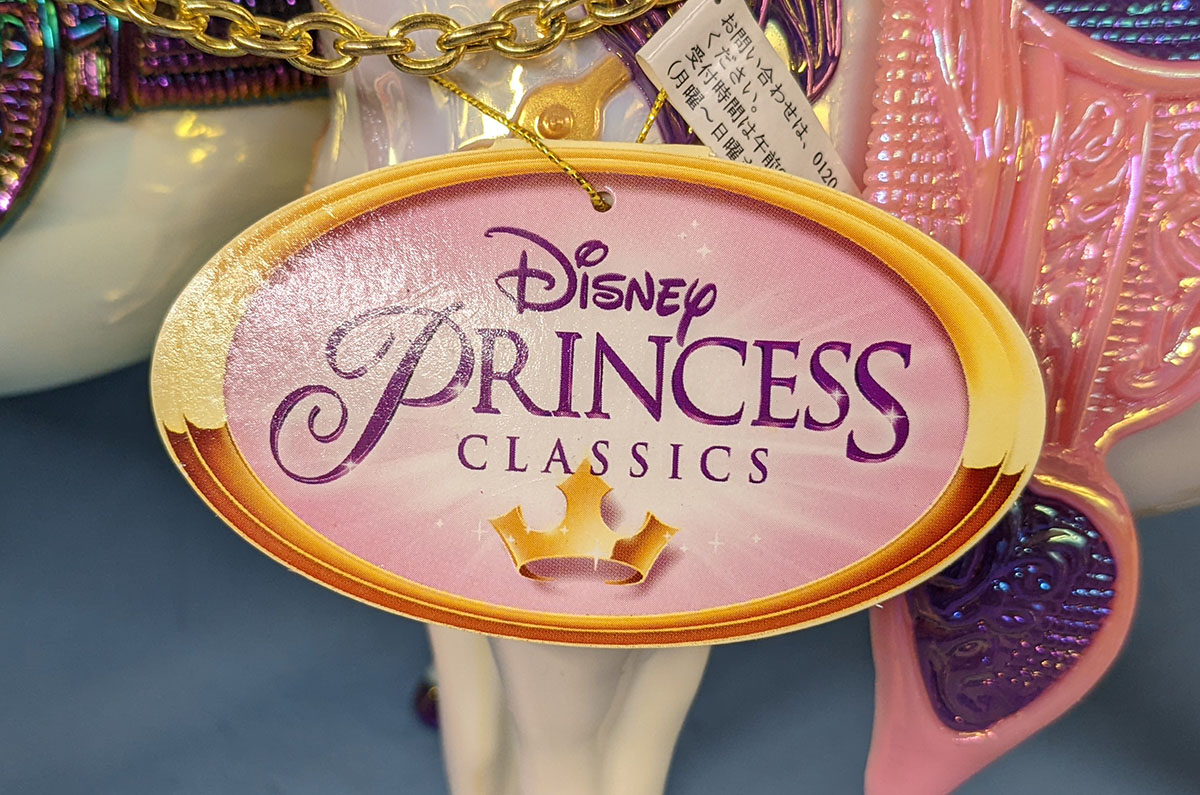
The Disney models are also opalescent white, but they have iridescent purple manes and tails. They also have gold bridles, and the saddles are pink with purple accents. They have a two sided folding hang tag that reads "Disney on Ice" on one side and "Disney Princess Classics" on the other. The saddles say "Disney on Ice" on the seat and are glued on just as with the circus horses. They lack a hole in the head for a feather.


Photo from eBay


Made in China Minis

Stablemate scale copies of the Western Horse also exist. Some of these these pieces are marked "Made in Hong Kong" while others are marked "Made in China." The former match the larger 1970s horses in terms of common colors and likely were made around the same time. The made in China horses are later, made after 1997 as mentioned above. They have chain reins and cute slip on saddles. They also have molded on plastic rings on the their chests as if they were designed to be chained together like you see on some '50s and '60s ceramic and plastic toys. I have seen other colors like pinto and appalosa besides those in this set of black, grey, and bay. The painting is a bit sloppy, but these are very cute copies all the same.


Breyer Ornament

In 2006, Breyer released their own mini Western Horse as a holiday ornament. Sadly, it is a less skillful reproduction of the Western Horse than the made-in-China minis.


Photo from eBay

Tiny HO Scale Western Horse

Jordan Highway Miniatures copied the Western Horse in HO scale (approximately an inch tall) for a tiny popcorn wagon in recent years. Interestingly, the company also copied the Breyer Old Timer, the Clydesdale Mare, and a couple of Hartland models for other HO vehicles. The owner of the company, Jordan Jackson, passed away in 2015, so his kits are no longer being made, but the family apparently still owns the molds.


Miscellaneous

The Western Horse seems to have been wildly popular with copy cat companies, and not only are there plastic copies, but there are also ceramic, metal, and even wall art copies. I'm sure there are more, but here are some fun examples I've seen or bought over the years.


A Japanese ceramic Western Horse. These come in varying sizes.
Photo from eBay.
A metal Western Pony copy (mane only on one side with this pony)
Photo courtesy of Rachel L.
Embossed Western Horse art, a fun antique store find of mine

In the next and final installment of the Western Horse Shaped objects series, I'll discuss the miscellaneous plastic and metal horse clock knock offs that are out there.

Also, if anyone has any textured tack horses, ponies, or clocks, or Kroll ponies for sale, especially a gold one, please email me at mumtazmahal (at) gmail (dot) com. Thanks for reading!

Part four of this series is here.


Sources:

1. Young, Nancy. Breyer Molds and Models: Horses, Riders, and Animals. (Schiffer Publishing Ltd: Atglen, PA), pg. 265.