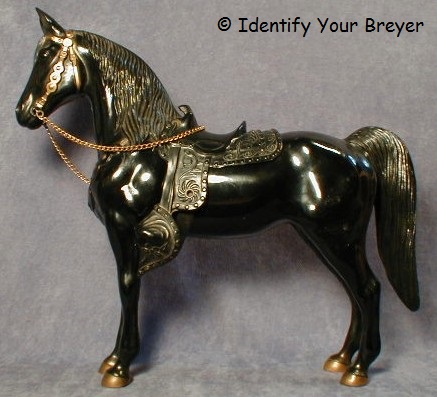
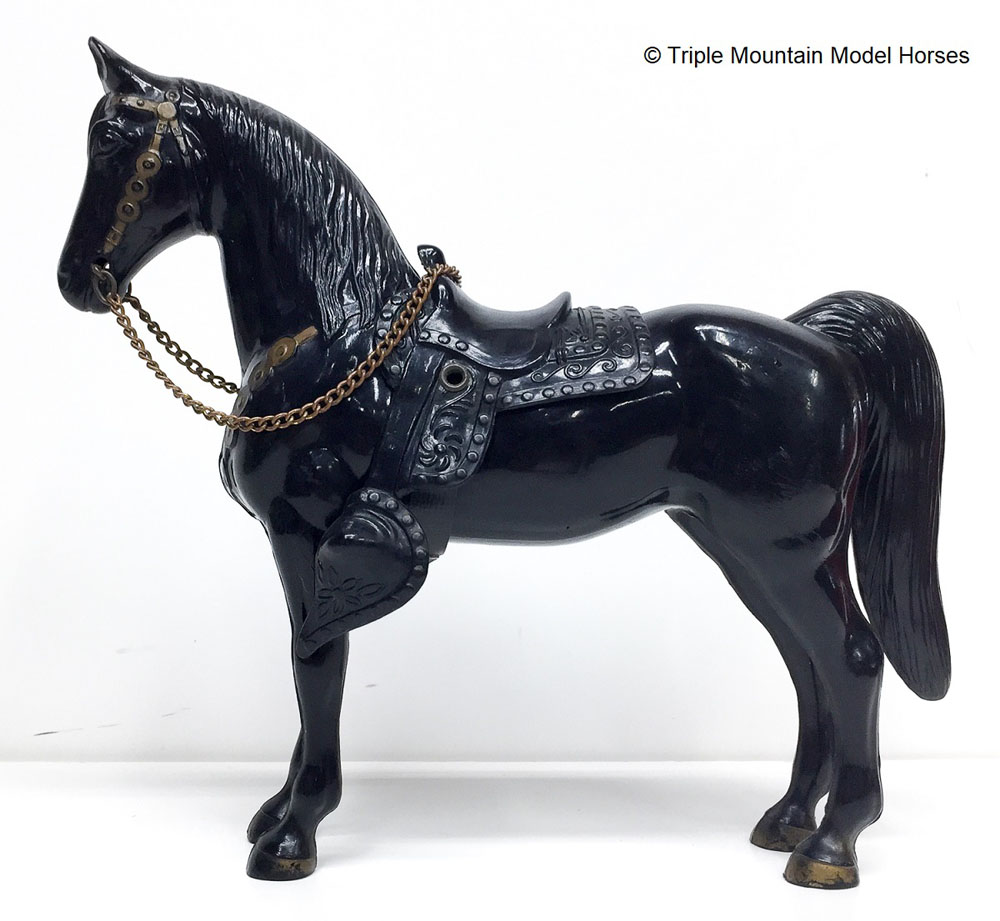
(Part one of this series can be found
here.)
Because the
Hartland Victor model came first in terms of Western Horse shaped models, I thought it would make the most sense to tackle the subject of Victor copies first, too. And while there aren't nearly as many of them as there are copies of the Breyer Western Horse, they do present a rather interesting story. To wit, I'm pretty sure I have uncovered a previously unknown manufacturer of model horses!
 |
Hartland Victor on the left (courtesy of Barrie Getz);
copies in the center and on the right |
I confess I never paid a great deal of attention to Hartland or Breyer copies until I started thinking seriously about this series of posts. I saw copies regularly in flea-markets and antique malls over the years, so I learned to recognize a lot of them on sight, but I never bothered to buy any or look particularly closely at them. If it wasn't a Breyer, I dismissed it. How I wish I had a time machine to go back and pick up some of these copies now! I couldn't have predicted how interesting I'd find them 25 years on. Since I was long overdue for more posts relating to the
collectibility judging test I put together a couple of years ago, I recently resolved to acquire a few of the most common Western Horse copies to compare, photograph, and discuss.
The first one I came across was not exactly what I expected, and it proved to be quite an intriguing mystery. While driving up to the Hagen-Renaker Fellowship event before BreyerFest last summer, my sister and I stopped to do some antiquing along the way, and just after I mentioned to her that I was looking for Western Horse copies, we turned a corner and found one waiting for us in the next booth. The horse was a dark brown shade with bronze-gold highlights, and it had a nice Breyer-like heft to it. It was clearly a well-made piece even if it wasn't a Breyer. Later that evening when I examined the model more closely, I realized that it had pointed conchos on the bridle and was therefore a copy of the Hartland Victor rather than the Breyer Western Horse. I knew it wasn't a Hartland either though because it lacked facial veins, the forelock and tail shape and contours were a bit different, and the ears and coronet band were less carefully sculpted. The horse was completely unmarked though, so I had no way to know who might have made it.
 |
| Dark brown mystery horse |
Shortly thereafter, my parents picked up another Hartland Victor copy for me at an antique mall. This model was black with gold hooves and was made of cheap-feeling, light-weight plastic. The bridle, breast collar, and saddle on the model featured raised, embossed stars, something I knew that was indicative of a piece made by the Ohio Plastic Company.
When I compared both horses in hand, I realized that while they are generally lumped together by collectors as Ohio Plastic creations, they had some interesting differences that made me skeptical of that assumption. Just as with the Hartland Victor and Breyer Western Horse, the differences are subtle, but they were enough to convince me that not only were the horses produced from two different molds, but that the black horse appeared to be a copy of the brown horse, making it a second generation copy of the original Hartland Victor. (The brown horse is on the left in all pictures below and the black horse is on the right.)
 |
The brown horse has a distinctly sculpted breast collar. The black horse's
breast collar is barely there and also has the characteristic embossed stars. |
 |
Strange pyramid shaped lump behind the ears on the black horse. The ears on
the brown horse are also more finely sculpted. |
 |
The brown horse has nice round hooves and stands square while the black
horse has misshapen hooves and stands with his legs akimbo. |
 |
Note the crisper detail on the brown horse and the stars on the bridle of
the black horse. |
 |
The brown horse has a tendon groove on his legs and a hint of the
coronet band while the black horse has neither. |
In hopes of learning more, I turned to
Nancy Young's 5th edition of Breyer Molds and Models to see if she could shed a little light on the subject. At the time her book was published in 1999, collectors still believed that the diamond concho horses were Breyers. Sure enough, Nancy did discuss the copies of the diamond concho horses, dubbing them "scooper-eared" models. Like me, she had concluded that the two knock-off versions were different, and that the light-weight horse was a direct copy of the nicer, heavier brown horse. Furthermore, she noted that she had observed brown and black examples of the nicer horse, including some beside Mastercrafters clocks. She did not however know the maker. Nancy also mentioned that the cheaper starred horses were probably made by Ohio Plastics, and as a number of these models have since been found in original Ohio Plastics packaging, their origin is confirmed.
1
But this still left me with a mystery as to the origin of the brown horse. I embarked on a serious crawl of Google, eBay, and
other sites in hopes of finding out more about it. In September 2019, I caught a break when I came across an example of the brown horse on eBay mounted
on a brown base. I took a chance on it, hoping that there might be some
sort of identification marks on the horse or the base. When it arrived,
I immediately turned it over, assuming that any maker's mark or copyright information would be on the underside of the base. No such luck. Disappointed, I flipped
the piece back upright and I realized there was a great big block of text
on the top of the base right under the horse's tail. Eureka!
 |
| The base is somewhat warped |
 |
| "Superlon Product CHGO." |
Given the Chicago-based history of Mastercrafters and Breyer, I was fascinated to see that this, too, was a Chicago-made product. I immediately began researching Superlon and quickly found out that it was not a company name but rather the trademarked name of a kind of plastic, much like Tenite and Bakelite are. Furthermore, Superlon appeared to have been the proprietary product of a Chicago plastic injection molding company called Superior Plastics.
Further searching turned up a variety of Superlon items made by Superior Plastics. In the 1950s, their product line seemed to consist of primarily kitchen and home goods such as lazy susans, kitschy salt and pepper shakers, dishes, utensils, coat hangers, and bathroom items.
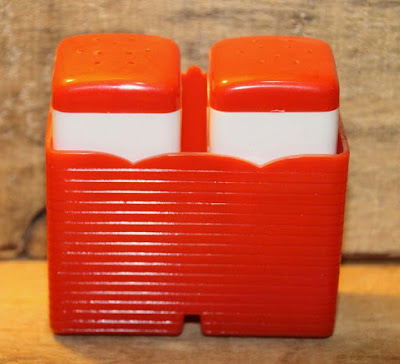 |
| Superior Plastics salt and pepper shakers (photo from eBay) |
 |
Manufacturer info on the bottom of the above salt and pepper set
(photo from eBay) |
 |
A 1951 advertisement for a lazy susan made of
"shatterproof Superon" (from the Montgomery Sun
courtesy of newspapers.com) |
 |
| Another cute S&P set with the original box (photos from eBay) |
By the 1960s, Superior Plastics had moved on to making educational models like a small articulated skeleton, a human skull, a lobster, a build-your-own Lincoln Memorial, and more.
 |
| (photo from eBay) |
 |
| (photo from eBay) |
I also found a pink glove box on eBay, the bottom part of which was marked identically to the base on my new brown horse. And in fact, the horse's base turned out to be completely identical to the bottom half of the glove box---sans lid and flipped upside down. On a whim, I decided to look through old holiday catalogs and found examples of the same glove box offered in several colors from about 1947 to 1952.
 |
| 1947 Sears holiday catalog listing |
I have since acquired
two more examples of the brown horse, one free-standing and another on a
base. Interestingly, the second horse on the base is mounted on a brown version of the glove box, too, but this one includes the lid of the box. And the horse is actually attached to the lid rather than the underside of the base.
Happily, both of these horses also came with their original slip-on saddles and one of them also had what are presumably the original reins. The reins are a thin, flat cord of stiff plastic. One saddle is brown while the other is black with gold trim.
Having two saddles and a set of reins in hand allowed me to compare them to the Ohio Plastics versions, and there were again some notable differences between them. The reins on the brown horse are made of a thin, flat strip of plastic that has become brittle-feeling over the years. The Ohio Plastics horses have a wide, flat strip of flexible plastic for reins. The Ohio Plastics saddles have shorter seats and skirts than those on the brown horses, and they have different molding artifacts (from sprues) on the undersides as well. Most importantly, the saddles that came with the brown horses are marked "SP" on the undersides. Other collectors who have owned these models with the original saddles have reported the SP makings as well. Presumably, it's short for either Superlon Product or Superior Plastics.
 |
| Note the differences in stance and general quality |
 |
| Differences in shape, seat and skirt length, and sculpting |
 |
| Different placement of molding artifacts (from sprues) |
 |
The tiny circled "SP" is hard to photograph, but it's there. Also note the
way the stirrup is attached versus on the Ohio Plastics saddle on the right
in the above photo. |
With all of this in mind, I have concluded that Superior Plastics is probably the manufacturer of these brown horses. I can't prove it conclusively, but it certainly would be odd in my opinion that Superior made the bases and saddles but not the horses. Furthermore, both Nancy Young and I concluded independently that the Ohio Plastics horses were derivative copies of the Superior Plastics horses. Copying was of course rampant at this time, and Ohio Plastics did in fact copy another Hartland horse as well as a Marx horse. But more on that in the section about Wells Lamont below.
Exciting Addendum! Four months after I posted this blog, another collector shared a snippet about Western Horse copies from Nancy Young's unpublished sixth edition of her book
Breyer Molds and Models. I reached out to Nancy, and she graciously allowed me to reference her findings here. She too had observed a brown horse on a base like mine, and her research also led her to Superior Plastics. It's gratifying to know we both came to the same conclusion independently.
Superior Plastic Horses
Now that I've made what I think is a pretty compelling case for Superior Plastics, let's talk about the company itself. Superior Plastics was located just a few blocks southwest of Breyer on the industrial west side of Chicago. The company was founded in 1943, and it survived as a family owned business until about 2015. It produced a variety of items as described above at its downtown Chicago location into the early 1970s before moving out into the suburbs by the end of that decade. Like so many plastic molding companies, Superior survived by adapting to the market. They switched from toys and household goods to siding for houses, tiles, and eventually floormats.
I believe these horses date to the early to mid-1950s based on several pieces of evidence. Because they are copied from the Hartland Victor horse, we know they can't be any earlier than 1949, and given the approximate dates of the glove box bases as predicated by their entry in the holiday catalogs, the horses were likely available by 1952 or 1953. A second piece of evidence dating the models to no later than about 1955 is discussed in the Wells Lamont section below.
To the best of my knowledge, they were issued in two colors, a dark brown shade with bronze-gold highlights and black with gold hooves, bridle, and breast collar. I have four examples of the former and three of the latter. Both of my free-standing brown horses are molded in a swirly dark blue-grey plastic. The horse mounted on the partial base (bottom of the glove box) is molded from red plastic, and the horse mounted on the full base (top and bottom of the glove box) is molded in the identical medium brown plastic as the base, further evidence in my mind that Superior Plastics made the horses. My three black horses are molded in pink, swirly reddish-brown, and black plastic.
The odd thing about these models is that they don't appear to have been painted dark brown or black; rather, they appear to be coated in a very thin veneer of dark brown or black plastic. They can get rubs through this finish, but at least one of my horses has a spot on the leg where the dark brown surface is curling back. Perhaps it's some kind of plasticized paint that bonds with the models? I'm not sure. The bronze-gold highlights are airbrushed on however, and the gold detailing on the tack was airbrushed utilizing a mask just like Hartland and Breyer painted their models.
 |
| Red plastic showing through ear rub |
Three of my four brown horses are consistently shaded with bronze-gold paint, but this one has much more exuberant highlights.
Here's an example of the black Superior Plastics horse. Nancy Young mentioned owning two in her book, one molded in green plastic and the other apparently molded in black plastic.
2 They have gold hooves and tack detailing. Another longtime collector shared a photo with me of one of these black horses beside a clock that has also been found with Breyer Western Horses on it. The clocks are cordless and are marked "Chicago" and "USA." They appear to be Mastercrafters products, but I'll cover those in the fourth installment of this blog series.
Nancy Young also described two copies of the black horse bearing a sticker that read "Red Ryder Gloves, Wells Lamont Corp, Chicago." I'll address this fascinating tidbit in the Wells Lamont section below as well.
Addendum #2: In October 2020, a collector sent me pictures of a white Superior Plastics horse, the only example in this color I know of. It's molded in white plastic and painted white like a chalky with a little grey shading around the eyes and nostrils. The bridle and breast collar are both painted gold, and the hooves are painted bluish-grey (I'm not sure the hoof paint is OF). The horse no longer has its original reins or saddle. I would guess the saddle was brown as the Hartland model from which it was copied had a brown saddle.
Ohio Plastics Horses
To reiterate, the horses made by the Ohio Plastic Company appear to be copies of the Superior Plastics horses, so they are second generation copies of the original Hartland Victor model. All of the examples I've seen are on the crude side and are made of cheap, light-weight plastic. They are not marked, but they can be easily recognized by the stars embossed on the bridle, breast collar, and saddle.
The company was located in Frazeysburg, OH, and began business in July 1938 although actual production seems to have begun the following year.
3 Like most other early plastic manufacturing companies, Ohio Plastics began with industrial items, especially things needed for the war effort in the 1940s. By 1946, they had reportedly branched out to "plumbing fixtures, sporting goods, office supplies, and toys."
4 A 1962 news item about the company indicates that plastic horses were one of their primary products at that time.
5
 |
Image from 1962 Times Recorder article
(downloaded via newspaper.com) |
Some Ohio Plastic horses were molded in black plastic like mine and have simple painted on details. I believe these may be the earliest version of the "Western Horse" models Ohio Plastics made. Other models, which I believe are a bit later, are molded in various colors and were airbrushed with a white basecoat before being painted in a couple of semi-realistic colors like alabaster, palomino, and sorrel. The finish on these models is very fragile.
 |
| The ball chain reins on this model may not be original |
 |
| And the uniquely shaped box some of these horses came in |
Some Ohio Plastic models were shipped in cardboard mailers as seen above while later models were shrink-wrapped.
 |
| Shrink-wrapped Ohio Plastic model owned and photographed by Kristin Chernoff |
 |
| Shrink-wrapped Ohio Plastic model owned and photographed by Kristin Chernoff |
 |
| Original shipping box owned and photographed by Kristin Chernoff |
Based on advertisements found by various hobbyists and the newspaper image above, we know that Ohio Plastic horses were in production by the early 1960s, and they may have been made as early as the mid-to-late 1950s and as late as the 1970s. In terms of how they look and feel though, I would guess most of them were primarily 1960s products.
Wells Lamont and Red Ryder
I've known about a cheap knock off of the Hartland Chubby model for some time that is marked "Red Ryder" on the saddle blanket and "Wells Lamont" on the inside of one hind leg. It was sold with a copy of the Hartland Chief Thunderbird molded in light-weight plastic. Not being a collector of Hartland horse and rider sets, I assumed the models were made by Wells Lamont and never gave much thought to them.
 |
| (Photo from eBay) |
But when I became aware of the black Superior Plastics horse with a Wells Lamont/Red Ryder sticker in the course of research for this blog, I began to look into Wells Lamont more closely. The Superior Plastics models are a much nicer quality than the ones marked Wells Lamont, and I couldn't believe they had been made by the same company.
A brief bit of Googling and a few emails later, I had the answer. Wells Lamont is a Chicago-based glove making company that began in 1907. They have never been in the plastic injection molding business, and they never made model horses. They did however create some promotional gloves in the 1950s as a merchandising tie-in with the popular comic-strip-cowboy-turned-movie-hero Red Ryder.
 |
| Red Ryder promotional gloves made by Wells Lamont (photo from eBay) |
The Red Ryder comic strip began in 1938 and was one of the longest running Western-themed comics. The titular character was a cowboy living in southwestern Colorado in the 1890s, and he of course had a faithful equine companion, a big black stallion named Thunder. The strip also featured Red Ryder's stereotypical Native American sidekick Little Beaver who rode a pinto pony named Papoose. The comic spawned a number of radio plays and movies and all sorts of merchandising, most famously the Daisy Red Ryder BB gun immortalized in the movie
A Christmas Story.
 |
| Allan Lane as Red Ryder |
I sent an email to Wells Lamont knowing it was a long shot that they'd have any records from the 1950s that might shed some light on the models bearing their name. They responded promptly, and while they did not have records stretching back that far, they could confirm that they had never done any plastic molding. Furthermore, a longtime employee did remember the glove and toy horse promotion, and he said that the company bid out the job of creating the toy horses. Given that Superior Plastics was also a local Chicago business, it makes sense that the company would have won the contract and produced the black horses. Presumably, they were meant to represent Thunder.
And sure enough, eBay came through for me with the confirmation I needed. I recently acquired this set of Red Ryder gloves made by Wells Lamont, one still sealed in the original packaging with the most fascinating promotional offer card tucked inside.
I suppose it might be sacrilege, but I opened the gloves carefully to extract the little card. The packaging is in pretty rough shape, but I was interested to note that this particular design was copyrighted 1953. And the card itself not only confirmed that the horse was made by Superior Plastics as can be seen from the photo (positioning of the legs, presence of a forelock bump, etc), but also that the horse was indeed a model of Thunder, and that offers were only good through May 1, 1955, meaning production probably ceased not long after that date.
Addendum #3: In March 2021, almost exactly a year after I first published this blog, I was the lucky winning bidder for this fantastic black Superior Plastics horse with the original Red Ryder sticker.


This information begs several questions. We know the Ohio Plastics horses were copied from Superior Plastics horses. Did Ohio Plastics simply copy the black and gold paint scheme, too, or did they perhaps make horses for the Wells Lamont promotion, too? Several collectors with black Ohio Plastics horses have related stories to me about relatives having collected coupons or tokens of some variety until they had enough to send in for Red Ryder's horse. It seems likely to me that both companies worked with Wells Lamont on a Red Ryder promotion, Superior Plastics first and then Ohio Plastic. Perhaps Wells Lamont and Superior Plastics parted ways just like Mastercrafters and Hartland did, and Ohio Plastics stepped into the void? And where do the black and gold
Breyer Western Horse and
Pony fit into this timeline? Did they copy the paint scheme, too, or was it just coincidence?
Regarding the first question, at least two palomino Ohio Plastics horses are known that were shipped in cardboard mailers with a Wells Lamont return label, so there was some connection between the companies even after the Red Ryder promotions. When it began and how long it lasted is anyone's guess until more information comes to light. As for the dating, we know the black Superior Plastics horses date to about 1954-1955. The promotion may have run for more than a year, so they may have been made as early as 1952 or 1953, too. The Ohio Plastics horses therefore probably only date from late 1955 at the very earliest. This intriguing September 22, 1955, ad from the Conneautville Courier (Conneautville, PA), mentions a coupon that could be sent in for "a plastic Red Ryder and horse." To the best of my knowledge, no riders have been found in association with Superior Plastics horses, but some generic cowboys have been found with various Ohio Plastics horses. I wonder which horse would have been shipped?
 |
| 9/22/55 Conneautville Courier ad |
We know Breyer's black Western Horse with gold trim was
available by late 1952 or very early 1953, so it is possible that the Superior Plastics Thunders and Breyer's models in the same paint scheme were contemporaneous. We may never know if one came before the other or if it was just a matter of convergent evolution, although if I had to guess, I would bet that the Breyers came first. The Ohio Plastic horses were of course later copies.
Which brings us back to the pinto Hartland Chubby copies. Based on the way they're painted, and particularly based on the distinctive way said paint tends to wear and rub, I suspect these models were made by Ohio Plastics. The company did make a copy of the Hartland Chubby with the characteristic stars on the tack, and the pinto model is quite similar. It has a cocked front leg, a roached mane, and no bridle or breast collar, but everything else about it suggests Ohio Plastics to me. Once again, I can't conclusively prove it, but it seems like a reasonable hypothesis. After all, Ohio Plastics had no qualms about copying other companies, and given the quality of their models, they probably could produce their models for less. They may have underbid Superior Plastics at some point or simply lucked into the contract when Superior Plastics moved on to non-horse production.
Interestingly, I did find this October 11, 1955, ad from the Haleyville, AL, paper The Advertiser that mentions the pinto horse and Indian rider. They represent Chief Flying Cloud and his horse from the Red Ryder comic strip or movies (or both).
 |
| 10/11/55 The Advertiser ad |
 |
| Ohio Plastics copy of a Hartland Chubby (photo from eBay) |
I hope you've all enjoyed reading this as much as I have enjoyed tracking down the clues to piece this story together. If you happen to have more information about Superior Plastics or Ohio Plastics that you'd like to share, please feel free to email me at mumtazmahal (at) gmail (dot) com. I am also most interested in acquiring a black copy of the Superior Plastics horse. I would also love to see any other variations people might own---on a clock, with a sticker, anything! Thanks for reading!
Part three about Breyer Western Horse copies can be found
here.
--------------------------------------------------------------------------------
1. Young, Nancy.
Breyer Molds and Models: Horses, Riders, and Animals. (Schiffer Publishing Ltd: Atglen, PA), pg. 263.
2. ibid.
3. “Plastic Company at Frazeysburg Begins Huge Expansion Program Designed to Double Manufacturing Capacity.”
The Zanesville Signal. (Zanesville, OH), January 13, 1946.
4. ibid.
5. “Ohio Plastics is Town's Top Industry.”
The Times Recorder. (Zanesville, OH), August 26, 1962.