Showing posts with label hartland. Show all posts

Monday, November 23, 2020

Western Horse Shaped Objects Wrap Up

Now that I've completed all of the Western Horse shaped objects posts, I thought it would be handy to post a link to them all here in one place. Enjoy!

Part 1: Mastercrafters Clocks: A brief history of Mastercrafters horse clocks and their relationship with Hartland and Breyer. Also a discussion of the differences between the Hartland Victor, Breyer Western Horse, and Hartland Champ.


Part 2: Superior Plastics, Ohio Plastics, and the Wells Lamont Connection: An in depth discussion of the Hartland Victor and the models copied from it by Superior Plastics and Ohio Plastics.


Part 3: Breyer, Textured Tack, Kroll, Hong Kong, and more! Breyer Western Horses and Ponies and their many, many, many copies. 


Part 4: Weird Clocks, Metal Clocks, and Gladys Brown Edwards: Unusual Breyer clocks, Superior Plastics and textured tack clocks, metal horse clocks, and the Gladys Brown Edwards connection.

Monday, February 10, 2020

Western Horse Shaped Objects, Part 1: Mastercrafters Clocks

Several years ago, I put together a list of basic questions that I felt any Breyer collectibility judge should be able to answer. It's taken me longer than I'd planned to get around to answering all of the questions, but I'm finally ready to tackle the one about how to differentiate between the various Western Horse shaped objects out there---Breyers, Hartlands, Ohio Plastics, Hong Kong knock offs, metal horses, and more. What had been in conception a very simple post with some pictures has morphed into something much bigger, and it will probably take me three or four posts to cover everything I want to discuss. Understanding the histories of these companies and their various imitators is just as important as recognizing the unique features of their models. 


The Beginning: Mastercrafters

Our story begins in 1939 with the advent of the Mastercrafters Clock and Radio Company founded by Ben and Kate Lerman in Chicago, lllinois. They made a few clocks early on, but when WWII broke out, their production shifted, like that of so many other companies, to aid the war effort.  After the war, the company returned to clocks and patented a number of popular designs including ships, airplanes, a girl on a swing, and so many more. Some manufacturing and 
assembly were done at the Mastercrafters factory in Chicago, but they did also contract out with other companies for part molding and even clock movements. (This is why some Mastercrafters clocks have Sessions movements.)1 Mastercrafters’ array of clocks show a particularly savvy understanding of post-war tastes, beginning with ships and planes and moving on to more abstract, mid-century modern styles. As all things Western grew in popularity in the late 1940s, Mastercrafters saddled up and hopped on board that trend as well, debuting a horse clock in late 1948 or early 1949.2 


According to Mastercrafters experts W. Clarke Eldridge and William F. Keller in a 2004 article in the National Association of Watch and Clock Collectors Bulletin, Kate Lerman herself was the artistic genius behind many of the company's most popular clock designs.3 A quick patent search shows she was responsible for a number of interesting clocks including the Melody Cruiser, a combined clock and radio in a stylized sailing ship housing. I have yet to track down the patent records for the Mastercrafters horse clocks (if they exist; the patent numbers referenced in Nancy’s book pertain only to the clock mechanism), but it stopped me in my tracks to think that maybe, just maybe, Kate Lerman dreamed up the horse clocks. Wouldn't it be something if we owe all of our plastic horse collecting obsessions to a woman?

The exact history of the Mastercrafters horse clocks has been lost over the years, but collectors have been able to piece together a reasonably solid timeline. For many years, what we now know to be Hartland Victor horses (as well as a variety of copies!) were all believed to be Breyers, but in the early 2000s, a group of collectors led by Hartland expert Mike Jackson and Breyer expert Nancy Young began to suss out the truth based on a variety of small clues.

Mike has an exhaustive explanation of this research with relevant pictures and evidence on his website here, and I highly recommend that all model horse history nerds read it if they haven’t already done so. The gist of this research is that Mastercrafters turned to Hartland Plastics to produce the plastic injection molded horse and base for their clock design in early 1949 or possibly the year before. Yes, the Hartland came first!

The earliest examples of these clocks feature what we now know to be the Hartland Victor model, and the evidence collected by Mike and his fellow researchers proved that this horse was available into 1950. Near the end of that run, Hartland introduced a similar horse with a wavy tail now known as the Hartland Large Champ. Why they switched to a new sculpture is unknown. At some point in 1950, Breyer replaced Hartland as the manufacturer of the horse models for the clocks.

Left to right: Hartland Victor clock, Hartland Champ clock, Breyer Western Horse clock
(Champ clock owned and photographed by Barrie Getz)

Why this change came about is unknown. The general consensus though is that Mastercrafters was unable to pay Hartland and gave them the horse mold to use in lieu of payment. Perhaps Hartland found that selling free-standing models as toys was more lucrative. Or it may be that Breyer, which was located only about 2 miles from Mastercrafters, was a more convenient option (Hartland was located several hours north in the far western suburbs of Milwaukee, WI). It may even be that Breyer undercut Hartland with the offer of a cheaper model. We’ll probably never know. Whatever the case, Breyer began producing a very similar horse standing over the clock in 1950. By 1951, Mastercrafters had switched to a style of horse clock featuring a longer base on which the horse was mounted at an angle beside the clock. (Other Western Horse shaped models made by different companies have been found mounted beside Mastercrafters clocks as well, but I'll discuss those in subsequent posts.)


Hartland Victor Clocks and Horses

Hartland Victor clocks are not exactly common, but of the three styles of horse-over-the-clock, they are by far the most easily found. They exist in two basic colors with variations known to each, white/cream and palomino/sorrel-turned-green. The white/cream horses usually have dark brown shading or antiquing in their manes and tails (often referred to as the “cream puff” version), but some do appear to be all white other than their eyes, hooves, and some tack detailing. The shading/antiquing is extremely fragile however, and it’s possible that some (maybe even all?) of the solid white horses found by collectors may have simply been cleaned over-zealously at some point. (A soft toothbrush, soap, and water will take the color right off; more than one collector has accidentally done so.) 


Hartland Victor horse over clock in white/cream
The palomino/sorrel-turned-green horses, dubbed “bile green” by Nancy Young, are usually an unfortunate shade of yellow or green with softer greyish-brown or brown-black shading. Light and dark versions exist, suggesting that the originals may have been two different shades of tan or brown. Or they may simply be examples of color variations within the run. We don’t know for sure. They are less common than the white/cream Victor horses.

Hartland Victor over the clock in bile green
Many of the white/cream Victor models have stains under their saddles where the brown saddle color bled into the white plastic of the horse. Conversely, many of the green horses have patches of their original color hiding under the saddles.

Hints of the original sorrel color under the saddle on the green Victor. The
delineation between brown and yellow-green is pretty distinct.
As seen in the pictures above, Victor horses came on two different colors of clock base: marbled  brown or pale yellowy-green with reddish faux marbling. (The lighter color when used on other Mastercrafters clocks was referred to as "onyx.) I have seen white/cream horses on both bases, but so far, the only bile-green examples I’ve seen have been on the light-colored bases. In general, the white/cream horses also usually have dark brown saddles with gold or white washing on the skirts while the bile-green horses generally have saddles molded in white plastic and painted in similar shades of (what has become) yellow, green, and grey/brown to match the horse. Most of these saddles are the slip-on style with no girth, but a few in both colors have been found with a vinyl girth that buckles rather than snaps. The girth is attached to the saddle with what appear to be small nail heads (rather than the hollow grommets seen on Breyer saddles). 


No girth on my Victor clock horse on the left vs a girth with nail head on
Barrie's free-standing Victor on the right. Note also the variations in yellow
and green shades and saddle decoration.
The bits on most Victor horses are a solid metal bar with a small hole in each end through which O-link reins are attached with small clips. The reins on a few are attached to a wire bit with small round jump rings instead (as is more typically seen on early Breyer Western Horses). These may be late examples. Some have no bit at all, and the reins are just passed through the mouth and held together with a small round ring. Interestingly, a few Victors have been found with no holes in the mouth at all for a bit.

Standard bar bit with clip attachment to reins
While there are some subtler sculptural differences between the Hartland Victor and the Breyer Western Horse, such as the angle of the hooves and the contours of the mane and tail, the easiest way to tell the difference is the shape of the conchos on the bridle. Hartland horses have several pointy, “diamond-shaped” conchos while Breyers just have round ones.

The pointed "diamond" conchos on the Hartland Victor

And the round Breyer conchos

Some free-standing Victor models---with no pegs or no holes drilled in the feet for clock assembly---are known. Again, of the examples in collectors’ hands, the white/cream horses outnumber the bile-green ones.


Hartland Champ Clocks

The Hartland Champ clocks were probably only made for short time in 1950. About a dozen are known to collectors. All of the ones I’ve seen are cream colored with shading/antiquing in the mane and tail like the earlier Victor horses. The most obvious difference between these horses and the Victor or Breyer Western Horses is the wavy tail and the mane on the right side of the neck. 

The Champ models do differ from the Victor horse in other ways. The musculature of the body is subtly more refined as is the head. The conchos on the cheekpieces of the bridle are a bit smaller, and the breastcollar is scalloped on the bottom edge only instead of being comprised of full conchos.

Barrie's Hartland Champ clock
Known examples have brown slip-on saddles, usually with a white/gold wash on them, and though later Champ models were sold with simple ball-chain reins, the examples on clocks generally have O-link reins with bar bits and clip attachments. So far, I have only seen Champs on brown bases.

After its short stint on the clocks, the Hartland Champ model was eventually sold free-standing in a variety of colors, some with generic cowboy or cowgirl riders, and in about 1954, a smaller version was released (after Breyer had released their Western Pony apparently). There are far too many for me to address here, and the clock Champs are the only ones relevant to this series of posts for the time being. For more information about non-clock Champs, Gail Fitch has an excellent book available called Hartland Horsemen


Breyer Horses Over the Clock

Like the Hartland Victor models they were copied from, Breyer’s first Western Horse models came in alabaster or palomino. The alabaster horses usually have antiquing in the mane and tail like the Victors, and it is likewise quite fragile. Solid white examples are also known, but they may or may not be formerly antiqued models. As with the Hartland Victors, we just don’t know because so few examples are in the hands of collectors. The palominos happily have retained their original color unlike their Hartland brethren. The alabaster horses over the clocks usually have black hooves, but I have seen both black and grey-hooved palomino examples. (The grey-hooved example may not have been original to the clock.) A number of these early Western Horses are made from chalky plastic.

Breyer Western Horse clock in palomino
Breyer horse-over-the-clock Western Horses, regardless of color, only seem to have been issued on brown bases. Both the palomino horses and the alabasters usually had brown high grommet snap saddles. Like the Victors, they have been found (rarely) with bar bits and clips, and more typically with the O-link reins attached to a wire bit with round jump rings. A few are bitless as described above. The sample size for these clocks is small, so more variations may come to light.


Breyer Western Horses Beside the Clock


By 1951, Mastercrafters had begun selling the more commonly found clocks with horses standing beside them. The clocks are inserted in an enameled metal, horseshoe-shaped frame decorated with a bas-relief of a cowboy roping a steer. The bases are a marbled brown color that resembles tortoise shell. As usual, the horses may be either alabaster or palomino. These clocks were likely made for several years because they exist in far greater numbers than any of the other styles.

The earliest examples have black hooves, and the alabasters had the usual antiquing. They also usually have O-link reins and high grommet saddles. Later examples have grey hooves, although again, these may not be original to the clocks. A number of them have been found with cream colored felt saddle pads. We don't now for sure how long these clocks were made, but probably until 1953. (Nancy Young found however that by late 1953, Breyer had made the switch from O-link reins to the twisted chain reins still used today, so that likely gives us a pretty solid end date.)4

An antiqued alabaster version
A solid white alabaster version

A palomino version
Like Hartland, Breyer began to offer free-standing horses for sale soon after their deal with Mastercrafters. By late 1952, Breyer had produced their mini me Western Pony mold (predating Hartland's Small Champ),5 and within a few years, both Breyer and Hartland had expanded their lines to include a variety of riders and other horses.

While models by both companies have been copied over the years, the Hartland Victors and Breyer Western Horses seem to have been copied particularly often by a number of companies. Collectors  have been able to identify a number of these copies and make reasonable guesses about when they were made, but a few are still mysteries. Interestingly, some of these copies are of surprisingly good quality and are becoming collectible in their own right. More on those oddities and how to spot them in the next installment!

Part two about Hartland Victor copies can be found here.

-----------------------------------------------------------------------------

1. Eldridge, W. Clarke, and William F. Keller. The Mastercrafters Story: 1939-1988. National Association of Watch and Clock Collectors Bulletin, August 2004.


2. Mike Jackson's article on Mastercrafters Clocks: https://myhartlands.com/?page_id=276

3. Eldridge and Keller.


4.Young, Nancy A. Breyer Molds and Models: Horses, Riders, and Animals
(Schiffer Publishing Ltd: Atglen, PA), pg. 345.

5. http://modelhorsecollectibility.blogspot.com/2022/04/turning-back-clock-on-breyer-western.html

Friday, November 8, 2013

Friday Featurette: Hartland grail achieved!

My dad travels a lot for work, and about 20 years ago, he came home from a trip with a special find. While on the road, he stopped for lunch and then decided to look through a nearby antique mall. When he arrived at the house later that evening, he came up the front steps grinning and said he'd found "a decorator." And he was right. It wasn't a Breyer decorator, but it was a gold Hartland 9" Mustang which was just as exciting. We didn't know much about it at the time, but eventually we learned that it had been made as a special run for a brewery. It was meant to be affixed to a sign that would have been on display in a bar.

For most of the intervening years since then, I focused mostly on collecting Breyers, but I happily bought old Hartlands when I could find them at reasonable prices. I've always liked their stylized look, especially the horses made in the 1960s, and for the last few years, I've been actively filling in gaps in my collection of horses from that era. I've also been filling in the gaps in my knowledge about Hartlands.

So, in my post about Hartland woodcuts earlier this summer, I mentioned the elusive gold woodcut 9" Mustang and included a photo of a partial set I found on Google.  According to Gail Fitch's book Hartland Horses and Dogs, the gold Mustang was issued as a special run in the late 1960s for the Pittsburgh Brewing Company in Pittsburgh, PA, who distributed Mustang Malt Liquor. No one knows how many were made or even exactly when they were made, but the horses are found often enough off the beer sign that I suspect there are a reasonable number to be had. Finding models still on the beer sign and with the original beverage container is however much more unusual. I see horses with the bases only very occasionally and complete sets hardly ever. So that said, I was really pleased to be able to add this set to my Hartland collection.


Unlike the other Hartland woodcuts which were molded in colored plastic, this model is molded in white plastic and was then painted gold. The base on this example is lettered on both sides, but some are only lettered on one side. I believe the piece was meant to come with the empty glass bottle as shown here, but I have seen at least one with an aluminum can instead. I'm not sure if it came both ways or if the can was a replacement for a presumably broken or lost bottle. Either way, it's a fun bit of breweriana and Hartland history.

Wednesday, July 17, 2013

(Almost) Friday Featurette: Wooden Horses Part 3

It's not quite Friday, but with BreyerFest rapidly approaching, I thought I'd make another post in the series about wooden horses and wooden wannabes.

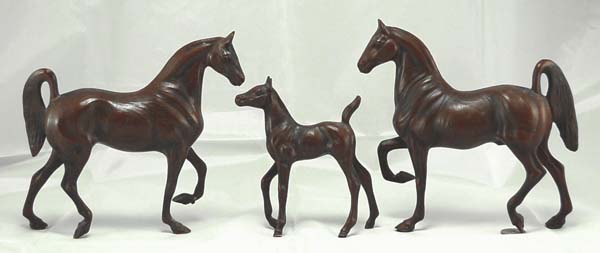
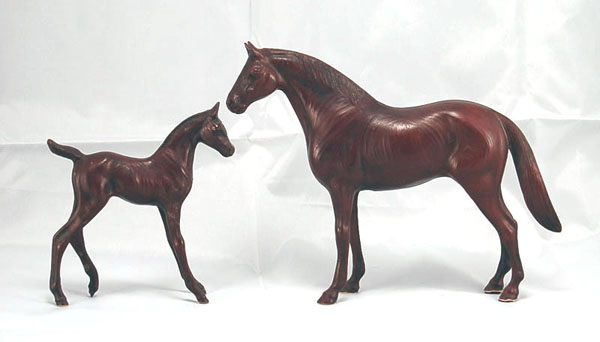
In the 1960s, Breyer was not the only company producing plastic model horses that were finished in a faux-wood style. Hartland Plastics of Hartland, Wisconsin, a town about 25 miles west of Milwaukee, introduced a line of models called "woodcuts" beginning in 1964.These models differed from Breyer's faux-wood models in that they were sculpted to look as though were whittled or carved from wood rather than just painted to look that way.

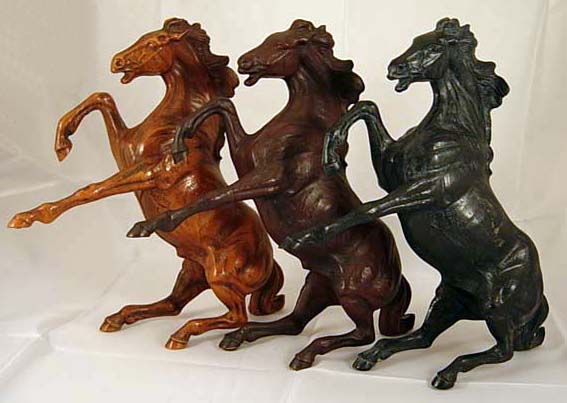
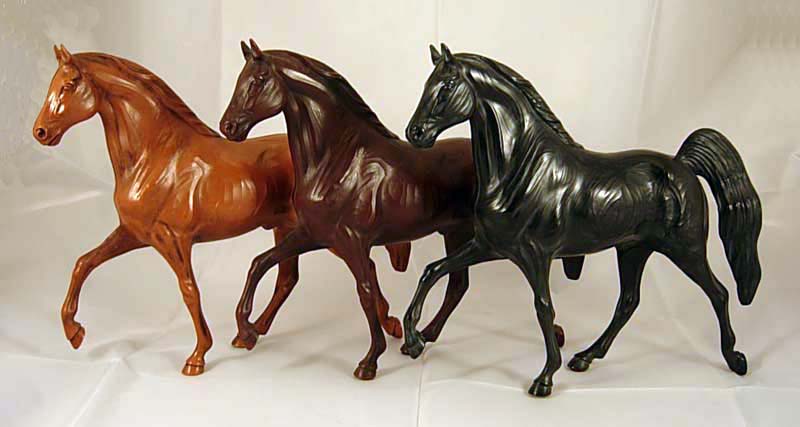
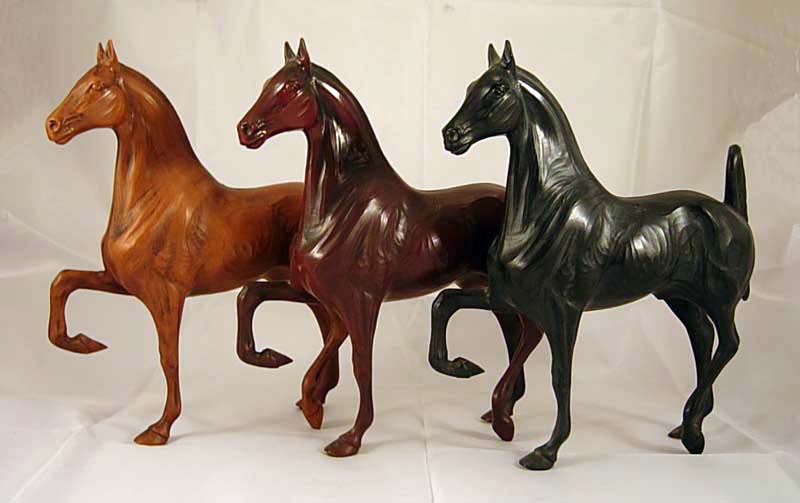
The Hartland woodcut look was achieved in three different ways. Some models have an angular surface meant to look like carving marks:
Walnut 9" TWH

Some are both carved and marked with incised graining (in horizontal bands in this case):
Ebony 7" Saddlebred Stallion

Carved (subtly) and grained (in swirls):
Cherry 9" Mustang

Only one mold shows graining but not carving:
Test Run Walnut 9" Five-Gaited Saddlebred (more on this one below)

The woodcut molds are unique molds separate from the corresponding smooth body versions. They were sculpted by Roger Williams, and the carving and/or graining was added by Alvar Bäckstrand. The models came came in three shades: walnut (tan), cherry (dark reddish-brown), and ebony (black). They were usually cast in tan, reddish-brown, and blue-grey or black plastic respectively and had a wash of darker shading rubbed over the surface to highlight the woodgraining look. Some models, especially the later walnut pieces, have very little of the contrasting color applied.

 Walnut, Cherry, and Ebony TWHs

Hartland issued the following molds as woodcuts in the mid-1960s: 9" Mustang (subtly carved and grained), 9" Tennessee Walking Horse (two mane variations, both carved), 9" Three Gaited Saddlebred (carved), 7" Saddlebred Family (carved and grained), 7" Thoroughbred Mare and Foal (carved and grained), and the 6" Arab Stallion (carved). All of these models were available in all three woodcut colors. The ebony and cherry colors were only issued between 1964-1966 whereas the walnut models were almost all available for 3 or 4 years in the mid- to late-1960s, and the 9" Mustang and Three Gaiter were also re-released in walnut from 1970-1973 when Durant took over the company.

Despite relatively short productions runs, the 9" models are all fairly common, the Mustang most of all. The 9" models bring around $20-40 depending on color and mold with the Mustangs tending more toward the $5-10 range because they are so easily found. The 7" and 6" models are considerably more scarce, having been limited in production in all colors to only 1 or 2 years. The Thoroughbred Mare and Foal for example were issued in 1965 only, making them the rarest of the bunch. The family sets often sell for around $100.

In the late 1960s, Hartland issued the woodcut Mustang in gold. Most were mounted on promotional Mustang Malt Beer signs to be displayed in bars.

Hartland has passed through several owners and has therefore been in and out of business a number of times since the 1960s. Under two new incarnations, those headed by Paola Groeber from 1987-1990 and Sheryl Leisure from 2000-2007, the 9" Mustang and TWH woodcut molds were issued in several realistic horse colors. The woodcut models painted and sold by Paola were all test runs as far as I know. The models sold by Sheryl were a mix of small regular runs and test runs. For more information on these models, I highly recommend Hartland Horses and Dogs and Hartland Horses: New Model Horses Since 2000 by Gail Fitch, both of which are available directly from the author.

An unpainted 9" woodcut TWH molded in swirled black and grey plastic
Less than 10 were sold by Sheryl Leisure in August 2002

The rarest woodcut, to the best of my knowledge, is a one-of-a-kind test run 9" Five-Gaited Saddlebred. She came from the collection of a former Hartland employee and probably dates to the mid-1960s. She was sold mounted on a base as shown and is grained only, not carved. My best guess is that she was possibly a one-off prototype that was never put into put into production, perhaps because she was too similar to the 9" Three Gaiters. 


Some woodcut Hartlands were issued with gold stickers, a factor that can make an ordinary model extraordinary if found with the sticker still in place. I have seen two different styles---a round sticker and a rectangular sticker. Both indicate the models have a "hand-rubbed, wood carved finish."

Ebony 9" Mustangs with two sticker variations 
(The rectangular sticker on the left is partially missing.)
 
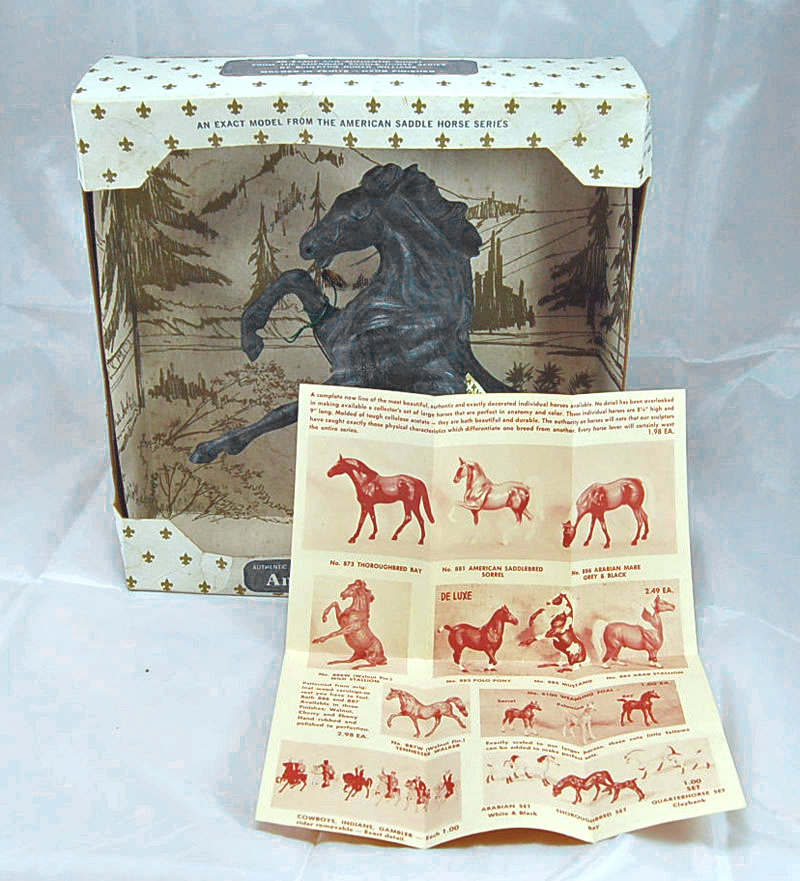
Finding Hartlands, especially woodcuts, in their original packaging is also unusual and adds significantly to their value. 
 
Ebony 9" Mustang with original box and catalog
 
If you enjoyed this post and want to learn more about Hartlands, Gail Fitch's books are the best source of information. I am still educating myself about Hartlands, and her books have been hugely helpful in learning about the company and the models produced under its various owners. Because they are highly stylized, Hartlands aren't to everyone's taste, but I find them charming, and I hope more hobbyists will take an interest in them.

The last installment featuring Peter Stone woodgrains will be posted after BreyerFest. Hope to see you there!