Sunday, August 9, 2020

Western Horse Shaped Objects, Part 3: Breyer, Textured Tack, Kroll, Hong Kong, and more!

(Part one of this series can be found here; part two is here.)

As discussed in the previous two installments of this series, the Breyer Western Horse, while much copied, is in fact itself a copy of the Hartland Victor model. Now that we've covered the Hartland Victor copies, it's time to move on to the Breyer Western Horse and its many, many copies.

Technically, the first copy of the Breyer Western Horse was the Breyer Western Pony. Other than a few small differences such as the number of studs on the browband and how the breast collar is overlaid by the mane, the Western Pony is nearly identical to the Western Horse, only smaller. We know the Western Horse debuted in 1950, and the scaled down Western Pony followed by late 1953.1 A number of the manufacturers that copied the Western Horse also copied the Western Pony, so I'll include those in this post, too.

To begin with, here are the Breyer Western Horse and Pony with snap saddles and slip on saddles as both versions have been copied. The snap saddles were made from 1950 until their last appearance in a Breyer catalog in 1966. There was no 1967 catalog, only a few insert pages introducing a handful of new models. The 1968 catalog shows the new slip on saddles, so the change-over happened sometime in 1967 or at the start of 1968, but we don't know exactly when.

Early Western Pony and Horse with snap saddles
Later Western Pony and Horse with slip on saddles

Textured Tack Horses and Ponies

The earliest Western Horse and Pony copies I know of were dubbed "textured tack" horses by Breyer  historian Nancy Young. The "textured tack" moniker comes from the distinct pattern found on the bridles, breast collars, and saddles (to a lesser degree) on these models. Nancy likens it to a chicken wire pattern. The saddles are similar to Breyer's snap saddles but lack girths. The reins are ball chains. There are both textured tack horses and ponies.


Textured tack horse and pony in brown pinto (the horse is yellowed)
A close up of the textured breast collar
Besides the textured tack, these models differ from the Breyers in several ways. Their legs are a bit thinner but their hooves are bigger and slightly oblong. The tails are also a bit different, but the pony's is more noticeably so, being thinner and pointier than the Breyer original. They do have a nice, very Breyer-like heft to them, and they seem to be well-made compared to some of the other copies out there.
Textured tack horse (left) and Breyer Western Horse (right)
Textured tack pony (left) and Breyer Western Pony (right)
The textured tack horses and ponies have been found in several colors so far: brown and white pinto, black and white pinto, palomino, alabaster, and black. The pintos have an unusual sort of reverse splash white pattern like white paint was spilled along their topline. Some collectors refer to them as "snowcaps" because of this.

A black and white "snowcap" example (photos from eBay)
A palomino textured tack horse (photo courtesy of Deirdre Price)
The white plastic on these models tends to fall into two types, a very opaque almost chalky looking plastic and a softer, more luminous, slightly translucent plastic. This difference is easy to spot in person, and I hope it can be seen in this photo despite the softer-toned plastic model being yellowed everywhere except where his saddle was. The model on the right is the chalky-plastic type model.


Even though they have the same paint pattern, the paint is also softer and slightly muted looking on the non-chalky plastic model as seen on the model on the right below and the palomino pictured above.

Chalky plastic on the left, softer, more luminous plastic on the right
Interestingly, even though these textured tack horses are copied from Breyers, they have been found with cowboys copied from Hartland's Large and Small Champ series. They are made in nicely weighted plastic just like the horses, and both have their guns molded into their holsters. The larger cowboy is copied from the early version of Hartland's cowboy that had a cigarette in his right hand. The examples I own and have seen are also made in the softer-looking plastic mentioned above and have a soft, diffused quality to the paint. I'm not sure if other colorways exist for these riders besides these shown below. They might have (I would guess probably did) come with hats.


I suspect these models date from the mid-1950s for two reasons. The first is that the maker seems to have copied the earliest colors used on the Breyer Western Horses and Ponies which were all available by 1954 or 1955. And secondly, the riders associated with these models were only made by Hartland from about 1954-1957. Given how hard they are to find, I would guess they were made for a relatively short time.


So all that said, while the textured tack models are easy enough to identify, the maker of these models is still a complete mystery. They were thought to be Lido products at one time, but no evidence has come to light to support that. Having owned several Lido horse and rider sets, I would be very surprised if Lido was the manufacturer based on the quality disparity between them. As I said above, the textured tack models seem to made of nicely weighted plastic and are nicely painted. Lido in comparison specialized in cheap "slum" toys---usually small items molded quickly, easily, and cheaply in one color of plastic. They primarily made small cowboy and Indian play sets, but they did make some larger horse and rider sets as well. Like their smaller counterparts, the larger pieces are molded simply in cheap, light-weight plastic, the reins and saddles are not separate pieces, and the paint jobs are uncomplicated and usually in bright, primary colors.
A typical Lido horse and rider set
Stablemate scale Lido "slum" horses and cowboys
So who made the textured tack models? Unfortunately, we don't know. The horses, ponies, and riders are all completely unmarked. The only hints I have found are the letter "T" on the underside of the textured tack horse saddle I have and the letter "A" on the underside of a pony saddle owned by another collector. (My own pony saddle is unmarked.) The marks appear to be deliberate, and if it were just a sprue or molding artifact, I would expect it to be round, like the mark above and to the left of the "T." It's a mystery for now.

"T" mark is just above my fingernail
Palomino and alabaster examples of textured tack horses have been found mounted on pink marbled bases beside clocks in a style very similar to the Breyer Mastercrafters horses beside the clocks. The shape and design of the clock housing is a bit different from Breyer clocks, and the base has a distinctive ruffled edge. Also, the horses are mounted in line with the clocks rather than at an angle. The clock movement is by Sessions, but unfortunately, the clock housing is not marked. Both Mastercrafters and United sometimes used Sessions movements. (In fact, United eventually merged with Sessions.) I'll discuss the various knock off clocks in the fourth installment of this blog series.

Palomino textured tack horse clock (photo courtesy of Carrie Brooks)


Kroll Ponies

We do at least seem to have a company name for this next bunch of copies, but unfortunately, very little is known about it. These models are copies of the Breyer Western Pony only, and they are marked "KROLL" on the belly. While that seems like a great clue, I have had a frustrating time coming up with any information about the company. Two Kroll ponies have been found with what are believed to be original boxes. One is marked Kroll Trading Company of New York, NY, and the other may be marked Kroll Entrerprises, but I can't be sure because I don't have a clear photo of it. (You can see it here on the Model Horse Gallery site about two-thirds of the way down the page.) The addresses on both boxes lack a zip-code, dating them to pre-1963.

As far as I can tell, the Kroll pony manufacturer does not appear to be related to the Chicago manufacturer of Kroll baby cribs, nor, frustratingly, to board game inventor Fred Kroll who worked for Pressman, Milton Bradley, and others, and most famously invented Hungry Hungry Hippos. Fred Kroll did work in the toy business in New York at the right time, and Pressman did loosely copy some Breyers in the 1960s, but Fred's obituary does not mention the company. His only venture in his own name was Fred Kroll Associates, a consulting firm, not a manufacturer.

Kroll models are not painted but rather are molded in colored plastic. I have seen brown, black, gold, white, and several varieties of swirled plastic. They are quite close copies of the Breyer Western Pony, but they have two key differences. Kroll ponies have their mane on both sides of the neck, and they are marked "KROLL" on the belly. Some have been found with slip on saddles and ball chain reins.


Interestingly, metal copies of the Kroll ponies have been found. They are unmarked, so who made them and when is a mystery. I suspect they're probably Chinese copies from the last decade or two. I would love to find one of these!

Photo courtesy of Deirdre Price

Hong Kong Western Horses and Ponies


A variety of Breyer (and Hartland) models were copied in the 1970s by a Hong Kong manufacturer (or possibly several). Among them were the Western Horse and Pony. They are marked "Made in Hong Kong" and have a diamond shaped mold mark with the letter "P" inside. Some also have a three digit number. Some collectors refer to these models as "diamond P" horses, but we don't actually know if that mark has any bearing on the name of the manufacturer. Many early Hartlands, for instance, are similarly marked with the letter "I" inside a diamond, and it simply stands for Iolite, the trademarked name for the kind of plastic used by Hartland at the time.


These Hong Kong models are very close copies of the Breyer originals, but they are ever so slightly taller and wider. The ponies also tend to have slightly splayed legs. The Hong Kong models are molded in lighter plastic than Breyers.

Breyer Horse on the left; Hong Kong on the right 
Breyer Pony on the left; Hong Kong on the right 
Because they have slip on saddles (copied directly from Breyer), they can date no earlier than about 1969. I'm not sure how long they were made, but they can be found pretty easily, so they seem to have been produced in fairly large numbers in the 1970s and possibly into the 1980s. The horses however, in my experience, seem to be more common than the ponies. Most of the Hong Kong models appear to have a thin white chalky basecoat under their various paint jobs. I have seen black and white pintos, brown and white pintos, black leopard appaloosas, bays, smokes/charcoals, and more.

Photo from eBay 
Photo from eBay
Photo from eBay
Interestingly, at least one copy of these copies exists, this strange Western Horse/Pony knock off with a molded on saddle. It is also marked Hong Kong, and it is in between Classic and Little Bit scale.

Photo from eBay

Ringling Bros Circus and Disney On Ice Horses

Both the Ringling Brothers Circus and the Disney On Ice shows have sold Western Horse copies as souvenirs beginning in the early 2000s. Both shows are produced by Feld Entertainment, and the models were sold with hang tags bearing their name. The circus horse hang tag has a copyright date of 2001, and this coincides with when the pieces began to show up in hobby circles. (Furthermore, both hang tags say "made in China" rather than "made in Hong Kong," indicating they were made after 1997 when control of Hong Kong was returned to China from Britain.) The horses are the same mold, just painted differently. The mold itself is a slightly retooled and stream-lined version of the 1970s Hong Kong copies pictured above (which makes perfect sense given the physical location of the mold tooling). They have the same distinctive wide face as the Hong Kong horses, but some of the details like the hooves, forelock, and coronet bands have been refined slightly.

Circus horse left, Hong Kong horse right


The circus models are opalescent white with a little shading to outline the hair detail in the mane and tail. They have bright gold bridles and breast colors and metallic purply-green color shifting saddles. They also feature stretchy rubber pink or purple leg wraps and a fluffy pink feather for the crown of the bridle. (My own new-in-package model came with two feathers.) The saddles are based on the Hong Kong saddles, but they have been retooled with different decoration and to have a flatter profile for the tapaderos. They are molded separately and glued in place. A matte buckskin version with a star and three socks was also made, but it seems to be much less common. The white horses were probably better sellers.

My complete circus horse was purchased new in package


A version with purple wraps; photo from eBay (missing feather)
 
Photo from eBay
 
The buckskin circus horse (missing feather and tag)


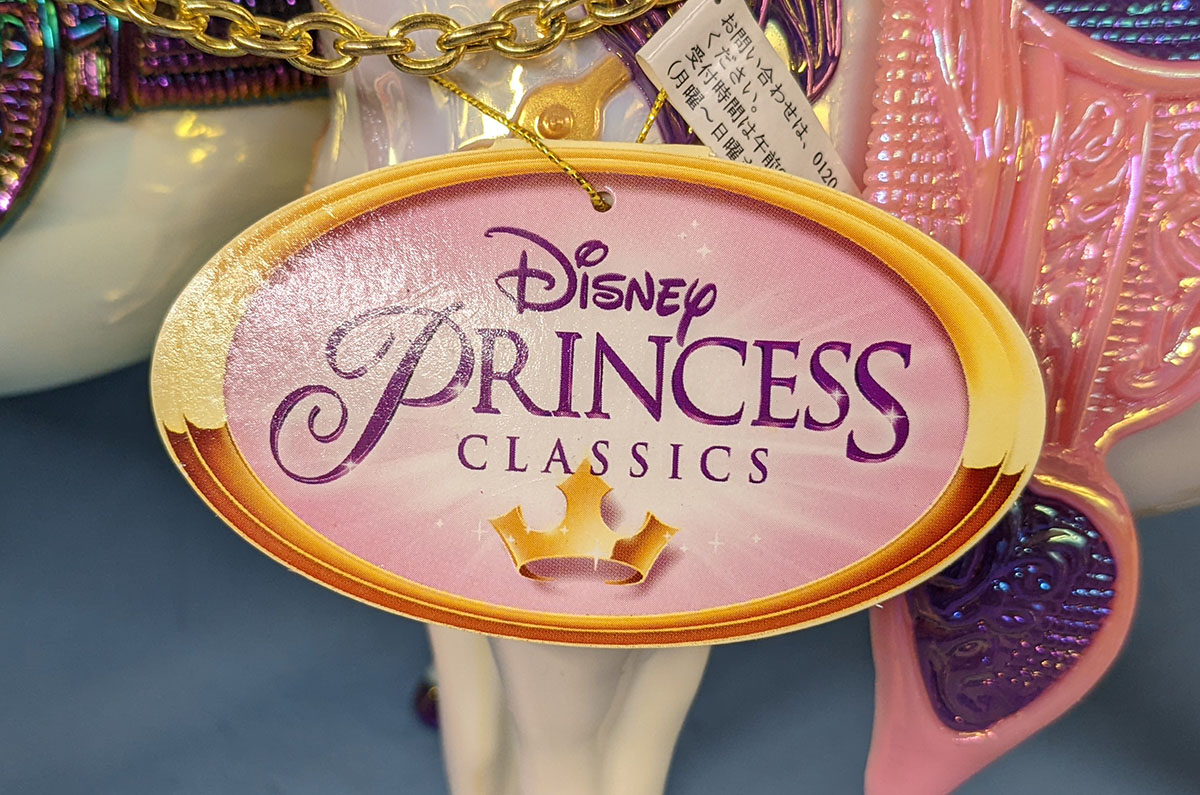
The Disney models are also opalescent white, but they have iridescent purple manes and tails. They also have gold bridles, and the saddles are pink with purple accents. They have a two sided folding hang tag that reads "Disney on Ice" on one side and "Disney Princess Classics" on the other. The saddles say "Disney on Ice" on the seat and are glued on just as with the circus horses. They lack a hole in the head for a feather.


Photo from eBay


Made in China Minis

Stablemate scale copies of the Western Horse also exist. Some of these these pieces are marked "Made in Hong Kong" while others are marked "Made in China." The former match the larger 1970s horses in terms of common colors and likely were made around the same time. The made in China horses are later, made after 1997 as mentioned above. They have chain reins and cute slip on saddles. They also have molded on plastic rings on the their chests as if they were designed to be chained together like you see on some '50s and '60s ceramic and plastic toys. I have seen other colors like pinto and appalosa besides those in this set of black, grey, and bay. The painting is a bit sloppy, but these are very cute copies all the same.


Breyer Ornament

In 2006, Breyer released their own mini Western Horse as a holiday ornament. Sadly, it is a less skillful reproduction of the Western Horse than the made-in-China minis.


Photo from eBay

Tiny HO Scale Western Horse

Jordan Highway Miniatures copied the Western Horse in HO scale (approximately an inch tall) for a tiny popcorn wagon in recent years. Interestingly, the company also copied the Breyer Old Timer, the Clydesdale Mare, and a couple of Hartland models for other HO vehicles. The owner of the company, Jordan Jackson, passed away in 2015, so his kits are no longer being made, but the family apparently still owns the molds.


Miscellaneous

The Western Horse seems to have been wildly popular with copy cat companies, and not only are there plastic copies, but there are also ceramic, metal, and even wall art copies. I'm sure there are more, but here are some fun examples I've seen or bought over the years.


A Japanese ceramic Western Horse. These come in varying sizes.
Photo from eBay.
A metal Western Pony copy (mane only on one side with this pony)
Photo courtesy of Rachel L.
Embossed Western Horse art, a fun antique store find of mine

In the next and final installment of the Western Horse Shaped objects series, I'll discuss the miscellaneous plastic and metal horse clock knock offs that are out there.

Also, if anyone has any textured tack horses, ponies, or clocks, or Kroll ponies for sale, especially a gold one, please email me at mumtazmahal (at) gmail (dot) com. Thanks for reading!

Part four of this series is here.


Sources:

1. Young, Nancy. Breyer Molds and Models: Horses, Riders, and Animals. (Schiffer Publishing Ltd: Atglen, PA), pg. 265.


Friday, May 8, 2020

BreyerFest, Boudicca, and Bizarre Uses of My Education

My sister and I recently had the pleasure of being guests on Heather Malone and Jackie Arns-Rossi's Mares in Black podcast (episode #37). One of the things we talked about was what led us to becoming collectibility nerds, and for me, it was an inevitable progression of my love of history combined with my passion for model horses. What could be more natural?

I have been a history nerd as long as I can remember---I'm interested in everything from the Ancestral Puebloans of the American southwest to the history of the Thoroughbred breed to pre-historic Britain  to the earliest people painting cave walls in France and Spain and so much more. (And let's not even get started on paleontology!) But my chief love is and always has been the Celts. What most people associate with the Celts or Celtic culture---all things Irish, men in kilts, and Celtic knotwork---is really more Celtic pop-culture, a narrow distillation of thousands of years of Celtic history and culture. And while the ideas of Celtic pop-culture are not wrong, they're only a tiny part of a broader and vastly richer picture.

What is considered Celtic culture by scholars and historians encompasses the related languages, material culture, art traditions, social structure, and religion of a tribal people who originated in the Halstatt region of Austria around 1200 BC. To make a long story extremely short, these tribes eventually spread across most of western Europe and into western Asia over the course of hundreds of years. The Gaels of Ireland, the Celtiberians of Spain, the Gauls of France, and the Galatians of Turkey were all part of the Celtic diaspora. They sacked Rome and Delphi, they drank their wine unwatered, they spiked their hair with lime, and they fought naked except for the torcs around their necks. They frightened their Greek and Roman contemporaries so badly that the Celts were regular "boogeymen" for many Classical writers.

My obsession with Celtic history and archaeology led me to a couple of (currently unused) degrees in the subject, and so the Celtic Fling theme for BreyerFest this year had me pretty excited. It's not often that my chosen field crosses paths with my hobby---I had such plans! Alas, as everyone knows by now, BreyerFest has been canceled because of the ongoing coronavirus pandemic. I was pretty sure that would be the case even before it was announced, and Breyer absolutely made the right decision, but it's still sad. The event will at least continue in a virtual form, and I've been loving the special run models they've announced (and especially their names). Epona is of course named for the Celts' patron goddess of horses; Lugh of the Long Arm was an Irish warrior-god of the Tuatha Dé Danann who was said to have invented horseracing; Brighid and Beltane refer to the most important of the Irish goddesses and the May 1st festival celebrating the beginning of summer and fertility for fields and livestock; and oak, ash, and thorn are some of the plants most sacred to the Celtic tribes and the druids.

But my favorite is Boudicca, named for the Celtic warrior-queen who led a rebellion against the Romans in Britain in the first century AD, nearly expelling them from the country for good. Boudicca's story factored heavily in my master's thesis, and so I felt compelled to write a post about her and this wonderful swirly blue horse that I must have.


To understand Boudicca, we first need a quick recap of the position of women in Celtic society and the basic history of Celtic and Roman Britain. The Celts did not have a written language, so we must rely on contemporary Classical sources for this information. Regarding the first subject, Celtic society was surprisingly and unusually egalitarian, especially when compared with the roles of women in Greek and Roman societies whose lives were largely dictated by their male guardians. Celtic women had far more freedom---they could own property, run businesses, be priestesses, judges, ambassadors, bards, healers, rulers, and warriors. This both horrified and fascinated the Greeks and Romans.

As for the second subject, by the time Julius Caesar and his troops first landed in Britain in 55 BC, the Celts had been established there for more than five centuries. That first Roman incursion was little more than a reconnaissance mission, and a real conquest of Britain was not made until almost a century later in 43 AD. The Celtic tribes, even though they shared a linguistic and cultural bond, were independent of one another, and their alliances changed periodically. Because of their general lack of unity, the Roman army was able to sweep across the island, establishing forts and formally subjugating many of the independent tribal leaders as client-kings under Roman rule.

Client-kings were loyal to Rome (primarily out of a sense of self-preservation), but the position did allow them to maintain some level of autonomy. That said, noted Celtic historian Miranda Aldhouse-Green wrote that client-kings became a means of easing conquered peoples into Roman dominion, though they "were [likely] treated with a fair degree of opprobrium by freedom-loving groups at home and with condescension by the Roman government."1 The status of client-king was generally not hereditary, and upon the death of these rulers, the territory they held was often "absorbed into the [Roman] empire proper."2 One of these client-kings was Prasutagus, husband to Boudicca and king or chieftain of the Iceni tribe who inhabited what is now Norfolk and parts of Suffolk on the eastern coast of England.


Boudicca in many ways has become a larger than life figure, but interestingly, most of what is known of her story can be attributed to just one source. The Roman historian Publius Cornelius Tacitus was a small child when the most important events of Boudicca's life played out, but he married the daughter of Gnaeus Julius Agricola, a Roman commander in Britain at the time of the rebellion, so it seems probable that his accounts were based on his father-in-law’s recollections. Tacitus described Prasutagus as "celebrated for his long prosperity,"3 and coin hordes discovered in that region dating to the time of the Boudiccan rebellion suggest that the Iceni were indeed a wealthy tribe.4 This affluence undoubtedly was at least partly to blame for the cascade of events that led to the rebellion.

According to Tacitus, Prasutagus, knowing the transitory nature of client-kingship, "had named the emperor [Nero] as his heir, together with his two daughters; an act of deference which he thought would place his kingdom and household beyond the risk of injury."5 Boudicca assumed leadership of the tribe upon her husband's death because, according to Tacitus, the British Celts "[admitted] no distinction of sex in their royal successions."6 The events that immediately followed Prasutagus' death are not entirely clear. Tacitus implied that Boudicca's assumptive claim of Iceni leadership was an affront to Nero. Dio Cassius, a Roman author who lived a century after the events and who perhaps had access to other sources now lost, added that Roman financiers, chiefly the philosopher and advisor to the emperor, Seneca, called in their loans at that time, which Boudicca presumably refused to pay.7 Regardless of the accuracy of one or both accounts, the Romans' subsequent actions touched off a firestorm that they would long remember and fear to repeat.

Roman soldiers descended on the Iceni territory and pillaged it, treating the people as though they were enemies of Rome rather than still-loyal subjects. They removed tribal elders from their lands and enslaved them, and worst of all, they flogged Boudicca and raped her daughters. These acts of public humiliation and crimes against innocents served to send a message of Roman contempt for the Iceni and also for the impending absolute subjugation of their tribe and its territory.

Incandescent with rage, Boudicca and the Iceni rose up in rebellion and were quickly joined by their neighboring tribe, the Trinovantes, among others. The Trinovantes were restless and unhappy under Roman rule at that time, in large part because of the building of a Roman colonia (a garrison of Roman citizens) at Camulodunum (site of the modern city of Colchester), a settlement that had been the capital of the tribe. According to Dio Cassius, the deliberate selection of that site was in part a punishment for an earlier rebellion.8 Tacitus wrote that the Roman veterans who forcibly settled there "[acted] as though they had received a free gift of the entire country, driving the natives from their homes, ejecting them from their lands, [and styling] them 'captives' and 'slaves.'"9 Of further offense to the Trinovantes at Camulodunum were a temple built to the conquering emperor Claudius and a statue of Victory, symbols whose implications were undoubtedly not lost on the subjugated population. 
 
As if the treatment of Boudicca's family and tribe was not enough to merit the backlash against Rome, the timing of these events coincided with the convenient absence of the Roman governor of Britain, Gaius Suetonius Paulinus, who, thinking the southeast of Britain sufficiently cowed, had marched his troops to the island of Mona (now called Anglesey) in northwestern Wales to subdue the druids whom he considered the greatest threat to peace in Britain. Camulodunum, which had no fortifications, was left essentially undefended, and Boudicca's army swept over it, destroying it as well as the hated temple to Claudius in two days time. The statue of Victory reportedly fell of its own accord in the days before Boudicca's attack, a terrible portent of things to come.10 Her army then met the Ninth Legion Hispania, sent too late to aid Camulodunum, and routed it. Destroying a Roman legion, especially one as experienced as the Ninth which had campaigned in Spain and pacified the Balkans, was a feat of exceptional military strategy and cunning. Tacitus wrote that Boudicca’s army slaughtered the 6,000 strong infantry to a man and that only some of the cavalry managed to escape.11

Upon hearing of the rebellion, Suetonius began a forced march southeast, arriving in Londinium with his light troops ahead of the warring Britons led by Boudicca. Londinium at that time was a commercial settlement less than 20 years old (in terms of Roman occupation), and like Camulodunum, it had no fortifications. Suetonius, who was still waiting for the bulk of the legions at his command to arrive, chose "to save the country as a whole at the cost of one town."12 He retreated to await his troops, and Boudicca’s army poured into Londinium, slaughtering and burning as they went.
(photo from Wikipedia)
Turning north and following Suetonius' retreat, her army sacked the colonia of Verulamium (now St. Albans) as well. Somewhere in the Midlands, probably near Mancetter, Boudicca's army engaged that of Suetonius and was ultimately destroyed. Dio Cassius wrote that the battle lasted most of a day, and that late in the day, the Britons broke and ran.13 Tacitus, who mentioned that a great number of women fought along side the men, wrote that as the Britons retreated, no quarter was given, even to the women.14 He also stated that "Boudicca ended her days by poison,"15 whereas Dio Cassius wrote that she fell ill and died after the battle.16 Whatever the case, both writers agree that without Boudicca's leadership, the cohesion of the British rebellion was lost, and the tribes splintered.

Neither Tacitus nor Dio Cassius gave a clear physical description of Boudicca, and of course, neither of them ever saw her. Nonetheless, she is frequently envisioned by modern writers and artists as a tall, pale woman with flaming red hair. (This very likely has something to do with the rediscovery of Tacitus' works during the reign of Queen Elizabeth I.) So Breyer's color choice on this model, a mulberry grey, is quite apt. I gather there was some angst from collectors that the blue woad patterns on the model are not Celtic knotwork, but that too was an appropriate choice. Knotwork did not become prevalent until several centuries after Boudicca's rebellion, so Breyer's nod to the curvilinear Celtic Hallstatt and La Tène art styles is more accurate.

Boudicca's rebellion shook Rome badly, and she remained a reviled character in Roman histories for centuries. But she is now of course considered one of the great early heroes of Britain. Her famous rebellion of AD 60-61 is still so well remembered that numerous books and film productions, both fiction and non-fiction, tell her story, and a large statue of Boudicca and her daughters in their war chariot prominently decorates the bank of the Thames in London near the Houses of Parliament. Aldhouse-Green perhaps sums it up best by stating that "by any standards, Boudicca was a woman 'writ large.'"18


----------------------------------------------------------------------------------
Works Cited:

1. Aldhouse-Green, Miranda. Boudica: Britannia Rebel, War-Leader, and Queen. (Harlow, UK: Pearson Education Limited, 2006), 68.
2. Aldhouse-Green, 26.
3. Tacitus. The Annals. (Trans. John Jackson. Vol. 3. London: William Heinemann Limited,
1943) 14.21.
4. Aldhouse-Green, 26.
5. Tacitus, The Annals, 14.31.
6. Tacitus. Agricola, Germania, Dialogus. (Trans. William Peterson. London: William
Heinemann Limited, 1943), 197.
7. Dio Cassius. Historia Romana. (Trans. Herbert Baldwin Foster. New York: Pafraets Book
Company, 1906), 62.2.
8. Ibid.
9.  Tacitus, The Annals, 14.21.
10. Ibid, 14.32.
11. Ibid.
12. Ibid, 14.33.
13. Dio Cassius, 62.12.
14. Tacitus, The Annals, 14.37.
15. Ibid.
16. Dio Cassius, 62.12.
17. Aldhouse-Green, 93.
18. Aldhouse-Green, 93.