Saturday, July 1, 2023

Pottery + Model Horses = Nerdy Bliss

My friends, I have a confession to make. I am a pot head. Yes, you read that right.

I. Love. Pottery.

There, I've said it. Now you all know my terrible secret. Model horses are (obviously) my main collecting passion, but I must confess to having a pottery addiction as well. There are pots all over my apartment. I seek them out to admire in museums. I even want to make my own. The horror!

Zuni, Hopi, and Acoma pots

I'm not sure I can quantify what it is I love about glazed ceramics. I am drawn to soft, matte glazes...


As well as brilliant glossy finishes.


I definitely have a thing for earth tones---shades of brown, grey, blue, and green.


I have pottery that was made near my home town.

Red Wing Pottery from Red Wing, MN

I even have a pot that once belonged to a famous person who owned a famous horse.

A pot from the estate of Penny Chenery, owner of Secretariat

But my particular pottery interest is Puebloan pottery made by the Native tribes of the American southwest. I grew up surrounded by Native American artefacts---Navajo rugs, Chippewa beadwork, Zuni jewelry, and Acoma pottery---and I can finally afford to indulge my interest in Native arts on a small scale. 

(The Black Bisque Quail is Hagen-Renaker;
the pots and black horse are Native made.)

Sometimes, my model horse and pottery addictions intertwine---I do collect a lot of ceramic horses and animals after all---and they display beautifully together on my shelves. 


One of my ceramic horses is actually a piece of Native pottery.

Santa Clara horse figurine

I also have a great deal of interest in ancient pottery, especially Ancestral Puebloan (aka Anasazi) pottery, in particular the beautiful and enigmatic figural Mimbres pieces. Such pots are far out of my price range, not to mention the due diligence needed to buy legally collected ancient pots, but happily I live near the Field Museum which has an incredible collection I enjoy visiting regularly.

Just one of many display cases full of amazing Ancestral
Puebloan pots at the Field Museum

I have also had the pleasure of visiting the lovely Chapin Mesa Archaeological Museum at Mesa Verde National Park near Cortez, Colorado.

Me geeking out over pots

My second love when it comes to ancient pottery is what is generally lumped together as Greek. This includes the early Minoan, Mycenean, and Geometric styles as well as the later, better known black-figure and red-figure pottery of Classical Greece. As you can see from my Native pottery collection, in addition to earth tones, I am also drawn to patterns of black and white or black, white, and red.

In terms of ancient Greek pottery, I love the simple geometric designs of the oldest Minoan and Mycenean pieces (circa 2600-800 BCE)---concentric bands of alternating color, patterns of circles and spirals, key patterns, and more. I am also hugely enamored of the many wonderful figural Minoan pots covered in googly-eyed octopi and other sea creatures.

L to R: Photos by Wolfgang Sauber, Olaf Tausch,
and Marie-Lan Nguyen

Styles in Greece transitioned from patterns of predominantly black designs on white backgrounds to the Classical form termed "black figure" in the 600s BCE. These were pieces featuring black designs painted on a reddish-orange background with fine details picked out in white. The decoration also morphed to feature the human figure predominantly, especially scenes from mythology or athletic competitions. The finest examples of Greek pottery were very often prizes awarded at various athletic games held every 2 or 4 years depending on the location. Some would have been large bowls intended as vessels for mixing wine while others were beautifully decorated containers for olive oil, a valuable commodity.

Needless to say, I was hugely excited when I saw Nemea, the BreyerFest 2023 special run inspired by this black-figure amphora depicting a chariot race in the British Museum. This pot was made in Athens circa 410-400 BCE and was found in Cyrenaica (modern Libya). It would likely have been a prize for an athletic competition, presumably a chariot race.

Photo by Carole Raddato from Frankfurt, Germany, CC
BY-SA 2.0, via Wikimedia Commons

Breyer artist (as well as fantastic artist in her own right) Heather Puleo did a magnificent job translating this work into a Breyer design.

Photo from breyerhorses.com

Breyer clearly has my number when it comes to all of the recent models inspired by historical figures or ancient art. I can't wait to add Nemea to my shelf along with Boudicca and Knossos!

Saturday, May 6, 2023

Secretariat, the Return of the Decorators, and a Missing Link Test Run?

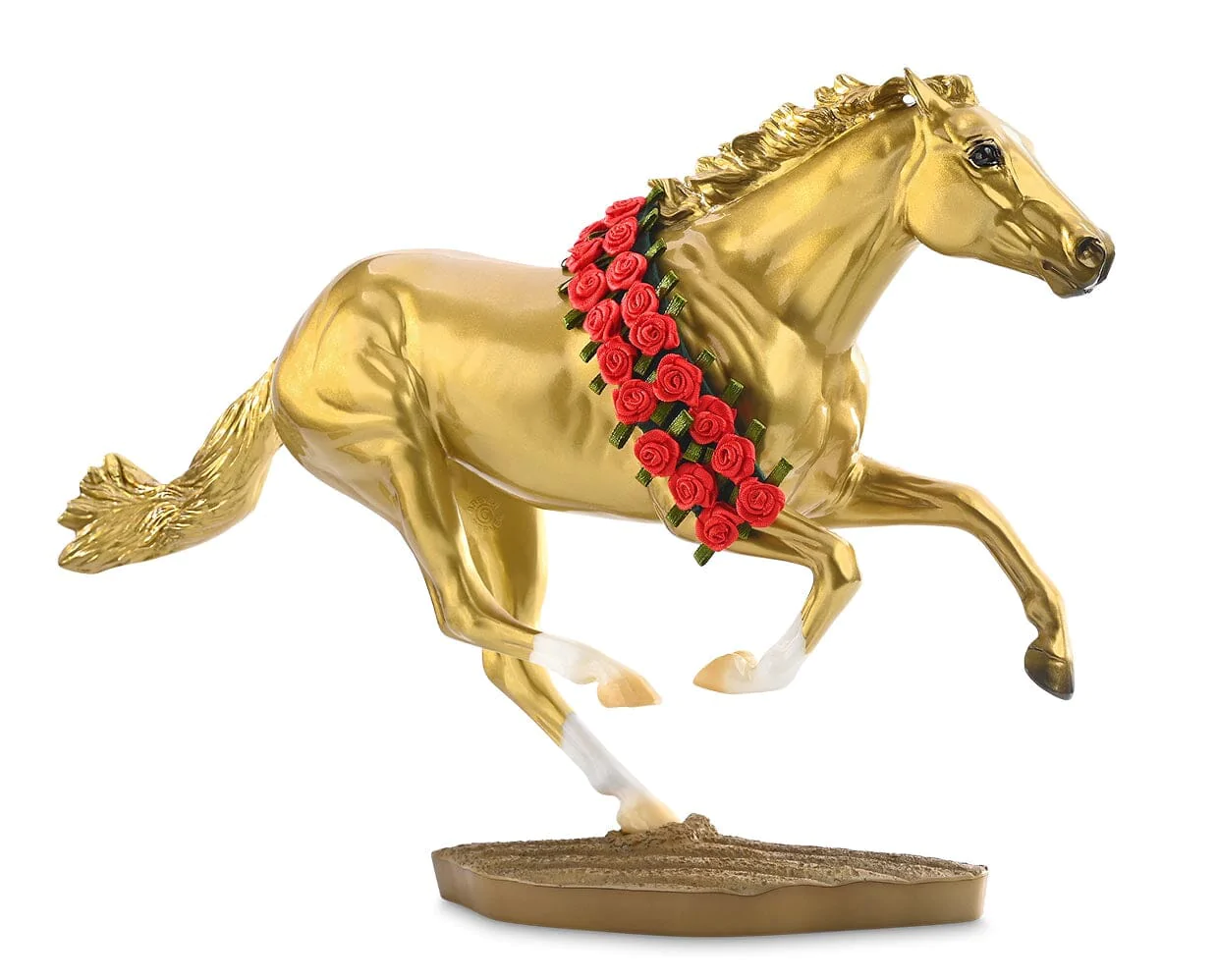
This year marks the 50th anniversary---the golden anniversary no less---of Secretariat's Triple Crown victory in 1973. To celebrate, Breyer has produced a new gold charm Secretariat model on the Smarty Jones mold reminiscent of the one they released almost 25 years ago on the original Secretariat mold. And they have also recently debuted a classic scale gold charm Secretariat for the Vintage Club on the Man O' War mold. So it seems particularly fitting therefore that a gold charm test run model possibly related to that first gold charm Secretariat model came to light just a few months ago.
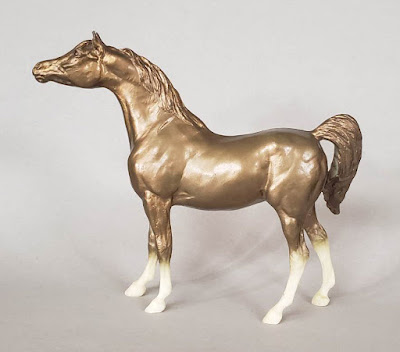
Unfinished test run gold charm Classic Black Stallion

But first, a little backstory. As everyone knows, Secretariat swept the Triple Crown in 1973 in dramatic fashion, winning the Kentucky Derby and Preakness in stakes record times before smashing the Belmont by 31 lengths in a new world record that still stands to this day.

As I've mentioned here and on my studio blog, I have been a horse racing fan my whole life. I learned to read with C. W. Anderson's horse stories, and I was always enthralled by his memories of great horses like Native Dancer, Stymie, Exterminator, and especially Man O' War. Despite all the talented horses he saw in his lifetime, Anderson never wavered from his opinion that the original Big Red was the greatest of them all. He died in 1971 however, two years before the mighty Secretariat swept the Triple Crown, and I have always wondered what he would have written about the second Big Red.

While I'm too young to have seen Secretariat, I do nonetheless have a very clear memory of the evening news reporting Secretariat's death on October 4, 1989. I was only eleven at the time, but I had seen his Triple Crown races on a VHS tape my parents had bought for me of the (then) eleven Triple Crown winners. I knew he'd been a phenomenal racehorse, and Lady's Secret and Risen Star had proved that he was a good sire as well only a few years earlier.

Breyer did not release a Secretariat model until 1987, almost 15 years after the great horse's Triple Crown triumph. Breyer historian Nancy Young wrote that Breyer had approached Penny Chenery, Secretariat's owner, shortly after his great victory to make a model, but Penny had declined, feeling that a toy was inappropriate. Peter Stone finally won her over years later with an appeal of "what about the children?" Secretariat debuted as part of the Artist Series, a line of small traditional scale models by well-known equine artists like Chris Hess, Rich Rudish, and Jeanne Mellin Herrick. It was the last model Hess sculpted for Breyer before he passed away.

I honestly don't recall a thing about buying my regular chestnut Secretariat model, but I do very well remember acquiring one of the next colors released on the mold, the gold charm.
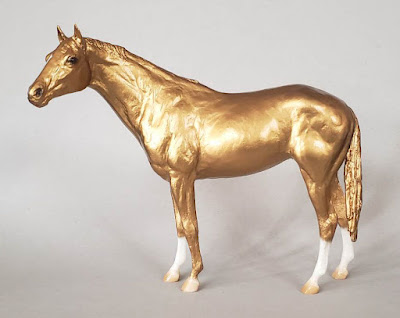
This model was in storage for 30 years, hence his bright,
untarnished gold color

In the late 1980s, after Reeves International bought Breyer, Peter Stone continued to work for the company and travel the country promoting Breyer models. For several years, Breyer hosted a series of signing parties at various toy stores where Peter would visit for an afternoon and sign any models customers purchased or brought in from their own collections. In 1990, a special run gold charm Secretariat model was offered to signing party attendees. My dad very sweetly drove me and my little sister Sarah to a toy store in downtown Atlanta where we stood in line to buy a gold Secretariat and have it signed by Peter.

 
At that time, it had been more than 25 years since Breyer had produced the original decorator models, and needless to say, the gold charm Secretariat caused a bit of a stir. While we stood in line, my dad and I chatted with other collectors about it, and part of the excitement was the reintroduction of a decorator color after so long, and part of it was due the fact that it was not quite a traditional gold charm model. Instead of having a white mane and tail, bald face, and four white feet like the '60s gold charm models, the new Secretariat was gold all over with a blaze and 3 socks like those of the real horse. And as a run of only 3500 pieces, he was considered somewhat limited in those pre-internet days.
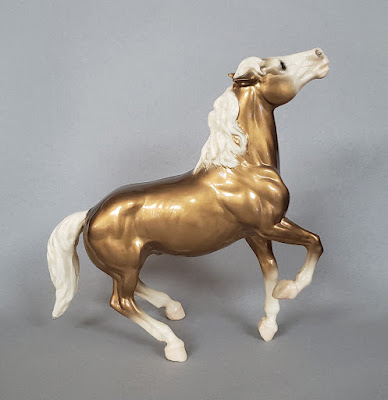


A 1960s gold charm Mustang for comparison

Later that summer in July 1990 at the inaugural BreyerFest, yet another new decorator was released, a florentine Misty raffle model limited to 21 pieces. The color and style of this model were a close match to the florentine models of the 1960s.
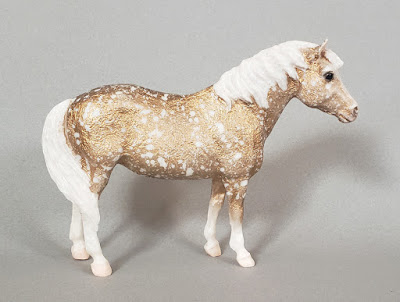
1990 BreyerFest raffle model florentine Misty

A 1960s florentine Mustang for comparison 

The following year, Breyer held BreyerFest events at four locations---in Lexington at the Kentucky Horse Park as they done the year before, as well as in Redmond/Bend, OR; York, PA; and Pomona, CA. Each location had a different decorator raffle model, and unlike the florentine Misty from the previous year, none of the 1991 decorator raffle models were a match for their 1960s counterpoints.
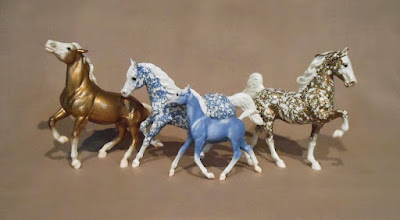
The 4 original 1960s decorator colors

The florentine Legionario does not have a white mane and tail, has only two socks and no bald face, and has grey hooves instead of pink. The copenhagen San Domingo does not have a white mane, tail,  socks, or bald face, and he also has grey hooves. The gold charm Man O' War is gold all over except for his star to match the real horse. And the wedgewood Sham has a white mane and tail and four socks but no bald face, and grey hooves instead of pink.
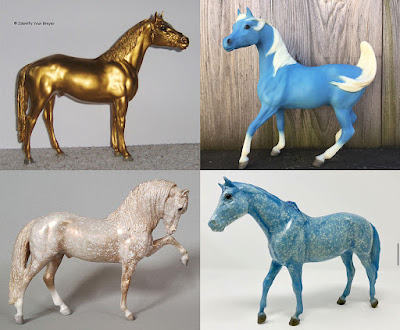
The 1991 BreyerFest raffle decorators (Man O' War photo
from Identify Your Breyer, Sham photo by Mel Grant,
Legionario photo by Sarah Wellman, San Domingo photo
by Molly Bates)

Subsequent decorator models such as the 1996 BreyerFest raffle model Malibu, a wedgewood Hackney, returned to the style of the 1960s models with white manes, tails, bald faces, socks, and pink hooves.

So when this gold charm Classic Black Stallion turned up in an online auction a few months ago, it immediately caught my attention because it reminded me strongly of the gold charm Secretariat and the 1991 raffle models. I was certain he was original finish because everything about the way he was painted, from the way the gold on his legs fades into white socks to the distinctive way the underside of his tail is not painted, suggested he was absolutely factory original. After 40 years of collecting, you just know that OF look.
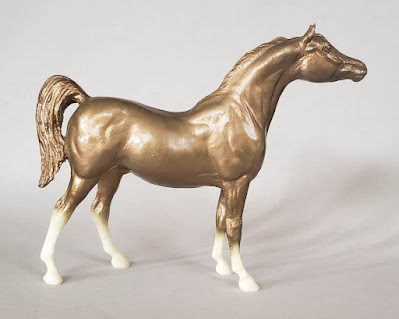
Interestingly, he escaped the factory unfinished (his hooves and eyes are not painted). His gold paint has oxidized ever so slightly in the 30 or so years since I believe he was created. The Classic Black Stallion mold was introduced in 1983, and until about 2002, it had some rough pimply spots on the barrel. The mold was smoothed out in 2003. This gold charm model does have the pimpled barrel, so he had to have been made sometime between 1983-2002. But I think the window for his creation date can be narrowed down to just a few years, probably sometime between 1989-1991.

Because he was painted with a gold mane and tail and a solid gold face and because he is a small standing model, I can't help but wonder if he was painted when Breyer was testing options for the gold charm Secretariat release. The models are of a similar size in a similar pose, and the non-traditional gold charm paint job is very alike in terms of style. He also bears a strong resemblance style-wise to the unconventional 1991 raffle models.

While I can't prove that this model is the missing link that brought decorator colors forward into modern production after a long hiatus, I think it's highly likely that he dates from the right time period. Furthermore, we do know of a few other oddball decorator colors on classic scale molds from this period, such as the wedgewood Classic Man O' War and the wedgewood Classic Kelso that were sold at the 1997 and 1999 BreyerFest auctions respectively. At the time, the models sold in the BreyerFest auctions were true factory tests plucked from the archive shelves, not one of a kind models made deliberately for the auction as they are now. Both of those models were likely painted several years earlier around the same time as the 1991 raffle models. Could this gold charm Classic Black Stallion be a part of that series of test models, too? I'm not sure we'll ever know for certain. And that is part of the thrill of collecting and hunting for rare Breyers. You just never know what unexpected things will turn up! 

Thursday, March 16, 2023

Souvenirs and Bygones: Engraved Model Horses and So Many Stickers!

As of April of this year, I will have been writing this blog for 12 years (which is kind of hard to believe)! I thoroughly enjoy writing about the hobby and model horse manufacturer history, and I have absolutely no intention of stopping. I am also planning to reboot my Model Horse History website and start adding more content this summer. Building websites and writing posts for this blog however take a great deal of time, effort, and research, and many of the historical archives and databases (not to mention webhosting) I utilize are not free. With that in mind, I decided to set-up a Kofi page. Both the MHH page and this blog will always be free to everyone to read, but donations or monthly support are very welcome. Thank you!

* * * * * 

Now, back to blogging!

Most travelers, myself included, enjoy bringing home souvenirs from trips, whether photos or tchotchkes or pretty rocks (especially pretty rocks). Souvenirs have been popular for centuries (millennia even), and they continue to remain popular today. Just about anything you can imagine is available as a souvenir---I personally like to buy fridge magnets depicting the new places I visit. 

Travel today is relatively easy and convenient by air or by car (and to a lesser degree by train), but that hasn't always been the case. The vast interstate highway system that crisscrosses the United States really only began to take shape in the 1920s, and while car travel became more accessible, in the decades leading up to World War II, most vacationers tended to be well-to-do.

The end of World War II triggered an era of growth and prosperity in the United States, and further work on the interstate highway system in the 1950s encouraged more middle class families to get out and explore the country. Roadside attractions with their requisite souvenirs, especially near tourist destinations, were already well-established. Interestingly, some of the souvenirs on offer included model horses, everything from metal models to plastic to ceramic. Given the popularity of Westerns at the time, this was a smart choice by retailers.

Most of the models horse souvenirs I'm aware of date to the 1950s or 1960s although some of the metal ones probably date to the late 1940s. Enterprising entrepreneurs personalized items to their locale by engraving them, adding stickers, and other means. These additions are all custom, aftermarket  embellishments. They were not added by the manufacturers (i.e. Breyer, Hartland, etc) and are therefore not OF. But that said, these souvenir models are still fun to collect!

A variety of Breyers and Hartlands have been found with engraved city names and dates on them. A few are even personalized with their owner's name. Most of the ones I've seen are marked New York or New York City, but I've also seen some marked New Orleans, Niagara Falls, Seattle, and San Francisco. The majority have dates from the 1950s, but a few have dates from the early 1960s. The models were engraved by retailers at the request of their customers. On light-colored models, the engraved area was rubbed with something dark (perhaps ink?) to make the lettering standout. On darker models, the engraving stood out against the existing paint and needed no further embellishments. Collectors who received engraved models as children related visiting certain stores in New York or the World's Fair in Seattle where their parents' purchased the models for them. What fun memories!

A Hartland Victor engraved "San Francisco 1949" (Photo by
Stormfront Stables/2004)

A Shetland from the early 1960s (Photo by Lois F)

Not just horses were engraved! (Photo by Lois F)

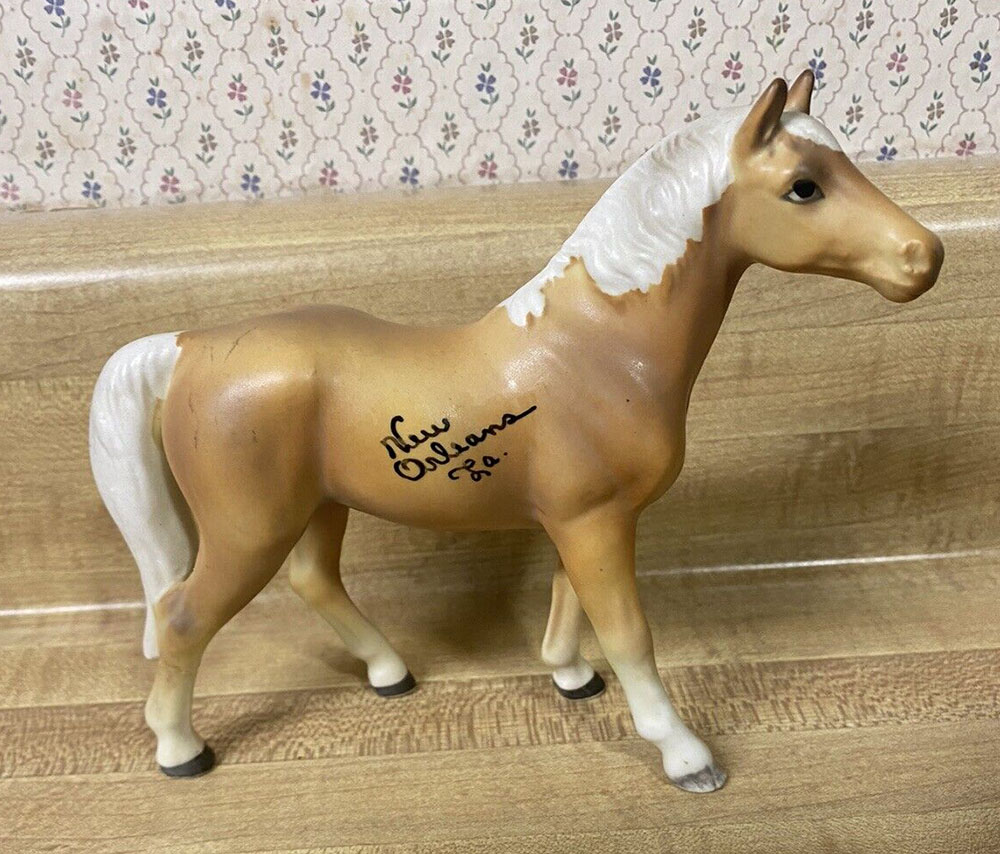
 Some horses made of materials that could not be etched were inscribed with ink instead.

A ceramic souvenir horse from New Orleans (Photo from eBay)

A funny little metal horse from the Farmers' Market in
Hollywood, California (Photo from eBay)

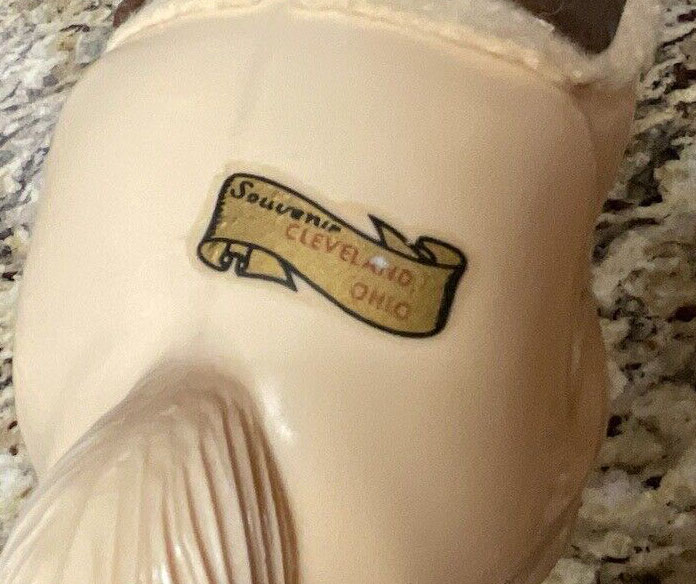
Many other souvenir models were decorated with stickers listing the location where they were purchased. The stickers varied in color and design, but the majority seem to be gold or yellow in the shape of a fluttering ribbon. As expected, many plastic horses---Breyers, Hartlands, and knock offs---bear these stickers.

  
An early Western Horse (circa 1951-1952) with a
Cleveland, Ohio, souvenir sticker (Photo by Lois F)


(Photo by Lois F)

A yellow ribbon with red ends is the most commonly seen style. They reference the names of towns, tourist attractions, stores, and even national parks.

A Hong Kong copy of the Breyer Western Prancer with a
souvenir sticker for Grant's Farm (Photo from eBay)


(Photo from eBay)

These stickers show up on ceramic models as well, including Hagen-Renakers, both horses and animals. Here is my sister's Monrovia-era King Cortez with a souvenir sticker from the Libertyville Gifts and Lamps store in the Chicago suburbs.

(Photo by Sarah Wellman)

Hagen-Renaker frog with HR sticker on his back...

And a souvenir sticker from Colorado
Springs, CO, on the bottom!

And here's a bone china pair from Japan with a Detroit, Michigan, souvenir sticker.

(Photo from eBay)


 Metal horses also had fun stickers...

A souvenir of Delta, Colorado (Photo from eBay)

Another Colorado souvenir (Photo from eBay)

Because the engraving and stickers on these models are after market and not OF, I personally don't tend to seek them out for my collection unless I want the base model regardless of the souvenir add-ons. For example, I most definitely wanted the HR frog pictured above, and the Colorado sticker was a fun bonus, especially since it was on the underside of the piece. (I am crazy about Colorado and love to visit whenever I can.)

I did buy this Western Horse however, even though I already had several black pinto examples in my collection, because the souvenir sticker was for a tiny town just down the Mississippi River from where I spent most of my childhood. It's a reminder of home.

Souvenir of Homer, Minnesota

When it comes to showing, the engraved pieces would definitely be considered customized and could not be shown as OFs. The models with stickers, on the other hand, could be shown, in my opinion, provided both the entrant and judge understand that the sticker should be ignored when judging.

While these pieces are no longer entirely OF, they are still very collectible and fun. More than a few collectors enjoy tracking them down as mementos of fondly remembered places they have visited or just for the sheer variety of locations represented. Do any of my readers collect souvenir models? Do you have a favorite piece? Please feel free to leave a comment or a story. And thanks as always for reading!

Thursday, February 2, 2023

Remembering Linda Walter

I did not expect to start off the new year blogging about another sad loss to the model horse hobby community, but alas, we have lost Linda Walter. I didn't know Linda well, but I had known of her almost as soon as I became aware of the hobby in the late 1980s. Linda was not only a founding member of the hobby---she was a talented artist, a dedicated publisher, an amazing font of knowledge, and a truly kind and good-humored person. I know she'd have had something funny and self-deprecating to say if she knew how many of us looked up to her as an icon of the hobby.

Photo of Linda from an article in her local paper
(Photo by Robbyn Brooks)

Linda became active in the nascent model horse hobby in the mid 1960s, and along with Marney Walerius and others, is considered one of the hobby's founding members. Like most early hobbyists, Linda was an avid photoshower, and in 1969, she started her own newsletter, the Model Horse Showers Journal. It featured ads for photoshows, sales lists, stallion ads for pedigree assignment, hobby news, and so much more. Linda drew all of the illustrations and produced all of the copies herself, first using a type writer and carbon paper and later a mimeograph. (Photocopiers were not yet widely available.) The MHSJ is one of the most important and influential early hobby publications, and by the time Linda stopped publishing it in 1980, she had a circulation of more than 700 subscribers.

One of Linda's hand-illustrated covers

Linda hard at work at her typewriter
(from the Spring 1978 issue of Just
About Horses)

The first 3 decades of the hobby largely revolved around communication through the mail. Many hobbyists met via classifieds ads in real and model horse publications and became pen pals. Others got to know each other through newsletters and photoshows. For a time, Breyer directed many of the questions they received about the hobby to Linda. She was even featured in their own publication, Just About Horses, in Spring 1978.

Linda on the cover of the
Spring 1978 issue of Just
About Horses


So it's no surprise that when I had questions about Hagen-Renakers that my local hobby friends couldn't answer in the early 1990s, I was told to contact Linda. It was not unusual to cold-call other collectors then, and with some encouragement from my parents, I gave Linda a call. She very sweetly chatted with me and explained that even though my HR Morgans looked sort of pinkish-grey, the color really was called "brown" by collectors. I don't remember what all we talked about besides HRs, but she was kind and enthusiastic and put my nervous teenage self at ease. She followed up the call with a letter which my mom happily saved. I'm pretty sure it has some of Linda's equine doodles on it.


I finally met Linda in person some 20 years later at BreyerFest. She brought loads of clinky minis to sell from her room at the CHIN, and I'm so glad I had the chance to buy a few and chat with her. She also graciously gave me permission to scan old copies of the MHSJ and post them on my Model Horse History website for the hobby at large to enjoy.

Linda's famous Beswick Appaloosa, Alconbury Hill
(Photo by Robbyn Brooks)

I am going to miss Linda's indomitable good cheer and clever puns at BreyerFest this July. It was always a treat to talk with her, and I wish I'd had more time to ask her about her involvement in the hobby in the early days. She was a treasure, and she will be much missed.

Tuesday, December 20, 2022

Bleach Damage in Breyers

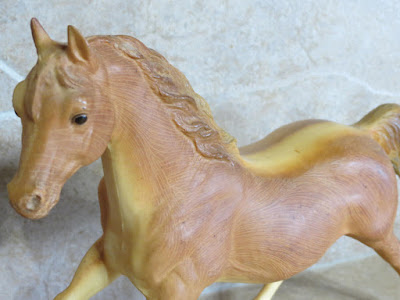
In the last few years, I've been seeing more and more bleach-damaged models popping up on eBay and social media, and I thought it was a worthwhile subject to tackle here since many hobbyists are confused by their appearance. A few unscrupulous sellers have even tried to pass these models off as rare tests or woodgrains because of the striping pattern caused by the bleach damage as seen on the Running Mare below.

Bleach damaged alabaster Running Mare (Photo from eBay)

But why on earth would anyone use bleach on a Breyer? Most hobbyists these days know that putting a yellow model in a sunny window is the best and safest way to whiten it up. In the past however, particularly in the '80s and '90s, many hobbyists soaked their yellow models in a mixture of bleach and water or even bleach and vinegar to brighten them up. (Obligatory PSA: For the love of all that is holy and/or unholy, DO NOT do this. Not only will it ruin your models, the latter mixture creates potentially deadly chlorine gas.) While bleaching models was effective in the short term, many models that were whitened in this fashion began to show damage from the process years later.

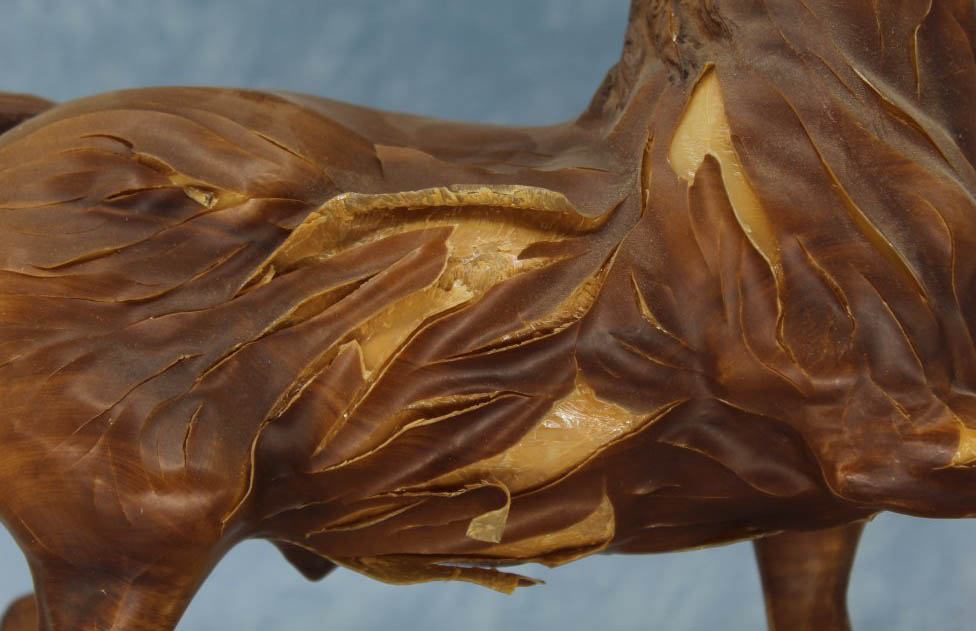
This delayed damage takes the form of brown discoloration and long parallel cracks in the top layer of plastic. The cracks usually look like fine, close-set striations, often with a bit of a raised texture. Sometimes these cracks open and the plastic begins to peel back. Some models are discolored and have striations all over from being completely submerged, and some are only partially damaged, indicating they were not bleached on both sides (or at least not for equal amounts of time).

Here is the other side of the Running Mare pictured above. While this side has developed some brown discoloration from bleach damage, it must not have been left floating in the bleach solution as long as the other side.

(Photo from eBay)
 

(Photo from eBay)

The mostly undamaged white stripe down the belly, back, and front of the neck shows the areas of the model that were exposed to the bleach the least while floating in the solution. The close up below gives a better view of the weird striations that are a tell-tale sign of bleach damage. They are absolutely not factory painted stripes.

(Photo from eBay)
 
Bleaching models to whiten them was a delicate game of timing. Collectors who left their models in too long would find the paint stripped from them. In fact, customizers often used bleach baths to deliberately strip OF paint off of models, especially for the creation of faux-OF paint jobs. Unfortunately, washing the model after subjecting it to bleach was not enough to prevent long-term damage. It was already done even if it wasn't apparent right away.

Because the bleach solution also couldn't be effectively rinsed and drained out of the inside of a model through the tiny airholes in the nostril or corner of the mouth, most bleached models, no matter how long they were subjected to the treatment, retained some amount of the damaging liquid inside. The model below was stripped to be repainted as a faux-woodgrain. The plastic is literally crumbling in strips.
 
Extensive bleach damage (Photo courtesy of Lucy Kusluch)

In addition to this weird peeling, some bleached models develop small holes in places where the plastic is thin. These are sometimes present when no other damage is yet apparent. In some cases, especially with models produced in the last 10-15 years which are usually made of softer plastic, bleaching can cause the model to disintegrate into pieces. Bleached models may take years to show the damage, but eventually, they will start to discolor and split or worse.

I hope this post has been helpful!