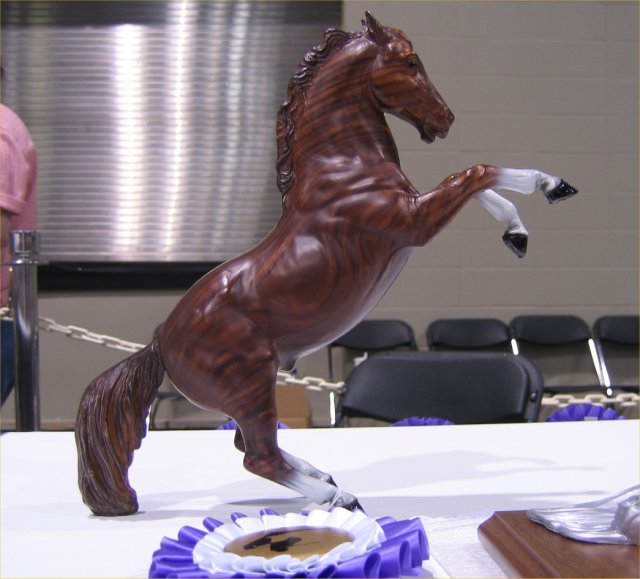
My dad travels a lot for work, and about 20 years ago, he came home from a trip with a special find. While on the road, he stopped for lunch and then decided to look through a nearby antique mall. When he arrived at the house later that evening, he came up the front steps grinning and said he'd found "a decorator." And he was right. It wasn't a Breyer decorator, but it was a gold Hartland 9" Mustang which was just as exciting. We didn't know much about it at the time, but eventually we learned that it had been made as a special run for a brewery. It was meant to be affixed to a sign that would have been on display in a bar.
For most of the intervening years since then, I focused mostly on collecting Breyers, but I happily bought old Hartlands when I could find them at reasonable prices. I've always liked their stylized look, especially the horses made in the 1960s, and for the last few years, I've been actively filling in gaps in my collection of horses from that era. I've also been filling in the gaps in my knowledge about Hartlands.
So, in my post about Hartland woodcuts earlier this summer, I mentioned the elusive gold woodcut 9" Mustang and included a photo of a partial set I found on Google. According to Gail Fitch's book Hartland Horses and Dogs, the gold Mustang was issued as a special run in the late 1960s for the Pittsburgh Brewing Company in Pittsburgh, PA, who distributed Mustang Malt Liquor. No one knows how many were made or even exactly when they were made, but the horses are found often enough off the beer sign that I suspect there are a reasonable number to be had. Finding models still on the beer sign and with the original beverage container is however much more unusual. I see horses with the bases only very occasionally and complete sets hardly ever. So that said, I was really pleased to be able to add this set to my Hartland collection.
Unlike the other Hartland woodcuts which were molded in colored plastic, this model is molded in white plastic and was then painted gold. The base on this example is lettered on both sides, but some are only lettered on one side. I believe the piece was meant to come with the empty glass bottle as shown here, but I have seen at least one with an aluminum can instead. I'm not sure if it came both ways or if the can was a replacement for a presumably broken or lost bottle. Either way, it's a fun bit of breweriana and Hartland history.
Friday, November 8, 2013
Monday, September 9, 2013
Shedding a little light on Breyer Western Horse Lamps
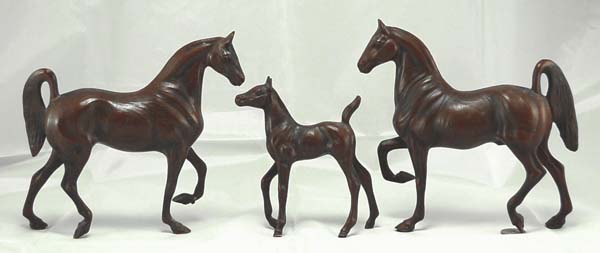
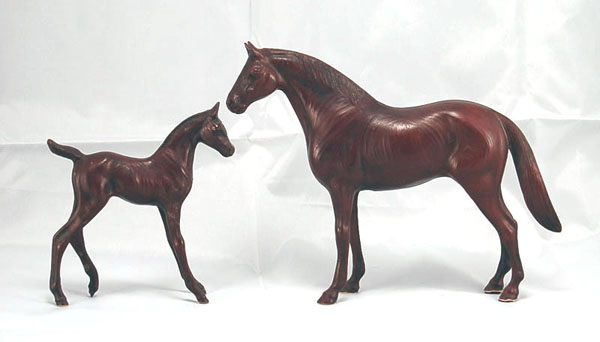
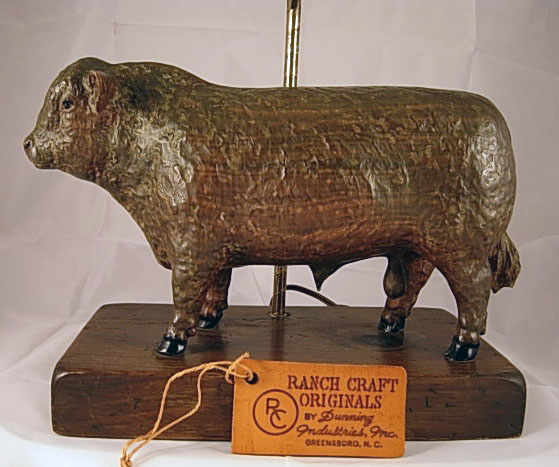
Most collectors are familiar with the "Ranchcraft" line of Breyer woodgrain lamps sold by Dunning Industries in the 1960s and 1970s. They featured models such as the Running Mare and Foal, the Fighting Stallion, the Family Arab Foal, and even a few animals like the Longhorn Steer and the Brahma Bull. These woodgrain models were mounted on wooden bases and the lamps sported rustic burlap shades.A few non-woodgrain models graced these lamps, too, like the grey Elephant and Donkey and the Bay Rearing Stallion.
Less common, however, are the Western Horse and Western Pony "scroll base" lamps. Like the Western Horse clocks, they date to the early 1950s, near the beginning of Breyer's model horse history. The Western Horse lamps, as with the clocks, have turned up in both alabaster and palomino. In my experience, the alabasters usually come on black-painted metal bases while the palominos are typically seen on brown or turquoisey-green bases. These metal scroll base lamps are generally harder to find than most of the Ranchcraft lamps.
I have not yet been able to track down much information about the Marks Manufacturing Company, but as I work in a top-notch research library, that of my alma mater, the University of Chicago, I have access to some handy sources like a 1956 Chicago phone book. I was able to track down the address of Marks, and like the Mastercrafter Clock Company, it was a near neighbor of the Breyer factory. All three were located just west of downtown Chicago. Mastercrafters was about one mile due east of Breyer, and Marks was a bit northeast, about 2 miles away.
The use of the zone number (22) rather than a zip code helps narrow the date on this piece to the 1950s, and the high grommet saddles and painting style of the Western Horses on the lamps pinpoint them to the early 1950s. Based on pictures I've found of other (non-horse) Marks made lamps, the company appears to have been in business as early as the 1930s if not earlier. I have not yet been able to determine if it was related to the well-known Clayton Mark and Company (of Evanston, IL) and Mark (no "s") Manufacturing Company of Indiana. The latter two companies specialized in steel manufacturing of pipes and well equipment and were founded by Clayton Mark (of Marktown fame) and his sons. It's not a huge stretch to think that someone in the family might have opted for the decorative side of metal work, but it could also be a complete coincidence.
I plan to do more digging to track down the history of Marks. I'm very curious to know how long the company was in business after their collaboration with Breyer and whether or not it was related to one of Clayton Mark's companies. I'll be sure to blog about anything I find!
Next time, some news on those chinas we all Love!
![]() |
| Rare woodgrain Buffalo lamp by Dunning |
Less common, however, are the Western Horse and Western Pony "scroll base" lamps. Like the Western Horse clocks, they date to the early 1950s, near the beginning of Breyer's model horse history. The Western Horse lamps, as with the clocks, have turned up in both alabaster and palomino. In my experience, the alabasters usually come on black-painted metal bases while the palominos are typically seen on brown or turquoisey-green bases. These metal scroll base lamps are generally harder to find than most of the Ranchcraft lamps.
We know these lamps date to the early 1950s because the Western Horses that are found on them were only made in that time period. Some have black hooves which peg them as the very earliest examples of Western Horses, and we know the black hooves were typical until about 1952. Grey hooved examples of these lamps are also known, but all of them have high grommet saddles, meaning the metal ring that attaches the girth to the saddle is at the top of the fender. By about 1954, Breyer had switched the attachment point to the bottom of the fender (low grommet), saving themselves a couple of inches of girth material per model. So that said, these lamps likely date from about 1950/1951 to probably no later than 1953.
Interestingly, by late 1952, the "Black Beauty" black with gold hooves colorway was available on the Western Horse and Pony, but that color has not been found on one of these lamps. It could be that not using the black horses was a stylistic choice, or it may mean that the scroll base lamps were discontinued by the end of 1952. We'll probably never know. Suffice it to say though, they were not made for long and remain quite desirable to collectors.
The scroll base lamps pictured below have the original shade, and I have seen a few other examples with shades of the same shape that may also be original. One looks almost identical to mine, but has some mid-century modern style geometric designs printed on it, and another is dark red with thin banding on the top and bottom edge rather than lacing. Retailers may have offered several shade options to consumers.
Interestingly, by late 1952, the "Black Beauty" black with gold hooves colorway was available on the Western Horse and Pony, but that color has not been found on one of these lamps. It could be that not using the black horses was a stylistic choice, or it may mean that the scroll base lamps were discontinued by the end of 1952. We'll probably never know. Suffice it to say though, they were not made for long and remain quite desirable to collectors.
The scroll base lamps pictured below have the original shade, and I have seen a few other examples with shades of the same shape that may also be original. One looks almost identical to mine, but has some mid-century modern style geometric designs printed on it, and another is dark red with thin banding on the top and bottom edge rather than lacing. Retailers may have offered several shade options to consumers.
The Western Pony version of these lamps is much harder to find than the Western Horse version. I've only seen 2 or 3 myself. All of those have been palomino ponies on brown bases. Here are some quick photos of mine. Interestingly, this guy came with a small burlap shade that matches the shape of the shades for the larger Western Horse lamps. I'm not sure if it's original, but it looks the part. (The saddle shown here is not the correct one. I'll have to get new photos eventually.)
On the back side of the Western Pony lamp, you can see a small metal band that screws into the side of the pony and bends around the lamp pole. The Western Horse versions of these lamps also usually have the same metal band and screw attachment.
My mom, sister, and I recently acquired the palomino Western Horse lamp pictured above, and we were pleased to discover a manufacturer's sticker on the bottom of the base. As far as I know, no other examples are known with any sort of identifying marks (although if you happen to have one, I'd love to know!), so we were pretty excited to finally have a maker's name to add to our provenance files.
I have not yet been able to track down much information about the Marks Manufacturing Company, but as I work in a top-notch research library, that of my alma mater, the University of Chicago, I have access to some handy sources like a 1956 Chicago phone book. I was able to track down the address of Marks, and like the Mastercrafter Clock Company, it was a near neighbor of the Breyer factory. All three were located just west of downtown Chicago. Mastercrafters was about one mile due east of Breyer, and Marks was a bit northeast, about 2 miles away.
The use of the zone number (22) rather than a zip code helps narrow the date on this piece to the 1950s, and the high grommet saddles and painting style of the Western Horses on the lamps pinpoint them to the early 1950s. Based on pictures I've found of other (non-horse) Marks made lamps, the company appears to have been in business as early as the 1930s if not earlier. I have not yet been able to determine if it was related to the well-known Clayton Mark and Company (of Evanston, IL) and Mark (no "s") Manufacturing Company of Indiana. The latter two companies specialized in steel manufacturing of pipes and well equipment and were founded by Clayton Mark (of Marktown fame) and his sons. It's not a huge stretch to think that someone in the family might have opted for the decorative side of metal work, but it could also be a complete coincidence.
I plan to do more digging to track down the history of Marks. I'm very curious to know how long the company was in business after their collaboration with Breyer and whether or not it was related to one of Clayton Mark's companies. I'll be sure to blog about anything I find!
Next time, some news on those chinas we all Love!
Friday, July 19, 2013
Welcome, BreyerFest readers!
Welcome to the Model Horse Collectibility blog! If you saw my flyers at the CHIN, thank you for surfing on over to check out the blog! Here are some quick links to some of the most popular posts:
What is collectibility?
http://modelhorsecollectibility.blogspot.com/2011/04/what-is-collectability-and-why-should.html
Collectibility reference materials
http://modelhorsecollectibility.blogspot.com/2011/06/collectibility-reference-materials.html
http://modelhorsecollectibility.blogspot.com/2011/08/collectibility-reference-materials.html
The importance of provenance
http://modelhorsecollectibility.blogspot.com/2011/11/importance-of-provenance.html
Vinegar syndrome: all about shrinkies and oozies
http://modelhorsecollectibility.blogspot.com/2013/01/vinegar-syndrome-breyer-shrinkies-and.html
Wooden horses, woodgrains, and woodcuts series:
http://modelhorsecollectibility.blogspot.com/2013/07/friday-featurette-wooden-horses-part-1.html
http://modelhorsecollectibility.blogspot.com/2013/07/friday-featurette-wooden-horses-part-2.html
http://modelhorsecollectibility.blogspot.com/2013/07/almost-friday-featurette-wooden-horses.html
Future topics will include:
* The resin revolution
* Stickers
* Original finish vs after market
* Epherema and values
* More real horse and portrait model profiles
If you'd like to suggest a topic, please feel free to leave a comment!
What is collectibility?
http://modelhorsecollectibility.blogspot.com/2011/04/what-is-collectability-and-why-should.html
Collectibility reference materials
http://modelhorsecollectibility.blogspot.com/2011/06/collectibility-reference-materials.html
http://modelhorsecollectibility.blogspot.com/2011/08/collectibility-reference-materials.html
The importance of provenance
http://modelhorsecollectibility.blogspot.com/2011/11/importance-of-provenance.html
Vinegar syndrome: all about shrinkies and oozies
http://modelhorsecollectibility.blogspot.com/2013/01/vinegar-syndrome-breyer-shrinkies-and.html
Wooden horses, woodgrains, and woodcuts series:
http://modelhorsecollectibility.blogspot.com/2013/07/friday-featurette-wooden-horses-part-1.html
http://modelhorsecollectibility.blogspot.com/2013/07/friday-featurette-wooden-horses-part-2.html
http://modelhorsecollectibility.blogspot.com/2013/07/almost-friday-featurette-wooden-horses.html
Future topics will include:
* The resin revolution
* Stickers
* Original finish vs after market
* Epherema and values
* More real horse and portrait model profiles
If you'd like to suggest a topic, please feel free to leave a comment!
Wednesday, July 17, 2013
(Almost) Friday Featurette: Wooden Horses Part 3
It's not quite Friday, but with BreyerFest rapidly approaching, I thought I'd make another post in the series about wooden horses and wooden wannabes.
In the 1960s, Breyer was not the only company producing plastic model horses that were finished in a faux-wood style. Hartland Plastics of Hartland, Wisconsin, a town about 25 miles west of Milwaukee, introduced a line of models called "woodcuts" beginning in 1964.These models differed from Breyer's faux-wood models in that they were sculpted to look as though were whittled or carved from wood rather than just painted to look that way.
The Hartland woodcut look was achieved in three different ways. Some models have an angular surface meant to look like carving marks:
Some are both carved and marked with incised graining (in horizontal bands in this case):
The woodcut molds are unique molds separate from the corresponding smooth body versions. They were sculpted by Roger Williams, and the carving and/or graining was added by Alvar Bäckstrand. The models came came in three shades: walnut (tan), cherry (dark reddish-brown), and ebony (black). They were usually cast in tan, reddish-brown, and blue-grey or black plastic respectively and had a wash of darker shading rubbed over the surface to highlight the woodgraining look. Some models, especially the later walnut pieces, have very little of the contrasting color applied.
Hartland has passed through several owners and has therefore been in and out of business a number of times since the 1960s. Under two new incarnations, those headed by Paola Groeber from 1987-1990 and Sheryl Leisure from 2000-2007, the 9" Mustang and TWH woodcut molds were issued in several realistic horse colors. The woodcut models painted and sold by Paola were all test runs as far as I know. The models sold by Sheryl were a mix of small regular runs and test runs. For more information on these models, I highly recommend Hartland Horses and Dogs and Hartland Horses: New Model Horses Since 2000 by Gail Fitch, both of which are available directly from the author.
The rarest woodcut, to the best of my knowledge, is a one-of-a-kind test run 9" Five-Gaited Saddlebred. She came from the collection of a former Hartland employee and probably dates to the mid-1960s. She was sold mounted on a base as shown and is grained only, not carved. My best guess is that she was possibly a one-off prototype that was never put into put into production, perhaps because she was too similar to the 9" Three Gaiters.
Some woodcut Hartlands were issued with gold stickers, a factor that can make an ordinary model extraordinary if found with the sticker still in place. I have seen two different styles---a round sticker and a rectangular sticker. Both indicate the models have a "hand-rubbed, wood carved finish."
In the 1960s, Breyer was not the only company producing plastic model horses that were finished in a faux-wood style. Hartland Plastics of Hartland, Wisconsin, a town about 25 miles west of Milwaukee, introduced a line of models called "woodcuts" beginning in 1964.These models differed from Breyer's faux-wood models in that they were sculpted to look as though were whittled or carved from wood rather than just painted to look that way.
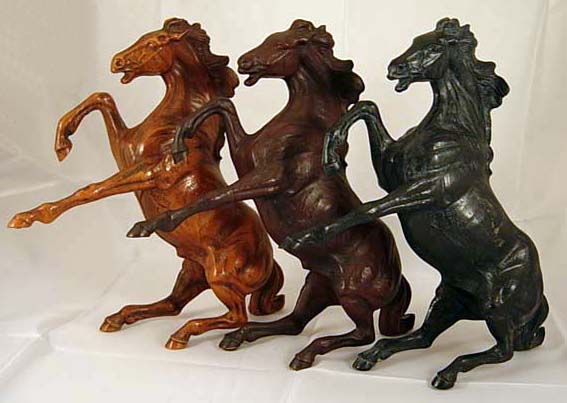
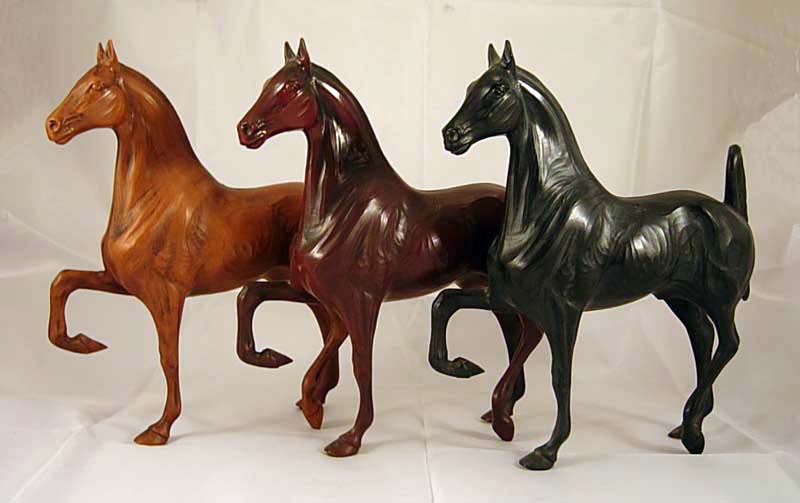
The Hartland woodcut look was achieved in three different ways. Some models have an angular surface meant to look like carving marks:
Walnut 9" TWH
Some are both carved and marked with incised graining (in horizontal bands in this case):
Ebony 7" Saddlebred Stallion
Carved (subtly) and grained (in swirls):
Cherry 9" Mustang
Only one mold shows graining but not carving:
Test Run Walnut 9" Five-Gaited Saddlebred (more on this one below)
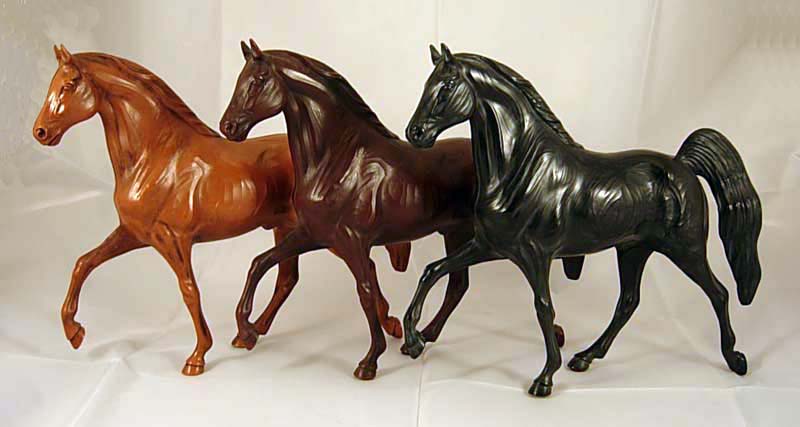
The woodcut molds are unique molds separate from the corresponding smooth body versions. They were sculpted by Roger Williams, and the carving and/or graining was added by Alvar Bäckstrand. The models came came in three shades: walnut (tan), cherry (dark reddish-brown), and ebony (black). They were usually cast in tan, reddish-brown, and blue-grey or black plastic respectively and had a wash of darker shading rubbed over the surface to highlight the woodgraining look. Some models, especially the later walnut pieces, have very little of the contrasting color applied.
Walnut, Cherry, and Ebony TWHs
Hartland issued the following molds as woodcuts in the mid-1960s: 9" Mustang (subtly carved and grained), 9" Tennessee Walking Horse (two mane variations, both carved), 9" Three Gaited Saddlebred (carved), 7" Saddlebred Family (carved and grained), 7" Thoroughbred Mare and Foal (carved and grained), and the 6" Arab Stallion (carved). All of these models were available in all three woodcut colors. The ebony and cherry colors were only issued between 1964-1966 whereas the walnut models were almost all available for 3 or 4 years in the mid- to late-1960s, and the 9" Mustang and Three Gaiter were also re-released in walnut from 1970-1973 when Durant took over the company.
Despite relatively short productions runs, the 9" models are all fairly common, the Mustang most of all. The 9" models bring around $20-40 depending on color and mold with the Mustangs tending more toward the $5-10 range because they are so easily found. The 7" and 6" models are considerably more scarce, having been limited in production in all colors to only 1 or 2 years. The Thoroughbred Mare and Foal for example were issued in 1965 only, making them the rarest of the bunch. The family sets often sell for around $100.
In the late 1960s, Hartland issued the woodcut Mustang in gold. Most were mounted on promotional Mustang Malt Beer signs to be displayed in bars.
An unpainted 9" woodcut TWH molded in swirled black and grey plastic
Less than 10 were sold by Sheryl Leisure in August 2002
The rarest woodcut, to the best of my knowledge, is a one-of-a-kind test run 9" Five-Gaited Saddlebred. She came from the collection of a former Hartland employee and probably dates to the mid-1960s. She was sold mounted on a base as shown and is grained only, not carved. My best guess is that she was possibly a one-off prototype that was never put into put into production, perhaps because she was too similar to the 9" Three Gaiters.
Ebony 9" Mustangs with two sticker variations
(The rectangular sticker on the left is partially missing.)
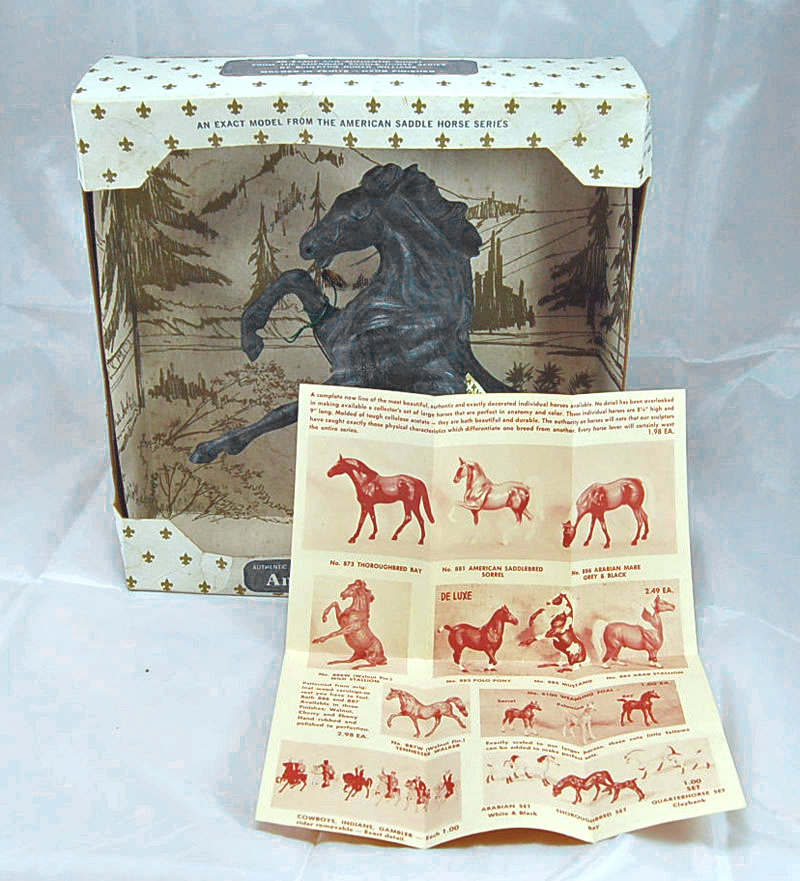
Finding Hartlands, especially woodcuts, in their original packaging is also unusual and adds significantly to their value.
Ebony 9" Mustang with original box and catalog
If you enjoyed this post and want to learn more about Hartlands, Gail Fitch's books are the best source of information. I am still educating myself about Hartlands, and her books have been hugely helpful in learning about the company and the models produced under its various owners. Because they are highly stylized, Hartlands aren't to everyone's taste, but I find them charming, and I hope more hobbyists will take an interest in them.
The last installment featuring Peter Stone woodgrains will be posted after BreyerFest. Hope to see you there!
Friday, July 12, 2013
Friday Featurette: Wooden Horses Part 2
As I mentioned in last Friday's blog post, the Breyer Racehorse bears a striking resemblance to the earlier "Whirlaway" model produced by Grand Wood Carving, a company that was located mere blocks from the Breyer factory near downtown Chicago in the 1950s. The resemblance is in fact too great to be a coincidence. The Breyer Racehorse was without a doubt copied from the GWC piece. (A number of early Breyer models were copies of pieces by other companies---the Western Horse (Hartland Champ), the Proud Arab Mare and Foal and Family Arab Stallion (Hagen-Renaker's Large Zara, Zilla, and Amir), the Large Poodle (Rosenthal), the Walking Hereford and Boxer (Boehm), etc---but that will be a subject for later post.)
The real horse Whirlaway won the Triple Crown for Calumet Farm in 1941, so we know the GWC piece must date to that year or later. Most of the GWC racehorses are portraits of horses from the 1930s-1950s, but they may have been produced after those years as well. I don't have any paperwork from the company unfortunately, so I'm not sure how long any of their horses were made. Nancy Young, author of Breyer Molds and Models, believed their heyday had ended by the 1960s.
Breyer's records from the 1950s are likewise pretty spotty. We do know that the Racehorse was the third equine model released by Breyer (circa 1954, preceded only by the Western Horse and Pony), and the mold was also one of the first to be released in woodgrain (circa 1959). The mold was undoubtedly copied directly from Grand Wood Carving's Whirlaway model as the comparison photo above attests, and I think that it's very likely that the distinctive woodgrain color with white markings was inspired by GWC as well.
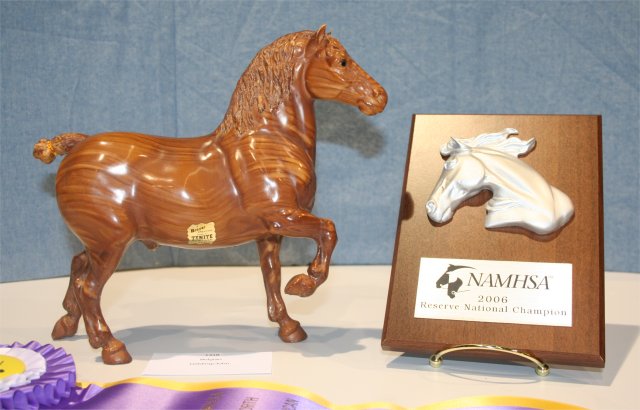
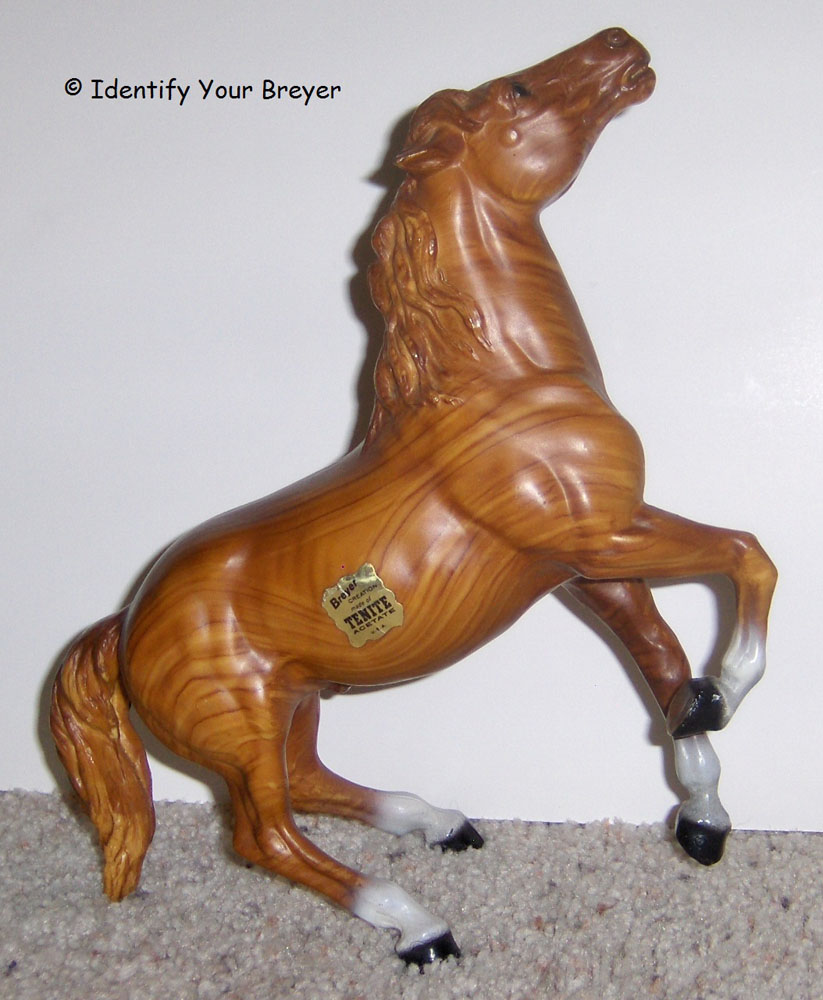
An interesting feature sported by some of the early Breyer woodgrains are gold foil stickers that declare them to be "made of tenite acetate." Glossy realistically colored models such as the Appaloosa PAM and PAF occasionally had these gold stickers as well. Presumably, they were to indicate and emphasize that the models were indeed durable plastic rather than wood (or porcelain in the case of the realistic models). The plastic models were also likely cheaper than their wood or porcelain counterparts while still looking the part.
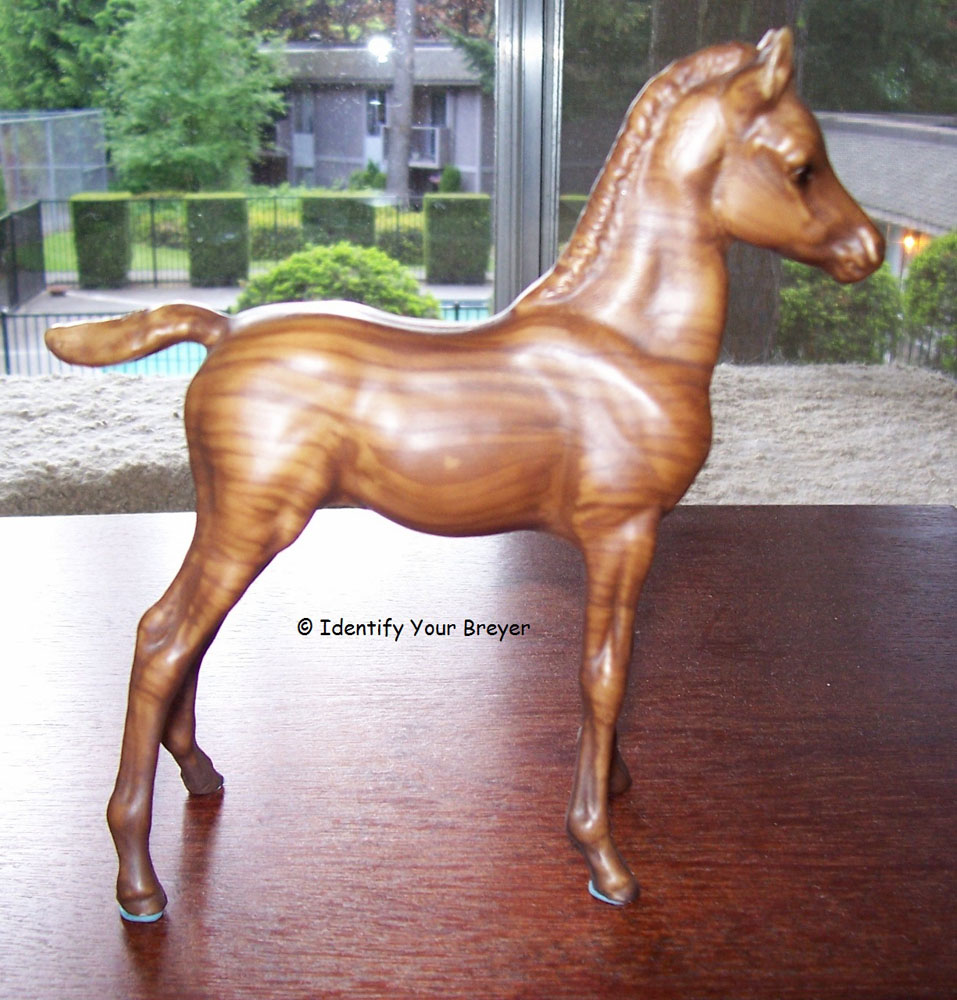
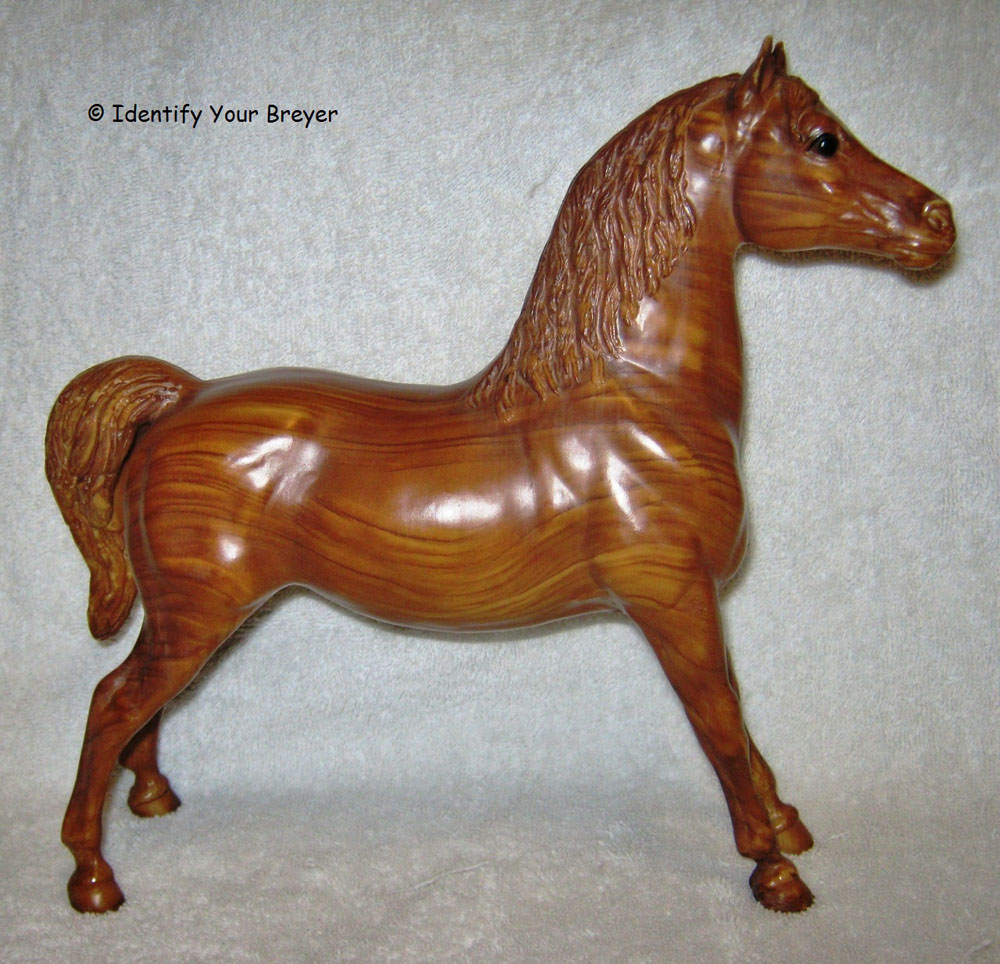
Breyer eventually produced 29 different horse and animal molds in the woodgrain color. Some are just streaked brown with no painted details other than black eyes while others have added white socks, a white star, and black hooves. Most woodgrains are matte to semi-gloss in terms of finish, though some, often those found on the Dunning "Ranchcraft" lamps, have a high semi-gloss or even glossy finish. The last woodgrain in production, the Fighting Stallion, was discontinued at the end of 1973.
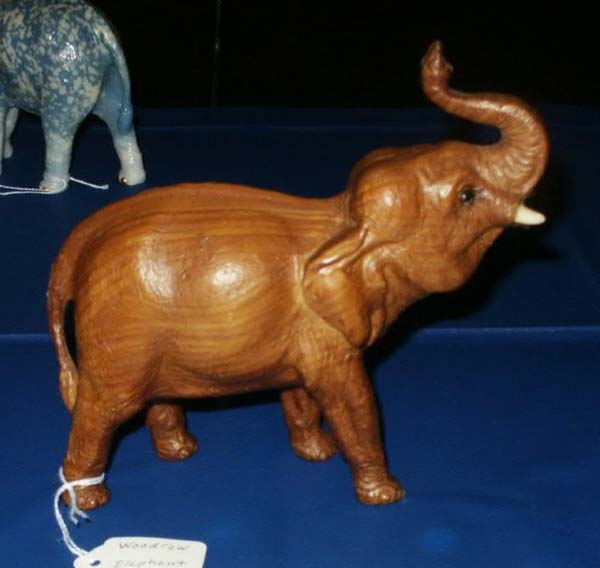
In terms of collectibility, the woodgrain line includes some of the very rarest and most desirable Breyer models ever made. Seven of them are rare enough that only a handful of examples of each are presently known to collectors. They are the Buffalo, Donkey, Elephant, In-Between Mare, Polled Hereford, Proud Arabian Foal, and Walking Angus molds.
Several other woodgrain models are considered very rare, and while they are hard to find, they do exist in greater numbers than the seven listed above. They are the Proud Arab Mare, the Fury, the Belgian, and the Stretch Morgan. Interestingly, though several dozen of each of these models are probably accounted for in collectors' hands, these four models are still highly desirable and command four-figure prices not far behind the rarest seven.
Most of the other woodgrain models are reasonably common, though several command multiple hundreds of dollars, such as the Mustang and the Walking Hereford. Others, like the Family Arabians or Fighting Stallion can be found and purchased at easily affordable prices, often less than the cost of a new Breyer.
The "graining" on Breyer's woodgrain models varies from model to model. Some, like the Fury above, have bold stripes of light and dark paint while others are more uniform in tone. The shade of brown used on these models also ranges from golden to dark chocolate. Many woodgrain Running Mares, Running Foals, and Fighting Stallions that came on the Dunning "Ranchcraft" lamps exhibit the dark brown coloration.
Besides the usual rubs and scratches other models are prone to, woodgrains sometimes develop bubbling as seen in the picture above. The exact cause is unknown, but it may be the result of exposure to heat and/or humidity. Woodgrains with semi-gloss or glossy topcoats occasionally develop a milky opacity to the finish, especially in the muscle grooves or other areas where the finish may have pooled. In my experience, both as a collectibility shower and a judge, in the show ring, only bubbling is generally considered a flaw.
Breyer has attempted to revive the woodgrain color twice since it was discontinued. In the early 1990s in Just About Horses, Breyer announced an upcoming special run series of new woodgrains. Unfortunately, according to Breyer historian Nancy Young, Peter Stone said the run was cancelled because the last Breyer employee who knew how to paint the distinctive color had left the company. Rumors have also circulated for years that the chemicals and/or paint used to create the woodgrain look were no longer legal. Then in 1999, Breyer released two woodgrain keychains, the G2 Andalusian and G2 Clydesdale, as a special run for Breyerfest. The models are dark reddish-brown with subtle darker striping, but they bear very little resemblance to the original vintage woodgrains. But given the recent success Breyer has had at duplicating some of their unique vintage paint jobs for the Vintage Club, I'm hopeful they'll try woodgrain again soon.
Next time: Hartland woodcuts!
GWC "Whirlaway" on the left, Breyer Woodgrain Racehorse on the right
Breyer's records from the 1950s are likewise pretty spotty. We do know that the Racehorse was the third equine model released by Breyer (circa 1954, preceded only by the Western Horse and Pony), and the mold was also one of the first to be released in woodgrain (circa 1959). The mold was undoubtedly copied directly from Grand Wood Carving's Whirlaway model as the comparison photo above attests, and I think that it's very likely that the distinctive woodgrain color with white markings was inspired by GWC as well.
Tenite sticker on a Woodgrain Poodle
An interesting feature sported by some of the early Breyer woodgrains are gold foil stickers that declare them to be "made of tenite acetate." Glossy realistically colored models such as the Appaloosa PAM and PAF occasionally had these gold stickers as well. Presumably, they were to indicate and emphasize that the models were indeed durable plastic rather than wood (or porcelain in the case of the realistic models). The plastic models were also likely cheaper than their wood or porcelain counterparts while still looking the part.
Breyer eventually produced 29 different horse and animal molds in the woodgrain color. Some are just streaked brown with no painted details other than black eyes while others have added white socks, a white star, and black hooves. Most woodgrains are matte to semi-gloss in terms of finish, though some, often those found on the Dunning "Ranchcraft" lamps, have a high semi-gloss or even glossy finish. The last woodgrain in production, the Fighting Stallion, was discontinued at the end of 1973.
In terms of collectibility, the woodgrain line includes some of the very rarest and most desirable Breyer models ever made. Seven of them are rare enough that only a handful of examples of each are presently known to collectors. They are the Buffalo, Donkey, Elephant, In-Between Mare, Polled Hereford, Proud Arabian Foal, and Walking Angus molds.
Woodgrain Buffalo Lamp
Both the Woodgrain Buffalo and the Woodgrain Hereford have only been found on lamps (to date) which suggests that they may have been special runs for Dunning Industries and never regular releases. (One Hereford does exist without a lamp, but the model has holes in its feet indicating that it was probably on a lamp at one time or was intended for a lamp.) The PAF was likely a regular run along with the PAM, but because of the copyright infringement lawsuit brought by Hagen-Renaker in 1959, we know that not many of them were sold before production was halted. The In-Between Mare, if it was actually released, was discontinued before very many were made. (You can read more on the HR lawsuit and the In-Between Mares here.) The others were possibly short special runs although no documentation on any of them has yet come to light. It's possible they were regular runs that were just never issued in large numbers for whatever reason.
Several other woodgrain models are considered very rare, and while they are hard to find, they do exist in greater numbers than the seven listed above. They are the Proud Arab Mare, the Fury, the Belgian, and the Stretch Morgan. Interestingly, though several dozen of each of these models are probably accounted for in collectors' hands, these four models are still highly desirable and command four-figure prices not far behind the rarest seven.
Most of the other woodgrain models are reasonably common, though several command multiple hundreds of dollars, such as the Mustang and the Walking Hereford. Others, like the Family Arabians or Fighting Stallion can be found and purchased at easily affordable prices, often less than the cost of a new Breyer.
Woodgrain Fury
The "graining" on Breyer's woodgrain models varies from model to model. Some, like the Fury above, have bold stripes of light and dark paint while others are more uniform in tone. The shade of brown used on these models also ranges from golden to dark chocolate. Many woodgrain Running Mares, Running Foals, and Fighting Stallions that came on the Dunning "Ranchcraft" lamps exhibit the dark brown coloration.
Click to see a larger view
Besides the usual rubs and scratches other models are prone to, woodgrains sometimes develop bubbling as seen in the picture above. The exact cause is unknown, but it may be the result of exposure to heat and/or humidity. Woodgrains with semi-gloss or glossy topcoats occasionally develop a milky opacity to the finish, especially in the muscle grooves or other areas where the finish may have pooled. In my experience, both as a collectibility shower and a judge, in the show ring, only bubbling is generally considered a flaw.
Breyer has attempted to revive the woodgrain color twice since it was discontinued. In the early 1990s in Just About Horses, Breyer announced an upcoming special run series of new woodgrains. Unfortunately, according to Breyer historian Nancy Young, Peter Stone said the run was cancelled because the last Breyer employee who knew how to paint the distinctive color had left the company. Rumors have also circulated for years that the chemicals and/or paint used to create the woodgrain look were no longer legal. Then in 1999, Breyer released two woodgrain keychains, the G2 Andalusian and G2 Clydesdale, as a special run for Breyerfest. The models are dark reddish-brown with subtle darker striping, but they bear very little resemblance to the original vintage woodgrains. But given the recent success Breyer has had at duplicating some of their unique vintage paint jobs for the Vintage Club, I'm hopeful they'll try woodgrain again soon.
Next time: Hartland woodcuts!
Friday, July 5, 2013
Friday Featurette: Wooden Horses Part 1
Breyer, Stone, and Hartland woodgrains/woodcuts
Grand Wood Carving got its start in 1939, producing a variety of horses and other animals carved from primarily Central and South American mahogany as well as a few other types of wood. Though they produced a variety of portrait horses and breeds, a large part of their equine line was devoted to racehorses, both Thoroughbreds and Standardbreds.
GWC's "Whirlaway" and "Dan Patch"
Because GWC horses are actually made of wood, they are of course all carved rather than injection molded like the plastic models inspired by them. To achieve a consistent look for each individual "mold," GWC utilized 24-spindle Salstrom carving machines which worked off patterns for each horse or animal. (For more information on these neat machines, please click here.) The pieces were all then hand-finished, a process that included sanding as well as staining. Because of this, GWC horses can vary a bit from piece to piece, particularly in leg thickness, stain color, and markings.
Many of the horses were issued with descriptive stickers, hang tags, or belly bands, and all of these bits of paper ephemera are decidedly rare today. Even the horses themselves are incredibly hard to find despite the company remaining in business until 1983. I suspect this scarcity is the result of several factors: 1) the models were probably never issued in large numbers, 2) they were expensive even when originally available, and 3) most importantly, GWC pieces were not physically marked. I would guess that this lack of identifying marks means many of them go undetected by people not familiar with the company. Happily, for those collectors interested in these quirky and charismatic folk art horses, Ed Alcorn has an amazing array of GWC models displayed on his website here. Breyer collectors should find both the Whirlaway and Man O' War models familiar. More on their inspiration from GWC next Friday!
Friday, June 28, 2013
Friday Featurette: Phar Lap, the Red Terror
Phar Lap (1926-1932)
Though Australia considers him a native son, the great chestnut gelding Phar Lap was actually bred and foaled in New Zealand at Timaru on the South Island. He was sired by Night Raid, a well-bred horse from England who failed to perform there and was eventually exported to Australia. Night Raid fared no better racing down under, retiring with an overall record of 2 wins and a 3rd from 35 starts. He stood at stud there only a year before being shipped on to New Zealand where he finally found his niche. Though siring Phar Lap alone would have made him a success, Night Raid actually produced a number of good runners, 13 of them stakes winners. He led the sire list in Australia from 1929-1931.
Night Raid
Phar Lap's dam Entreaty was a New Zealand-bred. Her sire Winkie was a full-brother to the 1910 1000 Guineas winner Winkipop though he never displayed the same talent, hence his exportation to New Zealand. Entreaty's other foals were no match for Phar Lap in terms of ability, but her daughters proved to be important producers. Interestingly, Entreaty can be found in the tail-female line of the modern Australian superstar mare Sunline through Phar Lap's full-sister Fortune's Wheel.
Entreaty with Te Uira, a full-siter to Phar Lap
Phar Lap, Entreaty's second foal, was born on October 4, 1926. In January of 1928, he was sold at the New Zealand Yearling Sales at Trentham racecourse for 160 guineas to Hugh Telford, brother of Harry Telford who would become Phar Lap's trainer. The colt was purchased for David Davis, Telford's racing partner, and was shipped to Australia to begin his career.
At first, Phar lap did little to impress his connections. He was thin, gangly, and wart-covered as a youngster, and it took him some time to grow into his huge 17 hand frame. Because he took so long to develop, he was gelded, and he eventually matured into a lean, handsome, and surprisingly kind horse. He was given the name Phar Lap from the Thai word "farlap" meaning lightning, a reference to his peculiarly shaped star.
His career started slowly with four off the board finishes as a two year-old, but in his last start of the season over six furlongs, he finally scored a win in the Rosehill Maiden Juvenile Handicap. It was not quite a portent of things to come as his three year-old season likewise began poorly with four more dismal up-the-track finishes. Given a little extra ground in his next start, the nine furlong Chelmsford Stakes, Phar Lap produced an excellent second place finish, and from that point on, he began a streak of dominanting wins that earned him the nickname the Red Terror.
Phar Lap made 15 further starts at three, winning an astonishing 13 of them, including the prestigious Rosehill Guineas and the AJC Derby at Randwick, the Craven Plate at Randwick, and the VRC Derby at Flemington. Sent against older horses for the first time in the 2-mile Melbourne Cup, Phar Lap finished third behind Nightmarch, another son of Night Raid, having made the pace through most of the race. He ran third again in the St. George Stakes at Caulfield, and then he easily annexed a string of important stakes races including the VRC St. Leger at Flemington, the Governor's Plate and King's Plate at Flemington, and AJC Plate at Randwick, among others. In the 2 1/4 mile AJC Plate, Phar Lap revenged himself on Nightmarch, humbling him by 10 lengths.
Given a break over the winter, Phar Lap was kept in shape with long gallops over the sand dunes on Australia's coast. (Fans of the 1983 movie about the horse will remember that spectacular montage.) When he returned at four, he was virtually unstoppable. He won 14 of 16 starts that season, most important of which were his victories in the Cox Plate and the Melbourne Cup. He defeated his former nemesis Nightmarch no less than four times with ease. As a five year-old, Phar Lap won 8 races in a row before finishing a shocking 8th in the Melbourne Cup. An overzealous training regimen and a staggering impost cost him that race.
In late 1931, Phar Lap boarded a ship destined for San Francisco in order to compete in what was then the world's richest race, the Agua Caliente Handicap held in Tijuana, Mexico. He arrived in good order and had two months to acclimate and resume training. Phar Lap went to post on March 20, 1932, as the heavy favorite, and he won as a heavy favorite should, with ease and in track record time. Thanks to the wonders of Youtube, footage of this historic race can be seen here:
After the race, Phar Lap was shipped back to California while his next career start was considered. Tragically, less than three weeks later, the great horse became suddenly ill and died. The cause of his death has not yet been conclusively proven, but the two most likely causes were either arsenic poisoning or duodenitis-proximal jejunitis, an acute form of gastroenteritis brought on by stress. Speculation was rampant for many years that Phar Lap had been deliberately poisoned (by rivals, American gangsters, etc), and recent tests done on Phar lap's hair did confirm the presence of arsenic in his system. Arsenic, however, was a common component in tonics for racehorses at that time, and trainer Harry Telford's own recipe book included such a tonic which he considered "good...for all horses."
(Photo by Benjamin Healley)
In my experience, taxidermists rarely do well with equine subjects, but happily for racing fans, Phar Lap's hide was beautifully mounted and has been well cared for. The grand gelding looks like he could step out of the case and walk around the display at any moment. He's so lifelike that one could argue he's the ultimate model horse.
Terrible joke aside, Phar Lap has been more traditionally immortalized in model form by Breyer on two occassions. In 1985, Breyer released a lovely galloping portrait of Phar Lap in a rich red chestnut color befitting his "Red Terror" nickname. Most Phar Lap models have two hind socks like the real horse, but occassionally, models with only a single sock turn up. The Phar Lap model was discontinued in 1988.

(Photo by Museum Victoria)
In 2007, Breyer produced a special run Phar Lap model on the Lonesome Glory mold exclusive to Target stores in Australia. Not surprisingly, this newer Phar Lap model is rather hard to acquire and is therefore quite desirable.
(Photo by eventingpony24)
In the mid-2000s, the English company Caughley Porcelain produced a number of sculptures of famous racehorses, both as limited editions and as trophies for prestigous races. Not surprisingly, they included a portrait of Phar Lap in their line up. The edition was limited to 250 pieces. Sadly, as of 2011, Caughley is no longer producing equine sculptures, and what few pieces they did are rarely seen for sale. (Hopefully, I will have a blog devoted to Caughley horses coming soon.)
(Photo by Caughley Porcelain)
I am not aware of any other Phar Lap models made either as toys or fine art, though I hope others do exist. Even after 80 years, Phar Lap is still the benchmark against which great Australian horses are measured, and because he is remembered with such affection, I hope more Phar Lap models will be produced in the future.
EDIT: Another video with more fascinating footage of Phar Lap:
https://www.youtube.com/watch?v=N5Fz7ltvwwA
EDIT: Another video with more fascinating footage of Phar Lap:
https://www.youtube.com/watch?v=N5Fz7ltvwwA
Subscribe to:
Posts (Atom)